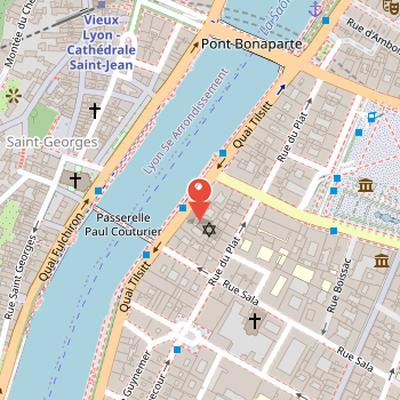
The Grande synagogue de Lyon is a Jewish religious building located in Lyon, in the Lyon metropolis of the Auvergne-Rhône-Alpes region. It stands at 13, quai Tilsitt, in the 2nd arrondissement, on the banks of the Saône. Built from 1863 to 1864 in a neo-Byzantine style, it was designed by the young Jewish architect Abraham Hirsch. The building has been listed in the inventory of historical monuments since 1984.
Its history reflects the development of the Jewish community in Lyon during the 19th century. At the beginning of the century, the community was initially attached to the consistory of Marseille. A communal rabbinate was established on May 7, 1848, and prayers were first held in a rented room on rue Écorche-Bœuf, then in an apartment on rue Bellecordière. A temple opened on rue du Peyrat in 1849, followed by another worship space on place Bellecour in 1863. The consistory later obtained the land on quai Tilsitt for the construction of a synagogue, and Abraham Hirsch was assigned to the project in 1866. Construction was estimated at about 150,000 francs.
Nearby Objects
-
 Église Saint-Georges 200 m away
 -
 Saint-Marc Lycée 250 m away
 -
 Place Bellecour 350 m away
 -
 Equestrian Statue of Louis XIV 350 m away
 -
 Rue Victor-Hugo 350 m away
Location and Construction
The Grande synagogue de Lyon is a Jewish religious building located in Lyon, in the Lyon metropolis of the Auvergne-Rhone-Alpes region. It was built on the banks of the Saone and designed by the architect Abraham Hirsch. Its setting by the river forms part of its place within the urban landscape of Lyon.
Location, Design, and Heritage Status
The Grande synagogue de Lyon is located at 13, quai Tilsitt in the 2nd arrondissement of Lyon. It was constructed between 1863 and 1864 in a neo-Byzantine style and was designed by the young Jewish architect Abraham Hirsch. The building has been listed in the inventory of historical monuments since 1984, reflecting its recognized heritage value.
From Community Worship to a New Synagogue Site
The history of the Grande synagogue de Lyon began with a small Jewish community that was initially attached to the consistory of Marseille at the beginning of the 19th century. As the community grew, it formed a communal rabbinate on May 7, 1848. Its early prayer spaces changed several times: first in a rented room on rue Ecorche-Boeuf, then in an apartment on rue Bellecordiere. A temple was inaugurated on rue du Peyrat on October 2, 1849, followed by another temple in a rented hall on place Bellecour on October 30, 1863.
The creation of a regional consistory by decree of Emperor Napoleon III on March 23, 1857, marked a further stage in the organization of Jewish life in Lyon. Its first regional grand rabbi took office on July 1, 1857, and the consistory adopted its statutes on November 30, 1857. With the increasing population, the consistory requested land from Senator Claude-Marius Vaisse on July 24, 1864, to build a synagogue. The city first offered a plot in Jardin des Plantes, montee des Carmelites, on December 16, 1864, but the specially created construction commission rejected that location and suggested quai Tilsitt instead. After the city refused that proposal, the municipality later offered land on quai Tilsitt on April 19, 1866, and the city council ratified the land exchange on April 12, 1866. Joseph Kuppenheim, elected president of the consistory on March 24, 1865, also proposed a provisional worship place in salle des Monnaies.
For the synagogue project, the consistory appointed architect Abraham Hirsch. Construction was estimated at about 150,000 francs, and bonds were issued on March 20, 1867 to raise that sum.
History and Public Life
The first stone of the Grande synagogue de Lyon was laid on September 30, 1867, and the building was officially inaugurated on September 29, 1872, in the presence of civil, military, and religious authorities. During the early 1940s, Lyon received a large influx of Jewish refugees from all over France, and in 1941 the synagogue became the local seat of the UGIF before the organization transferred to montée des Carmelites. In this period, Bernard Schonberg, the grand rabbi of Lyon, was arrested on March 8, 1943, and deported to Auschwitz. The synagogue was also closed for two months during the summer of 1944. Decades later, it was the target of an attack on Friday, April 8, 1980, when two grenades were thrown into the synagogue during the evening service canticle Lekha Dodi. The attackers escaped by car, eight people suffered minor injuries, and the perpetrators were never identified.
Wartime Arrests and Aftermath
According to the historque provided, French militia entered the synagogue on an unspecified date and arrested all persons present. Those arrested included the secretary of the consistory, the chief officiating minister, the concierge and his wife, and the cleaning lady. All of the detainees were interned at Montluc prison, then transferred to Drancy camp on an unspecified date, and later deported to Auschwitz on an unspecified date. The history also cites testimony from Eugene Weill, who described the condition of the synagogue on the day Lyon was liberated. In his account, the building was in an abominable state.
Desecration of the Temple Room
The historic account describes severe vandalism and desecration in the temple room. It was used as a drinking venue by the militia, and memorial plaques for soldiers killed during the First World War were used as targets. Torah scrolls were also used as targets. Bullet casings were still on the floor, while chandeliers, chairs, and benches had been vandalized. Prayer books were scattered throughout the space.
History, Maintenance, and Religious Life
The Grande synagogue de Lyon was built between 1872 and 1884, and the building benefited from late 19th-century technological advances. In the years that followed, however, it deteriorated rapidly. Water infiltrations appeared under the vaults and lateral naves, and these leaks threatened to dislodge stones from the edifice. A first phase of safety works was estimated, and the consistory, presided over by Marcel Dreyfus, appealed to the city of Lyon, the region, and the departments for funding. It also relied on donor generosity and auction proceeds to help cover the costs. The synagogue was later listed as a historic monument by decree. The municipal council then allocated a subsidy for roofing and facade renovation work, corresponding to 50 percent of the roofing costs and 50 percent of the facade renovation costs on the quay. This decision was confirmed by a decree approving the agreement between the city of Lyon and the Association cultuelle israelite.
The synagogue is closely linked to the Lyon consistory, which is located in its annex buildings. The Lyon consistory is the oldest Jewish institution in Lyon, and it coordinates educational and cultural activities for synagogues in the Rhone-Alpes-Centre region. It is also responsible for social aid for needy and sick persons. Lyon has about an unspecified number of Jews and 35 synagogues or oratories representing all French Judaism trends. After the Liberation, Rabbi David Feuerwerker became grand rabbi of Lyon and held the post for two years. During that period, he abolished the use of the organ in synagogue services on Shabbat and holidays. Since 2015, the synagogue's rabbi has been Nissim Malka, and Gilles Kahn has served as hazzan since the same year.
Building Layout and Functions
The synagogue is composed of two buildings. One has a facade on Quai Tilsitt and faces the street, while the other is set back behind a small courtyard. The street-facing building contains the offices of the consistoire, the Grand-Rabbin, and the rabbin. It also includes a small oratory used for weekday services, as well as a conference room and classrooms for Talmud Torah. The rear building is reached through a porch beneath the first building, marked by a wrought iron gate.
Interior Layout and Liturgical Features
A small vestibule with three round arches opens onto the courtyard and leads into the prayer hall. The hall is organized into three parts: a central nave and two lower side aisles. The central nave rises to the full height of the building, while the side aisles are separated from it by twelve columns symbolizing the twelve tribes of Israel. Each column has a Corinthian or composite capital. Above the side aisles and the vestibule, women use galleries with stone balustrades.
At the center of the nave, a blue-painted dome rests on a drum pierced by sixteen round-arched windows. This dome admits natural light into the prayer hall. At the eastern end of the nave, a semi-circular apse contains a carved wooden Holy Ark holding Torah scrolls. The Ark door is concealed by a green velvet embroidered parochet. The apse is surmounted by a small blue-painted dome with a central stained glass window.
The wooden Bimah, covered by a fabric canopy and supported by four wooden pillars, stands in front of the Ark. The synagogue also includes wooden stalls for men on the ground floor and for women in the first-floor gallery. Above the entrance door on the second floor is a wooden buffet organ that is heavily damaged and in need of restoration. The organ originally came from the Basilica of Saint-Martin d'Ainay and was sold to the synagogue in 1864.