Montluc Fort is a fortress in the French city of Lyon, originally named Fort de Villeurbanne. It was built from 1831 to 1835 as part of the first defensive ring around Lyon, under the leadership of General Rohault de Fleury and King Louis-Philippe I. The fort had a trapezoidal ground plan, with bastions, an entrance gate on the city-facing side, and a guard tower protected by four sentry towers. It was designed to accommodate 67 guns.
In the 1870s, the fort concept was considered outdated, and the bastions, curtains, glacis, and ditches were dismantled or leveled. Only the cavalier and the outer watchtower remained, and in 1887 they were renamed Fort Montluc. The site underwent further structural changes in the 1880s and again in the 21st century. Today, Montluc Fort serves as the police headquarters of Lyon and is located in the 3rd Arrondissement, south of Lyon Part-Dieu station and adjacent to the former Montluc prison.
Nearby Objects
-
 Montluc prison 200 m away
 -
 Manufacture des tabacs de Lyon 450 m away
 -
 Avenue des Frères-Lumière 750 m away
 -
 Tour Silex 2 950 m away
 -
 Institut Lumière 950 m away
History and Use of Montluc Fort
Montluc Fort, originally named Fort de Villeurbanne, is a fortress in the French city of Lyon. It was built from 1831 to 1835. The structure underwent major changes in the 1870s and 1880s, and it was altered again in the 21st century. Since 1921, it has been located south of the former Montluc prison. Today, the fort serves as the police headquarters of Lyon.
Location and Surroundings
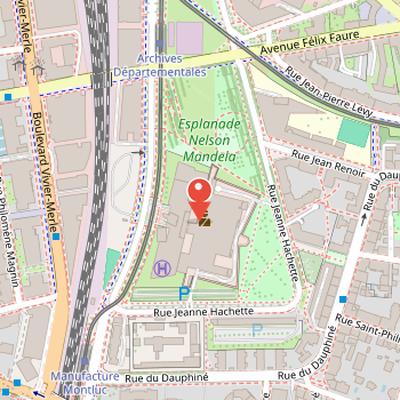
Montluc Fort is located in the 3rd Arrondissement of Lyon, on the left side of the Rhone River. It lies approximately 700 m south of Lyon Part-Dieu train station. The site is bordered to the west by Rue du General Mouton-Duvernet and is behind the Collonges-Fontaines-Lyon-Guillotiere railway line on the west side. It is bordered to the east and south by Rue Jeanne Hachette.
Original Layout and Defenses
Montluc Fort was constructed as part of the first defensive ring around Lyon starting in 1831. It was designed under the leadership of General Rohault de Fleury and King Louis-Philippe I. The fort had a trapezoidal ground plan, with the short base facing east. Two large bastions were placed at the ends of this short base, while two more bastions stood on the western city-facing side beside the entrance gate. The gate was protected by a near-cubic guard tower with four sentry towers. In the center of the fort stood the cavalier, bounded on the west by a barracks building with an additional tower. The fort was designed to accommodate 67 guns. Today, only the guard tower from the original fort fortifications remains.
Reuse and Renaming in the Late 19th Century
By the 1870s, the fort concept was considered outdated, and a second defensive ring was being built around Lyon. At Fort de Villeurbanne, the bastions and curtains were dismantled, while the glacis and ditches were leveled. In this process, only the cavalier and the outer watchtower remained. These surviving elements were renamed Fort Montluc in 1887. The freed areas were then put to new military uses: they served as a training ground, and buildings were erected on the glacis. A military court was later housed in these buildings, showing how the site was adapted from fortification to other institutional functions.
Post-1969 Use and Reconstruction
From 1969, Montluc Fort was assigned to the Interior Ministry. It served as barracks for the Compagnies Republicaines de Securite (CRS) police until 1982. Later, between 2005 and 2007, the fort was completely rebuilt to become the seat of the Police nationale of Lyon. During this reconstruction, new buildings were added inside the fort, while its external appearance as a fortress was retained.
Military Prison and Memorial Site
Gefangnis Montluc was built as a military prison in 1921 on the former Glacis in the south of the fort. It was decommissioned in 1932, but was recommissioned at the beginning of the Second World War. From early 1943, it served the German occupiers and especially the Gestapo. During this period, up to 10,000 people passed through the prison. Most prisoners were transported to German concentration camps, and many were executed in the greater Lyon area from Gefangnis Montluc. The prison continued to be operated after the war and has been a memorial site since 2009.