Montluc prison is located at 4, rue Jeanne-Hachette in Lyon. Built in 1921 on the glacis of fort Montluc, it was designed as a military prison and inaugurated in October of that year. The complex consisted of a cell block, registry, kitchens, officers’ pavilion, showers, and workshops, and it had capacity for 122 individual cells for soldiers and non-commissioned officers, as well as five places for officers. The prison and the adjacent military tribunal formed the center of military justice for a large southeastern region.
Although it was little used for parts of the interwar period, the prison became notable for its role as a detention place during World War II. More than 5,000 prisoners passed through Montluc between 1943 and 1944, including Jean Moulin and Marc Bloch. Registered as a historical monument since 1994, Montluc prison is also identified as a place of national remembrance.
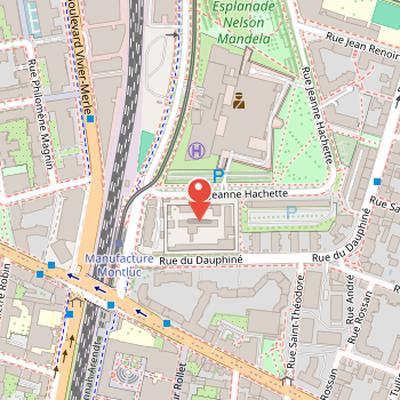
Nearby Objects
-
 Montluc Fort 200 m away
 -
 Manufacture des tabacs de Lyon 300 m away
 -
 Avenue des Frères-Lumière 600 m away
 -
 Parc Sergent Blandan 850 m away
 -
 Caserne Sergent Blandan 850 m away
History and Location of Montluc Prison
Montluc prison is located at 4, rue Jeanne-Hachette in Lyon. It was constructed in 1921 as a military prison on the glacis of fort Montluc. The site is especially known for its role as a detention place during World War II, when more than 5,000 prisoners passed through it between 1943 and 1944, including Jean Moulin and Marc Bloch. Montluc prison has been registered as a historical monument since 1994.
Construction and Early Use of Montluc Prison
The prison militaire at Montluc began construction in 1921 and was inaugurated in October of the same year. It was built on land belonging to fort Montluc under the Ministry of War, and it took its name from the fort while remaining a distinct set of buildings. Together with the adjacent military tribunal, it formed the center of military justice for a large southeastern region.
The complex consisted of a cell block, registry, kitchens, an officers' pavilion, showers, and workshops. Its capacity included 122 individual cells for soldiers and non-commissioned officers, as well as 5 places for officers. Despite this scale, the prison was rarely used in practice. This was linked to the progressive release of war convicts and the decrease in military detainees in the early 1920s. It was also lent to civilian justice in 1926, but it remained little used because the civilian prison population also declined in the 1920s and 1930s.
Among the people held there were about a hundred Chinese student workers after their expulsion from the Institut Franco-Chinois de Lyon. According to a report by the Prefect of Rhone dated February 26, 1927, they were lodged and fed in the fort Montluc dependencies, and on March 10, 1927, they were transferred to Brotteaux station for expulsion to China. The prison closed in 1934 and reopened in 1939.
Montluc as a Military Prison in 1939-1940
Put back into service in September 1939, Montluc prison again became a military prison during the period from September 1939 to June 1940. It held mainly the usual detainees of military justice, but also many communist militants in 1939. These detainees were affected by the first special jurisdictions and by the state of siege declared in 1939. After the signature of the Germano-Soviet non-aggression pact on August 23, 1939, communist militants were considered threats to internal state security. Many were arrested and brought before military courts under the legal provisions of the state of siege.
Montluc under the Vichy Regime
From June 1940 to November 1942, Lyon was in the free zone after the division of French territory, and Montluc prison remained under military control because an armistice army was maintained there. After the vote granting full constituent powers to Philippe Petain, a new regime was established and violent repression was directed against the enemies of France under the Vichy regime. Montluc became central to these repression policies. During this period, the military tribunal of Lyon, through a special section, judged and imprisoned military personnel at Montluc. General de Lattre de Tassigny was condemned for ordering troops to leave garrisons and fight, while disobedient soldiers and resistance members were also judged and detained there. The prison additionally held communists, early gaullist resistants, and members of prohibited thought groups. Although the prison gradually filled up, it remained relatively acceptable compared with other French prisons. By 1941, nearly 400 people were detained in a facility officially intended for 127.
Montluc Prison Under Nazi Occupation
From February 1943 to August 1944, Montluc prison was used as a Nazi prison after being requisitioned entirely by the Germans on November 9, 1942. It became a German military prison managed by Klaus Barbie. During this period, it held thousands of hostages, racial persecutees, and Resistance members. The prison originally had 135 individual cells, but conditions became severely overcrowded, with up to eight detainees in cells of 3 square meters. Between January 1943 and August 1944, an estimated 15,000 to 20,000 detainees passed through the prison.
Montluc Prison under German Occupation
Between February 1943 and August 1944, Montluc prison functioned as a Nazi prison. It held a number of notable detainees, including Captain Seive, who later published a testimony in 1945, and Beatrix de Toulouse-Lautrec, who was detained between May and October 1943. Jean Moulin and his companions were interned there after the Caluire-et-Cuire arrest on June 21, 1943, and Andre Devigny escaped from the prison on December 24, 1943. René Carmille was interned in January 1944, and children from Izieu were held there before deportation on April 6, 1944.
The prison also became associated with large-scale executions. Between December 20, 1943 and June 3, 1944, 440 prisoners were executed in eleven different locations. Among these were 21 internees executed at Dagneux in Ain on May 20, 1944, 52 prisoners shot at Dorieux on June 3, 1944, and 120 prisoners killed in the Fort de Cote-Lorette massacre on August 20, 1944. Prisoners were also massacred at Bron airfield on August 17, 18, and 20, 1944. During this period, pressure from the Resistance, the Red Cross, and religious authorities tried to stop the executions.
The prison was evacuated on August 17-18, 1944, when 109 male and Jewish prisoners were removed. It was run by Wehrmacht non-commissioned officers rather than SS personnel. FFI men were posted nearby to prevent prisoner evacuation. When the Germans left on August 24, 1944, the keys were handed to French officers Chevallier and Touchon, and the French flag was raised on the roof, marking the prison's liberation. About 900 internees took refuge in nearby religious structures after the German departure.
Montluc Prison After the Second World War
After the Second World War, Montluc prison was made available to the penitentiary administration in 1947 and became the third section of the Lyon prisons. In 1955, a decree specified that all capital executions in Lyon were to be carried out there. In the same year, death row was transferred from Saint-Paul prison to Montluc together with its two inmates, and the new rule was first applied to an ordinary criminal condemned in Ain. Montluc then became closely associated with the penal and judicial history of the city during the following years.
Between 1959 and 1961, Algerian members of the FLN and MNA condemned to death by the permanent military tribunal were imprisoned at Montluc. Eleven FLN death row prisoners were guillotined there after clemency was refused by Charles de Gaulle. During the Algerian War, conflicts between the FLN and MNA caused 103 FLN deaths and 47 MNA deaths in the Lyon region. In total, 850 Algerians were judged at the Montluc TPFA, leading to 112 death sentences for 90 individuals.
The prison also remained the site of later notable events. Two condemned criminals were executed there on October 2, and the last execution in Lyon took place on March 29 for a triple murderer condemned in Loire. In 1972, the last occupant of death row was bank robber Guy Chauffeur. Montluc was also entered at night by three activists of the Group of Action and Resistance to Militarization, who used a ladder; Gérard Bayon, Michel Guivier, and Yvon Montigne were arrested, jailed for six days, and later sentenced to three months with a suspended sentence and a fine. On September 9, Said Remli and Boumedienne Merdji killed guard Charles Pahon during an escape attempt. In 1983, Klaus Barbie was symbolically incarcerated there for several days after extradition.
Postwar Use and Later Reuse
After the Second World War, Montluc prison continued to be used in different ways across its male and female wings. The male wing was decommissioned in 1997 and then repurposed for regional intervention and security training. The female wing remained operational for detention until the prison closed in 2009. The prison also saw individual cases during this later period, including Jamila Belkacem, who was placed in provisional detention after her indictment for the assassination of her veterinarian lover.
Memorial and Public Heritage Site
After 2009, a large part of the former Montluc prison in Lyon was established as the M emorial national de la prison de Montluc. The site is listed as a historic monument and is dedicated to internment under the Vichy regime and German authorities during the 1940 to 1944 occupation. It is open to the public and also hosts temporary exhibitions. The memorial is owned by the Ministry of the Armed Forces and managed by the National Office for Veterans and War Victims. It is one of the 10 major national memory sites of the Ministry of the Armed Forces, reflecting its role as a place of remembrance within the public heritage landscape.