Institut Lumière is an association loi de 1901 founded in 1982 by Bernard Chardère and Paul Génard. Based in Lyon’s Monplaisir district, at 25 rue du Premier-Film, it is dedicated to the diffusion and conservation of cinematic heritage. The site is closely linked to the history of the Lumière brothers, who designed their Cinématographe camera in Monplaisir, and it contains a camera Cinématographe dating from 1895.
The institution originated from the former Lumière factory, which was nearly destroyed after municipal acquisition. A cinema museum project was decided by the city council in 1966 and initially entrusted to Dr. Paul Génard. After the Lumière heirs sold the facilities to Ilford Photo, the company later sold them to the municipality in 1976. Before renovations in 1981 and 1982, the site had a single screening room. The park also includes the Mur des Cinéastes, created in 1982 as a Lyon version of the Hollywood Walk of Fame and restored in 2016, with plaques marking visits by hundreds of cinema personalities.
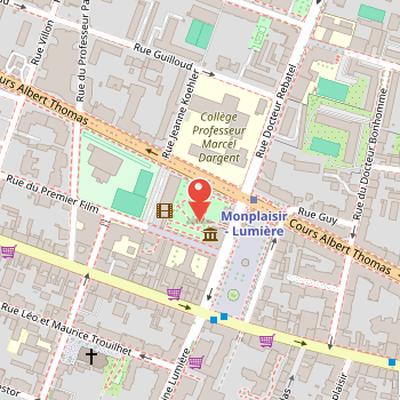
Nearby Objects
-
 Villa Lumière 30 m away
 -
 Place Ambroise Courtois 70 m away
 -
 Avenue des Frères-Lumière 400 m away
 -
 Hôpital Édouard-Herriot 800 m away
 -
 Manufacture des tabacs de Lyon 850 m away
Institution and Mission
The Institut Lumiere operates as an Association loi de 1901 and was founded in 1982 by Bernard Chardere and Paul Genard. Based in Lyon, its zone of influence is also centered on the city. The institution dedicates its activity to the diffusion and conservation of cinematic heritage. This focus defines its role as a cultural organization concerned with preserving film history and making it accessible to the public.
From Lumiere Factory to Cinema Museum
The Institut Lumiere is located in the Monplaisir district at 25 rue du Premier-Film, on the site where the Lumiere brothers designed their Cinematographe camera. The institute has owned a camera Cinematographe since 1895, linking the place directly to the history of cinema. Its origins lie in the old Lumiere factory, which was nearly destroyed after municipal acquisition.
In 1966, the city council decided on a cinema museum project involving the site. This project was first entrusted to Dr. Paul Genard and was planned for the premises of the Lumiere company. The Lumiere heirs sold the facilities to Ilford Photo rather than to the city, and Ilford Photo later sold the facilities to the municipality in 1976. Before renovations carried out from 1981 to 1982, the implantation had a single screening room.
The site also includes a park feature known as the mur des Cineastes, created in 1982. Described as a Lyon version of the Hollywood Walk of Fame, it carries plaques that confirm visits by hundreds of cinema personalities. The mur des Cineastes was restored in 2016, reinforcing the institutes role as a place of cinema memory and public heritage.
Film Heritage and Festival Activity
The Institut Lumiere is an organisation focused on the diffusion and conservation of worldwide cinematographic heritage. It is administered by the critic and historian Bernard Chardere, directed by Thierry Fremaux, and presided over by the actress Irene Jacob, who took up the presidency after the death of Bertrand Tavernier in March. The organisation holds the Lumiere cinematographic collection, including originals restored in 1998 by the French Archives from CNC. Its cinematographic heritage was registered in UNESCO's Memory of the World in 2005.
Since 2014, the organisation has also overseen the digital restoration of a selection of Lumiere works in 4K, carried out by Eclair in France and Il cinema ritrovato in Italy. Public programming is centered on the Festival Lumiere, organised since 2009 and held every October in cinemas in Lyon and its metropolitan area. The festival presents more than 140 films to the public and includes the awarding of the Lumiere Prize to a filmmaker for their body of work. The organisation also owns three art and experimental cinemas.
Programming and Screening Spaces
The artistic programming at the Institut Lumiere has been organized through a range of screenings and events, including themes, meetings, historical conferences, previews, and festivals, which were announced in the magazine Rue du Premier-Film until 2015. Daily screenings take place on a large basic screen in the Premier-Film hangar room, where each seat has a plaque on the armrest bearing the name of a famous director. From late 2004 to 2013, the programming also included a monthly black and white meeting in the small room of Villa Lumiere, except for the last projections, with films from the Institut Lumiere collections presented by Raymond Chirat. The Villa Lumiere room is still used for some cycles and during the Festival Lumiere. Each July and August, the program also offers L'Ete en cinemascope, with free outdoor screenings of classic films at place Ambroise-Courtois in Lyon, including foreign films shown in original versions with subtitles.
Villa Lumiere and the Museum Collection
Le musee Lumiere is installed in Villa Lumiere, a mansion built by Antoine Lumiere between 1899 and 1902. The villa stands on the place de Monplaisir, now place Ambroise-Courtois, near the premises of the Lumiere company. The property was first sold in 1967 by the Lumiere heirs to the Ilford Photo group, which occupied the villa until 1976. The villa and the factory were then resold to the city of Lyon.
The museum was created mainly from the collection of doctor Paul Genard and the Lumiere fund. It presents the inventions of the Lumiere brothers, including the Cinematographe, which projected the first films at the Salon indien du Grand Cafe in Paris. Other objects and processes on display include the Photorama, the Autochrome, the photographic plate called Etiquette Bleue, the 3D projection, the Photostereosynthese, and the mechanical hand. A permanent projection room on the first floor allows visitors to view restored Lumiere films.
The museum also gives access to the hangar from which the workers in La Sortie de l usine Lumiere a Lyon are shown, linking the exhibition space to a key image from Lumiere film history.
Raymond-Chirat Documentation Center
Founded by film historian Raymond Chirat, the center de documentation Raymond-Chirat is located on two floors at the top of Villa Lumiere, in the former painting studio of Antoine Lumiere. It offers collections of books, periodicals, scripts, and technical works about cinema, making it a specialized research resource within the Institut Lumiere. The center is networked with the Bibliotheque du film and the Cinematheque de Toulouse, which places it within a wider system of film documentation. Access is free, and visitors can consult materials through traditional reading or by computer. Since 1992, the center has also partnered with publisher Actes Sud to publish books on cinema history.
La galerie photo
La galerie photo is dedicated to cinema photography and to exhibitions of collectible posters. It presents temporary exhibitions focused on the links between cinema and photography. The gallery is located on rue du Premier-Film, alongside the bookstore, and is installed in the former warehouse of Usine Lumiere.
Les Cinemas Lumiere
In 2014, the institute created Les cinem as Lumiere, an art house cinema network. That same year, the network purchased and fully renovated La Fourmi, CNP Bellecour, and CNP Terreaux cinemas. Two of the venues, Lumiere Fourmi and Lumiere Bellecour, opened to the public in 2015, followed by Lumiere Terreaux in 2016. The network now consists of three cinemas with a total of ten screening rooms. Through these venues, the institute established a public cinema presence linked to the Lumiere name.