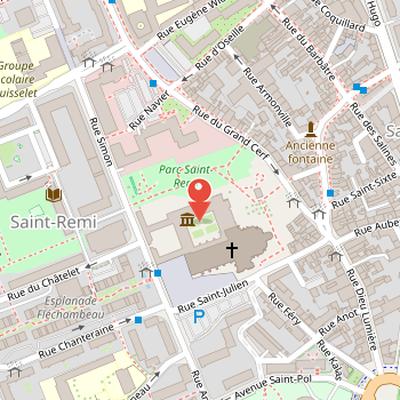
Musée Saint-Remi is located on rue Simon in Reims, Marne, in the Grand-Est region of France, in the former abbey Saint-Remi, also known as the former Hôtel-Dieu. The project to transform the old abbey into a museum began in the 1950s, after the building had served as a hospital and a lapidary depot for local scholarly societies. Official creation was approved in 1965, when it received the status of a first-category controlled municipal museum.
The museum covers the period from prehistory to the Renaissance around 1530. Its collections include regional archaeology from prehistoric, Gallic, Gallo-Roman, Merovingian, and medieval periods, as well as classical archaeology from Greece and Etruria. It also holds a series of ancient weapons, equipment, and uniforms dating from the 16th to the 19th centuries. The collections are arranged thematically and chronologically in the rooms. The building preserves important architectural remains of the abbey, including a grand staircase, original floor parts, sculpted capitals, and other vestiges of the abbey state. The site was classified as a UNESCO World Heritage site in 1991.
Nearby Objects
-
 Saint-Remi Abbey 0 m away
 -
 Basilica of Saint-Remi 60 m away
 -
 Old Church of Saint-Nicaise 300 m away
 -
 Les Crayères 800 m away
 -
 Basilique Sainte-Clotilde de Reims 900 m away
Location and Former Identity
Musee Saint-Remi is located at rue Simon in Reims, in the Marne department of the Champagne-Ardenne region, now part of Grand-Est, France. The building is identified as the former abbaye Saint-Remi, also referred to as the ancien Hotel-Dieu. Its address and earlier use place it within the historic fabric of Reims, linking the museum to a site with a documented religious and institutional past.
From Abbey to Municipal Museum
The idea of transforming the old abbey into a museum emerged in the 1950s. At that time, while the abbey was being used as a hospital, local scholarly societies had already employed it as a lapidary depot. The project received official approval in 1965 from the direction of the Musees de France and the city of Reims, and it was granted the status of a first-category controlled municipal museum. Beginning in 1968, the city of Reims and historic monuments launched a major restoration program, through which the site slowly recovered from damage caused by the First World War.
Musee Saint-Remi forms part of the heritage of the Reims hospital, which signed a long-term lease with the municipality. The former Benedictine royal abbey was classified as a UNESCO World Heritage site in 1991.
The museum covers the period from Prehistory to the Renaissance around 1530. Its collections include regional archaeology from the prehistoric, Gallic, Gallo-Roman, Merovingian, and medieval periods, as well as classical archaeology from Greece and Etruria. It also holds a series of ancient weapons, equipment, and uniforms dating from the 16th to 19th centuries. The rooms present the collections in thematic and chronological order.
Architectural Features of the Former Abbey
Musee Saint-Remi preserves one of the best maintained vestiges of the abbey state. Among its most notable architectural features is a grand staircase aligned with the transept axis of the church, completed in 1778 by the master mason Lecoq. In the staircase area, a portrait of the king copied after Hyacinthe Rigaud is displayed, surrounded by forged ironwork railing made by the locksmith Revel. The site also includes a room that connects the cloister, the abbey rooms, and the church entrance. This preserved room retains original floor elements and numerous sculpted capitals, giving it particular historical and architectural interest.
Musueum Exhibitions and Key Objects
Musee Saint-Remi presents a range of museum events centered on historical and artistic objects, with one display bringing together 1500 treasures from the late Middle Ages. Among the items shown is a 15th century parchment depicting a pope, a cardinal, and an abbot, as well as stalls from the abbey of Saint-Lucien de Beauvais. The museum also exhibits a Marie Madeleine from 1525, attributed to the school of Troyes, and a capital from the tomb of Saint Remi. Other religious works on display include a marble Marie a l'enfant from around 1325, Marie de Courcelles, a reused stone discovered in 2017, and a classified wooden statue of Marie a l'enfant from the 16th century. The museum further presents Jesus crowning Marie from the 18th century, noted as coming from the hospital depot. In addition to these Christian artworks, the events include a reconstructed O-yoroi armor, a writing box by Leonard Foujita, a palanquin of Onna morimono, a decorated marriage Onna morimono, and a drawing by Kano Tsunenobu. One exhibition commemorates the anniversary of Jean-Baptiste Colbert's birth and retraces the evolution of Reims.