Place des Cordeliers is a public square located in the center of the Cordeliers district in Lyon, France. According to its history, it was created in 1557 when Cordeliers monks ceded their cemetery land for an annual rent. The square originally had an irregular shape and was divided into two spaces by the Rue du Port du Rhône. One part extended south of this street between the church forecourt and the junction of Rue Grenette and Rue de la Gerbe, while the other lay south of Rue de la Blancherie, west of the church, on the present-day route of Rue Grôlée. A stone cross stood at the center after the square was created, later replaced in 1748 by a new cross serving as a fountain and meridian. In 1768, a column topped by a statue of Uranie was installed. The sector was redeveloped in the 19th century and extensively remodeled in the 20th century, as part of broader urban changes in the area.
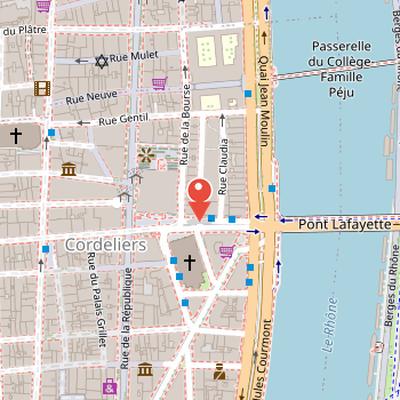
Nearby Objects
-
 Anciennes Galeries Lafayette 50 m away
 -
 Saint-Bonaventure Basilica 50 m away
 -
 Grand Bazar de Lyon 80 m away
 -
 Place de la Bourse 110 m away
 -
 Rue de la République 120 m away
Place des Cordeliers
Place des Cordeliers is a public space located in the center of the Cordeliers district in Lyon, France. It was created in the 19th century and was extensively remodeled in the 20th century. These changes reflect its long-standing role within the district and its later adaptation over time.
Formation and Layout of Place des Cordeliers
Place des Cordeliers was created in 1557, when the Cordeliers monks ceded their cemetery land in return for an annual rent. The square was originally marked by a stone cross at its center. Histoire describes it as having an irregular shape, made up of two spaces divided by Rue du Port du Rhone. One of these spaces extends south of Rue du Port du Rhone between the church forecourt and the junction of Rue Grenette and Rue de la Gerbe. The other lies south of Rue de la Blancherie, west of the church, on the present part of Rue Grolee. The sector of the current Place des Cordeliers was redeveloped in the 19th century. To the east, the monks also ceded land toward the Rhone for the founding of a music academy, leading to the arrangement of Place du Concert between the rear of the concert hall and the Rhone quay. Rue Stella and Rue Claudia connect Place des Cordeliers and Place du Concert on the north and south of the theater respectively.
The Cross and Column at Place des Cordeliers
In 1748, the stone cross at the center of Place des Cordeliers was replaced by a new cross that served both as a fountain and as a meridian. Later, in 1768, the column at the site was topped by a statue of Uranie, the muse of astronomy and astrology. According to Histoire, the statue pointed to the meridian at its feet, linking the monument to both water use and astronomical reference.
Redevelopment and Commercial Growth
Place des Cordeliers was reshaped by a major urban planning operation led by Claude-Marius Vaisse from 1853 to 1864, as part of the restructuring of the Presquile. The square was included in a large redevelopment program that altered both its layout and its surroundings. To the west, rue Imperiale, now rue de la Republique, was created to connect place de la Comedie and place Bellecour. At the corner of rue Imperiale and Place des Cordeliers, Palais de la Bourse was built under the direction of Rene Dardel, with construction beginning in 1855 and the building inaugurated by Napoleon III in 1860.
Other nearby streets were also modified. Rue Buisson was straightened and widened east of Palais de la Bourse and renamed rue de la Bourse, while rue Grenette was straightened and widened. The portion of rue de la Gerbe facing the square was removed, and rue Grolee was extended and straightened to align with Saint-Bonaventure church, with the part of the square west of the church also removed. The colonne du Meridien was demolished in 1858. The square was then extended east toward the Rhone by absorbing rues Stella and Claudia and place du Concert, and buildings north of former rue Stella were demolished.
The redevelopment also introduced commercial and market functions. Construction of a covered market began in 1858 between rue Buisson, now rue Antoine-Salles, and rue Claudia, with the metal frame designed by Tony Desjardins. Later, Grand Bazar de Lyon opened in 1886 at the corner of rue de la Republique and Place des Cordeliers. In 1890, buildings south of former rue Claudia were destroyed for the creation of rue du President-Carnot and the extension of rue Symphorien-Champier, and Grands magasins des Cordeliers opened in 1895 in the resulting triangular area. Galeries Lafayette took over the building in 1919, and major renovations in 1924-1925 added two levels. The square underwent no major modifications until the second half of the 20th century, when the Lyon halls moved to the new Part-Dieu district and a building was destroyed in 1976, with its facade reflecting those of the square's monuments.
Roadway Reorganization and Bus Stop Changes
In 2025, the roadway of Place des Cordeliers was reorganized to accommodate a bus stop of the same name. The stop had previously been located on rue de la Republique before the pedestrianization of its northern part, and it now serves the new TramBus TB11 line. The widening of the sidewalk alongside the Palais de la Bourse also made it possible to install urban seating furniture. This furniture informs passers-by about the establishment of a limited traffic zone in the sector, and part of it was sourced from the nearby Place de la Bourse.