Saint-Bonaventure Basilica is a religious building in the Presqu'île in Lyon, located in the Cordeliers district and dedicated to the Catholic cult. It is the only medieval building remaining in the north of the 1st arrondissement of Lyon, having survived the opening works of rue Impériale, now rue de la République, and the redevelopment of place des Cordeliers under the Second Empire by the Rhône prefect Claude-Marius Vaïsse. Since 1971, it has been an urban sanctuary, and it is not a parish church. The building was erected as a minor basilica by Pope Francis.
Its history is closely linked to the convent of the Minor Brothers, or Franciscans, established on land bequeathed by the seneschal of Grolée. The church’s name and that of the district derive from the nickname “cordeliers,” given to the monks because of the knotted rope belt associated with their rule of poverty. The larger church, begun around 1325, was placed under the patronage of Saint Bonaventure and later completed around 1484. It also received the mortal remains of Cardinal Bonaventure de Bagnoregio, who died in the convent church and was buried on site.
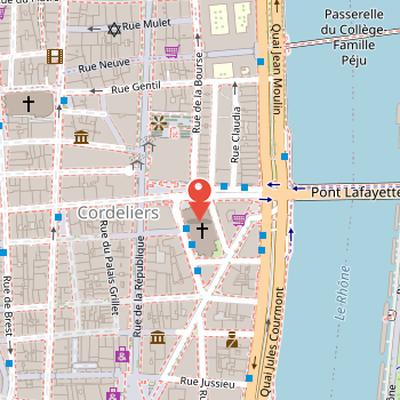
Nearby Objects
-
 Anciennes Galeries Lafayette 50 m away
 -
 Place des Cordeliers 50 m away
 -
 Grand Bazar de Lyon 60 m away
 -
 Rue de la République 80 m away
 -
 Place de la Bourse 150 m away
Historical Status and Urban Setting
Saint-Bonaventure Basilica is a religious building in the Presqu ile area of Lyon, dedicated to the Catholic cult in the Cordeliers district. It is the only medieval building remaining in the north of the 1st arrondissement of Lyon, having survived the opening works of rue Imperiale, now rue de la Republique, and the redevelopment of place des Cordeliers under the Second Empire by the Rhone prefect Claude-Marius Vaisse. Since 1971, it has been an urban sanctuary. It is not a parish church, and it was erected as a minor basilica by Pope Francis.
History and Patronage
Saint-Bonaventure Basilica is closely linked to the convent of the Minor Brothers, or Franciscans, established on land bequeathed by the seneschal of Grolee. The religious order was founded by Saint Francis of Assisi, and its members were quickly called cordeliers because of the knotted rope belt worn as a sign of poverty. This nickname gave its name to the church and to the neighborhood in the Presquile in Lyon.
The convent included a small abbey church oriented west-east. A larger church was decided around 1325 by Jacques de Grolee, grandson of the seneschal. The new church was placed under the patronage of Saint Bonaventure and oriented south. Construction began with the apse and two apse chapels. The church received the mortal remains of Cardinal Bonaventure de Bagnoregio, who had died in the convent church and been buried there. The unfinished church was consecrated by the archbishop of Lyon, Pierre de Savoie, and dedicated to Saint Francis of Assisi. It was extended north between 1450 and 1480 with financial help from Jean de Pavie, counselor and physician to Kings Charles VII and Louis XI. The building was finally completed around 1484 and placed under the patronage of Saint Bonaventure, who had recently been canonized. Saint Bonaventure was also known as the Doctor Seraphicus and was proclaimed Doctor of the Church in 1586 by Pope Sixtus V; he is celebrated by the Catholic Church on July 15.
The church underwent several vicissitudes of history. It was pillaged in 1562 during the Wars of Religion, and during the French Revolution the convent and church were sold as national property. After the looting of furniture, stained glass, and doors, the church served for about ten years as stables, a warehouse, and housing. It was restored to worship around 1806 and repaired despite the Canut revolt of 1834, during which around ten people were killed in the church. The Saone flood of 1840 caused one meter of water inside the building. Around 1890, buildings and shops attached to the church were removed to widen rue Grolee on the west side. Ownership of the church and its furniture was transferred to the city of Lyon by the laws of 1905 and 1907. The last attached building was demolished in 1975. The church was listed as a Monument historique in 1927.
Faade Remodelling and Later Alterations
From the Middle Ages to the 1860s, Saint-Bonaventure Basilica presented a poor and bare facade that followed Franciscan principles. Its exterior was plastered over uncut stone masonry, and its only decorative features were the central porch, two lateral porches, and a rose window with original tracery made up of six circular units around a central circle. This condition changed during the Second Empire, when Prefect Vaissse initiated the complete redevelopment of Lyon's Presqu'ile. In this context, the Palais de la Bourse was built opposite the basilica, and architect Claude-Anthelme Benoit was assigned to remodel and decorate the dilapidated facade. He doubled the existing frontage with a high-quality stone wall built in large blocks, carefully cut so that each stone had the same depth and height and was finely adjusted. Benoit also raised the central gable by about ten meters and created a new slate roof on the first bay.
The remodeling added a smaller rose window decorated with half-engaged lateral pinnacles and an accolade. The roof border was finished with fleurons and ended in a cross decorated in the same manner. The main porch was widened with deep ashlar stone facing, and the architrave and voussoirs were altered from six to eleven slender colonnettes. The tympanum was replaced by a stained glass panel decorated with mouchettes, and a statue of the Virgin Mary sculpted by Joseph-Hugues Fabisch was placed at the center of the porch. The four central and lateral buttresses were extended with fleuroned pinnacles, while a balustrade with mouchettes emphasized the roof slopes and small angel consoles. Around 1860, Benoit completed the facade with coats of arms placed here and there. Between 1890 and 1900, the basilica was freed from old dilapidated buildings, and Benoit's decoration was extended on both sides with roof balustrades, small angel consoles, and fleuroned pinnacles, though these additions were initially unsculpted. On the Rhone side, meeting rooms and a secretariat were preserved at the request of the parish council, creating an asymmetrical overall appearance. The side chapels also contain contemporary stained glass windows with French legends, set low at the base of each bay, below one meter in height.
Guilds, Patron Saints, and Mutual Aid
Guilds were associations of Christian laypeople formed to promote mutual aid among members of the same trade and to develop a specific religious tradition. They grew significantly in Christian nations during the Middle Ages and were organized around a patron saint, whose protection was understood as having a spiritual purpose. Members practiced religious activities in the hope of obtaining the intercession of their patron saint. Faith and prayer were relied on in response to wars, epidemics, poor product sales, excessive taxes, and other social difficulties, and patron saint protection was regarded as the only support available. Group prayers were believed to benefit each member individually beyond what solitary prayer could achieve. At the same time, mutual aid strengthened ties within trade guilds, which were funded by voluntary donations, legacies, and collections.
The Side Chapels of Saint-Bonaventure
At Saint-Bonaventure, trade guilds constructed seventeen side or apse chapels between the 15th and 17th centuries. The chapels were described from the right entrance, on the Saone side, toward the choir. Abbé Pavy reproduced Fodere's 1619 description of the chapels at the Cordeliers convent, which preserves part of their earlier history and naming.
Several chapels were associated with specific guilds, patrons, and devotional themes. Chapel 1, named Notre-Dame chapel, was built by Jean Ogii, a wealthy Lyonnais and consulate member, who paid 2300 Viennese livres to monks through his heir Guillaume de Durchie. Jean Ogier, his heir, and family were buried there. The chapel was initially dedicated to Saint Francois d'Assise, then to Saint Bonaventure, later to King Saint Louis by the confrerie des Sergents royaux, and is now called chapelle des resurrections or chapelle du Christ. It has also been converted into a sacristy.
Other chapels reflect the groups that built them or the saints to whom they were dedicated. Chapel 2 was the chapelle de saint Fortune, built by merchants from Troyes in Champagne in 1345, and is currently the chapelle du Sacre Coeur. Another Chapelle 2 is identified as the chapelle de l'Assomption, consecrated to Notre-Dame and built by all who work in the art of silk; it changed its name in 1662 to Notre-Dame de la Delivrance. Chapel 3 appears in several historical forms: one was the chapelle saint Joseph, built by the confrerie des tailleurs d'habits and dedicated to Saint Jacques and Saint Philippe. It carried the confrerie's coat of arms on the arcade arch, showing scissors topped with a shell, and contained a marble retable with a statue of Saint Joseph carrying the Child by Jean-Andre Delorme, as well as four episodes from Saint Joseph's life and a coronation sculpted by Vincent Fontan and Gaetan Visconti. Another Chapelle 3 was the chapelle saint Nicolas, built by the bateliers, partly destroyed by baron des Adrets' troops to pass artillery, and rebuilt in 1572. Chapel 3, together with chapels 4 and 5, was later merged into one chapelle Saint Joseph. Chapel 4 was dedicated to Saint Luc and Saint Clair by the confrerie des peintres et vitriers, and is now the chapelle du Sacre-Coeur with an altar added by order of monseigneur de Neuville.
The remaining chapels also show the same pattern of guild patronage and changing dedication. Chapel 5 was dedicated to Saint Jean-Baptiste in one description, and elsewhere appears as the chapelle saint Bernardin, now the chapelle du cure d'Ars. Chapel 6 was the chapelle saint Antoine de Padoue, built in 1388 by the confrerie des hoteliers des taverniers. Other chapels included Sainte-Elisabeth de Hongrie, Chapel 8, formerly called Notre Dame de pitié and dedicated to Saint Mathieu, built by the confrerie des tondeurs de draps, the chapelle de l'Annonciation built by Simon de Pavie, and a chapel dedicated to Saint Michel built by the confrerie des revendeurs.
All the chapels were ravaged during the Revolution francaise, and nothing remains of their original description at the beginning of the .
Altars, Retables, and Chapels
Saint-Bonaventure Basilica contains three Gothic style chapels that were merged into one in 1839, and the site includes a door giving direct entrance from rue Gribeaude. Its devotional furnishings combine several periods and styles. The altar and retable in one description date from the 19th century and are presented in an Italian Renaissance or neo-classical style. The retable was a donation from abbé Marduel, curé of Saint Bonaventure, in 1852, and it was designed by architect Agnisetti around a pieta sculpture. Above the altar, a bas-relief represents the monogram of Marie with the letters AV, while the front center of the altar bears another bas-relief showing the death of saint Joseph, supported by Jesus, Mary, and disciples. The retable statue is a life-size figure of sainte Jeanne d'Arc from the early 20th century. It is described as hierarchical and almost military, with the figure, called la pucelle, holding a large sword vertically and looking straight ahead. Two large columns support a horizontal pediment with partly gilded cornices.
The basilica also preserves a confessionnal that is the only piece of furniture not in neo-Gothic style. It has a clear color and simple curves in the Restauration style of the early 19th century, and a painting above it was made by Charles Auguste Chavard (1810-1885). Another chapel furnishing is a bronze statue of saint Antoine de Padoue by Fontan, dated 1896, placed at the left entrance. It shows the saint holding a lily in his right hand and the child Jesus on his left arm, with the child moving a small hand toward the saint's face. In addition, a marble altar from 1893 and a retable in flamboyant Gothic or Gothic revival style are associated with a narrative cycle on saint Joseph, including his triple dream, the flight into Egypt, his marriage to Mary, his carpentry workshop, and his arrival in heaven. The retable style is described as typical of the late period and common in the basilica's side chapels.
Chapels, Altars, and Decorative Program
The interior includes several former chapels that were combined by removing the partition walls between them. The choir corresponds to the old chapel dedicated to Saint Bonaventure, where the body of Saint Bonaventure was deposited in the cloister behind the chapel. The southernmost old chapel has a vault treated in flamboyant Gothic style, with liernes forming a cross in the central part and tiercerons beginning in a V shape toward the crossing pillars. Another chapel was formerly dedicated to Saint Bernardin de Sienne in 1534 during the time of the butchers' guild, and later became the chapel of the guardian angels.
Between 1855 and 1863, Claude-Anthelme Benoit and his son Louis-Francois were assigned to create an altar and retable on the theme of guardian angels. They installed a girdle altar with quatrefoil motifs and a retable decorated with musician angels around a central painting. Two cherub statues flank the retable, while six colored musician angels are set into circles at the top of the painting under pointed arches. The team used a relatively light Gothic style described as more spider-web-like, and the blue paint on the vaults and ribs emphasized the angelic theme, although it has mostly disappeared except locally due to age and lack of maintenance.
The chapel entrance is framed by two statues symbolizing Faith and Hope, attributed to sculptor Jean-Pierre Robert. Between the two stained glass windows, Charity is represented by a woman holding a child in each arm. Four statues placed on the four chapel corners represent the four evangelists, identified by their symbols: man for Matthew, lion for Mark, ox for Luke, and eagle for John. The altarpiece is elevated and difficult to access, so ordinary cleaning is impossible; it is dusty and awaiting heavy renovation. It is richly sculpted, with many niches filled with statues of angels, and two angels flank the statue of the Sacred Heart in the central position.
Other works in the chapel include an oil on canvas titled The Adoration of the Magi, placed on the left of the entrance by rue Grolée. It is a copy inspired by Jacopo Bassano, the famous Venetian painter of the late 16th century. The painting is barely visible because it is placed above the neogothic walnut confessional. Nearby, another painting above the confessional on the left shows Jesus meeting the Samaritan woman and was painted by Leonard Lagarde in the 19th century. A beige stone altar dated to the 19th century was partially gilded and decorated with floral motifs on six lancets on its facade.
The Gothic troubadour style altar is very ornate and is surmounted by a large altarpiece designed by Benoit father and son and sculpted in yellow Cruas stone by Jean-Pierre Robert in 1864. Its niches present a narrative sequence: the left niches show the Annunciation and the Adoration of the Magi, the right niches show the Nativity and the presentation of Jesus at the temple by Mary and Joseph, and the center above the Assumption and Crowning of the Virgin shows the discovery of the empty tomb. A monument under the central stained glass window honors Abbot Pater, who served as priest from 1844 to 1859 and worked extensively on the restoration of the church.
The Baptismal Chapel of Saint-Bonaventure Basilica
The baptismal font chapel at Saint-Bonaventure Basilica is noted for several distinctive features. Unlike most parts of the basilica, it does not have a retable, which is described as a rare exception. Instead, the altar carries a large oak group representing the baptism of Christ, a work sculpted in 1850 by Antoine Cubisole and renovated in 2023 by the Heritage Commission. In this scene, Saint John the Baptist appears slightly smaller than normal as he pours water on the forehead of kneeling Jesus Christ, who is shown with crossed arms.
Cubisole, who studied under Leopold de Ruolz at the Lyon School of Fine Arts, also sculpted the statues of Moses and Elijah placed on the left and right sides of the entrance vault. The vault itself has a keystone marked by a hand holding scales, representing the corporation of resellers, and it does not have an armorial or numbered keystone. It is divided by lancet ribs into four double leaves and punctuated by five small hanging keystones.
The chapel floor is paved with square limestone slabs and black stone quatrefoil corner pieces. The baptismal font is octagonal, symbolizing new life, and its oak lid is decorated with cut iron fittings in relief. The font was renovated in 2024. The basilica states that four chapels are decorated with late Gothic baroque style vaults, including the baptismal font chapel, the central part of the Virgin chapel, the Sacred Heart chapel, and the southern part of the Saint Joseph chapel.
Stained Glass and Wartime Damage
The basilica's stained glass was significantly affected when German armies exploded the Lafayette bridge near the building on an unspecified date. The blast damaged a large part of the stained glass windows. Surviving 19th-century windows were preserved, with or without restoration, while the empty bays created by the explosion were filled with contemporary stained glass windows between 1945 and 1965. These later windows were designed by Louis Charrat and made by Josepheine Lamy-Paillet.
Among the older windows, the 1840s stained glass was created by Emile Thibaud, a master glassmaker from Clermont. These windows reflect a 13th-century style associated with Chartres and Notre-Dame de Paris. Their lancets are divided into squares containing circular medallions, and their coloring is typical of the 19th century, with dominant reds and blues. The medallions depict scenes from the life of Christ, the Virgin, and Saint Bonaventure, although the small size and distance make the scenes difficult to read. The choir is brightly illuminated by light between 10 a.m. and 3 p.m. because of the south-facing windows.
A similar composition scheme appears in the large three-light stained glass window with eight openings in the right apse chapel, which was also created by Emile Thibaud. This window was damaged by the explosion and repaired by Josepheine Lamy-Paillet's workshop. Two large four-light windows with eleven openings also contain stained glass designed by Louis Steinheil, a painter-decorator and stained glass designer who collaborated with Eugene Viollet-le-Duc for 40 years. These Steinheil windows were made in 1854 in the Italian Renaissance style.
Steinheil Windows and Gothic Revival Details
The Steinheil windows at Saint-Bonaventure Basilica present a series of biblical scenes and patriarchal figures through stained glass painting. In the first bay, the windows depict the nativity of Jesus, the adoration of shepherds and magi, and related scenes arranged with architectural perspectives. They also show the marriage of Marie and Joseph, blessed by a priest wearing Judaic priestly garments, with children playing on a blue and white tiled floor covered with flowers in the foreground and a joyful crowd in the background. Another scene presents Joseph sleeping during a dream in which the angel of the Lord announces the virgin birth of Jesus, while Marie receives the announcement from the angel Gabriel in the background of the first bay. The angel Gabriel is shown wearing a long red robe, and carpenter tools are scattered on the floor.
In the second bay to the right of the first, the windows illustrate the adoration of the shepherds. The design relies on facial expressions and postures to indicate each character's role. The stained glass painting is used to render modeling and details effectively, while large white glass panels with less lead branching allow light to pass through. Decorative backgrounds highlight the silhouettes and drapery of the biblical figures.
The basilica also features four lancets with three lights each representing four patriarchs on a light background. These patriarchs are supported by richly decorated consoles and canopies in a Gothic Revival style, a style described as widespread in England, the United States, and Germany from about 1850 to 1900. The patriarchs include King David with a large harp singing the psalms he invented, Moses descending from Sinai carrying the heavy stone tablets of the Law, Abraham armed with a large knife but not sacrificing his son Isaac, and King and priest Melchizedek carrying bread and wine as prophetic symbols of Judaism and Christianity.
Bridges in Lyon on September 2, 1944
On September 2, 1944, German forces destroyed all bridges in Lyon, although two bridges did not explode. American engineers then built temporary bridges in less than twenty-four hours. The German attempt to slow the Allied advance did not delay it, and the Germans risked being encircled by troops from Normandy and Provence that were soon to join.
The Stained Glass Windows
Saint-Bonaventure Basilica is distinguished by nine stained glass windows that were once shattered and irreparable, then gradually regained between 1945 and 1965 over a period of twenty years. They were made from designs by the Lyon artist Louis Charrat, born in Fontaines-sur-Saone near Lyon, who entered Lyon's Ecole des Beaux-Arts in 1920, studied under Georges Decote, received the Societe Lyonnaise des Beaux-Arts Medal of Honor, and won the Prix de Paris at the 1934 Salon des Beaux-Arts. His cartoons were transformed into glass by Josephine Lamy-Paillet's workshop at Vitrail Saint-Georges in old Lyon, from 1940 to 1965.
These nine windows form an important set of twentieth-century art and are now the main feature of the basilica. They combine modern colors, large compositions, figurative and stylized drawings, French legends, and a low placement that makes them easier to observe. Their imagery illustrates the history of France, Saint Bonaventure, and the basilica itself, while also depicting scenes from the gospels of Mary, Joseph, and the life of Christ.
The nine windows follow a route through the building, beginning in the first left lateral chapel near the Rhone river at the Saint-Jean-Baptiste chapel with its baptistery. The sequence continues with six windows on the Rhone side, crosses the nave to the Saint-Joseph chapel, and ends with the last three windows near the west porch by the Saone river.
The Fresco of Clovis' Baptism
Behind the baptistery is a large fresco of the baptism of Clovis. It represents the baptism of the first Christian king of France, an event described as marking nearly fifteen centuries of Christian kings. The fresco also displays the French legend: 'Saint Remy baptise Clovis le jour de Noel 496'. Its composition includes a large curtain rod linking the four lancets below the stone tracery, separating blue background coats of arms from the tracery above. A red and orange curtain is shown closed behind three bishops and the Frankish king, but open to witnesses. The scene is further enclosed by soldiers' lances and includes a horse and a group of elegant women. Clovis is shown throwing away his sword and red cloak while crossing his hands over his chest in humility. The image is marked by vivid red, yellow, and emerald green colors distributed across the composition.
Stained Glass Scenes and Chapel Patronage
The chapel of Saint-Bonaventure Basilica includes stained glass imagery combining narrative, devotional, and commemorative elements. One description refers to the announcement made to Marie, shown standing on a carpet of flowers and surrounded by a large flock of doves ascending to the sky. The angel Gabriel appears with large wings colored orange, green, and yellow, colors described as rare for angels. Another angel on the left covers part of the scene, with orange wings extending into the right lancet and a large emerald green cape; its hand points in the direction Joseph must take, conveying the message that he should take the child and mother and flee to Egypt. Marie is shown holding her child on her heart, wearing a blue veil contrasted with an orange and gilded cape, while a mass of tulips closes the composition at the bottom. The sky is striped with pink bands, with the moon and stars shining on a light or dark blue background according to the glass sections, and the firmament continues into the tracery of the window. Another stained glass composition in the chapel of Saint Antoine de Padoue presents a Christ in glory rising towards the sky at the center. The descriptions also include historical references to Simon de Pavie, identified in a legend as a doctor and advisor to the kings of France who built the chapel in 1471, and to Jean de Pavie, shown kneeling in prayer as a great benefactor of the sanctuary who funded three additional bays of the church in the 1470s.
The Organ at Saint-Bonaventure
The history of the great organ at Saint-Bonaventure shows several phases of rebuilding, relocation, and restoration. Earlier instruments had already existed at the site, since the organ was destroyed by Calvinists in 1562. Around 1592, the consulate allocated a large sum in gold ecus to finance a new instrument. By 1693, Les grandes orgues were documented as being placed above the central portal of the church, on a tribune at the back of the nave before the revolutionary period. A 1693 document describes the instrument as having sixteen feet, forty stops, five manuals, and pedals with nineteen steps. It was made in the style of sieur Alexandre Thierry and sent from Paris by Monsieur Le Begue.
The Alexandre Thierry organ and its tribune did not survive the revolutionary period. Later, Joseph Callinet from Rouffach was commissioned to build a new organ for Saint-Bonaventure. His organ was inaugurated on an unspecified date and placed on the right side of the choir. In 1855, Callinet moved the instrument to the back of the choir. The organ case also dates from 1855, although the old central part was reused in the Saint-Antoine-de-Padoue chapel. After this move, the organ had twenty-two stops and was considered to have weaknesses.
In 1869, the parish signed a contract with Joseph Merklin for modernization and mechanical renovation. The modernized organ was inaugurated by Edouard Batiste and Charles Marie Widor. Further restoration was requested in 1894 by Leon Reuchsel, and a convention signed in 1895 planned additional transformations, including the replacement of the bellows and the installation of new keyboards.
The Grandes Orgues and Their Restoration History
The grandes orgues of Saint-Bonaventure Basilica have undergone a long sequence of technical changes and restorations. In 1885, approval was given to repair existing stops and add new ones. At that time, the instrument still used mechanical transmission before later adopting an electrical system by Merklin. Its construction combined three transmission modes: one keyboard with an electrical system, one with pneumatic traction, and the others with mechanical action. Because of this mixed design, three different touch types were required for performance. In 1912, an electric blower was installed, replacing the need for blowers to fill air reservoirs that weighed five hundred kilograms or more.
The instrument suffered fire damage in 1928 during Marcel Paponaud's tenure and remained silent for a long period afterward. It was restored in 1936 by Michel Merklin and Kuhn under Paponaud. That restoration included the work of a harmonist trained at Cavaille-Coll for stop voicing, with particular attention to improving the quality of the reed stops in order to enhance the trumpet and clarion stops. The organ was restored again in 1960 by Michel Merklin and Kuhn, and later in 1985 by Rene Micolle, Georges Valentin, and Charles Mesle. The 1985 work added two chamade reed stops on two keyboard sections.
A further restoration took place in the early 2020s under the direction of Michel Jurine and his team. This campaign included cleaning all parts, re-leathering nine reservoirs, installing new fans, replacing five thousand membranes and many wooden elements, replacing electrical transmissions with a digital system, re-facing the keyboards, adding a combination system, washing pipes, and re-voicing four thousand two hundred forty-nine pipes. The restoration respected the 1936 aesthetic. When the work was completed, the organ was blessed by Archbishop Olivier de Germay and inaugurated by its titular organist.
The instrument now has sixty-eight stops, three keyboards of sixty-one notes, and a thirty-two note pedalboard. It also includes a computerized combination system with infinite possible combinations. Its current titular organist is Gabriel Marghieri, who teaches at the Conservatoire national superieur de musique et de danse de Lyon and also holds the grand organ of Sacre-Coeur Basilica in Paris.