The Musée d'art moderne et d'art contemporain de Nice is located next to Place Garibaldi and spans the Cours du Paillon in the form of a tetrapod arch. Designed by architects Yves Bayard and Henri Vidal, its square-plan architecture is inspired by neoclassical rules. The building has smooth facades covered with white Carrara marble and includes an entrance and shop on the Niki de Saint Phalle esplanade, overlooking Place Yves Klein. This site also includes the auditorium and the museum's contemporary gallery.
The museum has nine exhibition rooms on three levels. Temporary exhibitions are shown on the first floor, while the second and third levels house the permanent collections. A terrace called the Promenade des arts connects the museum to a theater. The museum received visitors in 2010 and became the second most visited single site in Nice. It is open every day from 11 a.m. to 6 p.m., except Monday, Easter Sunday, and certain holidays, and offers free entry for students.
Its collections comprise 1,331 works by 346 artists, including paintings, sculptures, and installations. They present an avant-garde panorama of artistic creation from the late 1950s to the present, structured around different movements. The holdings include works by Serge Charchoune, Alexander Calder, Joseph Cornell, Hans Hartung, Lucio Fontana, Nicolas de Staël, Simon Hantai, Pierre Soulages, Olivier Debré, Victor Vasarely, Karel Appel, Paul Mansouroff, Annette Messager, Jan Fabre, Ai Weiwei, Éric Michel, and Claude Goiran.
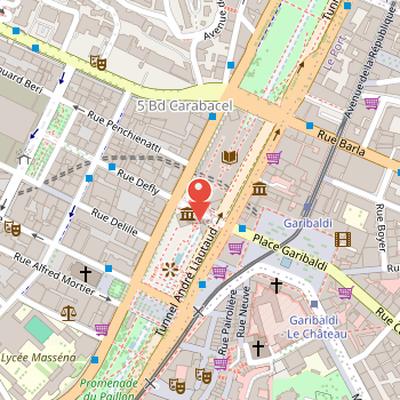
Nearby Objects
-
 Muséum d'histoire naturelle de Nice 90 m away
 -
 National Theatre of Nice 90 m away
 -
 Louis-Nucéra Library 110 m away
 -
 Place Garibaldi 140 m away
 -
 Monument to Giuseppe Garibaldi 140 m away
Architecture and Layout
The Musee d'art moderne et d'art contemporain de Nice is located next to Place Garibaldi and was designed by architects Yves Bayard and Henri Vidal. Its architecture takes the form of a tetrapod arch spanning over the Cours du Paillon, while a terrace called the Promenade des arts connects the museum to a theater. The building has a square plan inspired by neoclassical rules, and its smooth facades are covered with white Carrara marble. The entrance and shop are situated at the Niki de Saint Phalle esplanade, overlooking Place Yves Klein, where the auditorium and the museum's contemporary gallery are also located. The museum offers an available area divided into nine exhibition rooms on three levels. The first floor is dedicated to temporary exhibitions, while the second and third levels house the permanent collections. Opened to visitors in 2010, it became the second most visited single site in Nice. It is open every day from 11 a.m. to 6 p.m., except on Monday, Easter Sunday, and certain holidays, and entry is free for students.
The museum collections
The museum's collections comprise 1,331 works by 346 artists, including 436 paintings and 292 sculptures and installations. They present an avant-garde panorama of artistic creation from the late 1950s to the present, organized around different movements. The holdings include works by Serge Charchoune, Alexander Calder, Joseph Cornell, Hans Hartung, Lucio Fontana, Nicolas de Stael, Simon Hantai, Pierre Soulages, Olivier Debre, Victor Vasarely, Karel Appel, Paul Mansouroff, Annette Messager, Jan Fabre, Ai Weiwei, Eric Michel, and Claude Goiran. A room is dedicated to Yves Klein and contains about twenty of his works, some of which belong to the permanent collection.
The collection was also shaped by significant donations and deposits. Niki de Saint Phalle gave the City of Nice 170 works, including paintings, sculptures, engravings, lithographs, serigraphs, and original documents. Other important additions include Albert Chubac's donation of about one hundred works in 2004, 94 works from collector Khalil Nahoul in 2010, and the Berggreen bequest in 2014. The museum also holds the monumental sculpture Le Monstre du Lochness and Christo's Empaquetages through a deposit from the Lilja Art Fund Foundation.
Temporary Exhibitions
Since the museum opened, the Expositions temporaires program has presented more than 213 temporary exhibitions. This record indicates that the museum has maintained an active and ongoing exhibition schedule over time, with temporary shows forming a significant part of its public activity. The figure also suggests that the museum has used temporary exhibitions as a major means of renewing its programming and offering varied content to visitors.