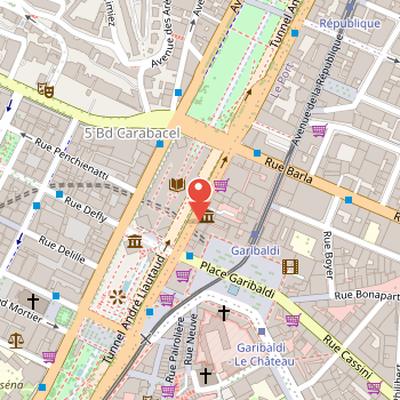
The Muséum d'histoire naturelle de Nice is the oldest municipal museum in Nice and is known by Niçois as musée Barla. It preserves a heritage of more than one million specimens, mainly from Mediterranean regions, alongside examples from South America, Africa, and the islands of the Indian Ocean. The museum is located in the district of place Garibaldi, at 60 boulevard Risso.
Its origins are linked to local naturalists who studied the flora and marine world of the Prealps of Nice. The museum idea came from Antoine Risso, leader of the Nice Naturalist School, and the museum opened in 1846 in a room of the communal palace at place Saint-François. Its early collections included birds, mollusks, minerals, and fossils gathered by Jean-Baptiste Vérany, as well as private collections assembled by Jean-Baptiste Barla. The two collections were later united under the arcades of Maison Barla. In the early 20th century, a new museum space with a glass façade facing boulevard Risso was built. Today, this space is the only part open to the public after exhibition room updates.
Nearby Objects
-
 Louis-Nucéra Library 70 m away
 -
 Place Garibaldi 100 m away
 -
 Monument to Giuseppe Garibaldi 100 m away
 -
 Chapelle du Saint-Sépulcre 140 m away
Historical Museum and Collection
The Muséum d'histoire naturelle de Nice is the oldest municipal museum in Nice, and it is known by the Niçois as the musee Barla. It holds a heritage of more than one million specimens, drawn mainly from Mediterranean regions. Its collections also include specimens from South America, Africa, and the islands of the Indian Ocean. The museum is located in the district of place Garibaldi, at 60 boulevard Risso.
Origins and Early Collections
The museum grew out of the work of local naturalists who studied the flora and marine world of the Prealps of Nice. Its idea originated with Antoine Risso, the leader of the Nice Naturalist School. The museum opened in 1846 in a room of the communal palace at place Saint-Francois, and its early holdings consisted of Jean-Baptiste Verany's collections of birds, mollusks, minerals, and fossils.
Jean-Baptiste Barla also assembled a private collection focused on the natural history of Nice, including fish, flowering plants, and mushrooms. In 1863, the Verany collection was housed in Maison Barla at 6 place Garibaldi, and the two collections were then united under the arcades, with the museum entrance on the building door. The natural history cabinet occupied two large rooms with shelves full of specimens. One room was dedicated to mushroom molds collections, while a second was devoted to shells and jars of cephalopods and gastropods.
In 1896, J.B. Barla bequeathed all buildings, collections, and the library to the city. The Barla property buildings extended along the Paillon river bank.
Museum Space and Later Changes
At the beginning of the 20th century, the Musaeum d'histoire naturelle de Nice built a new museum space with a glass facade facing boulevard Risso. In 1975, an additional room for fossils was added. The museum later suffered flooding in its reserves, laboratories, and workshops after a major water pipeline rupture on boulevard Risso, but museum staff and volunteer naturalists prevented any specimen from being permanently lost. After later exhibition room updates, the early 20th century museum space remains the only part open to the public. The institution also organizes temporary exhibitions periodically at parc Phoenix, the Louis-Nucera library, and the Maison de la nature at the Grande Corniche park. A planned relocation to a future Science and Nature City, including a new museum and a parc Phoenix building, was once scheduled for 2013 but was postponed to an indefinite date.