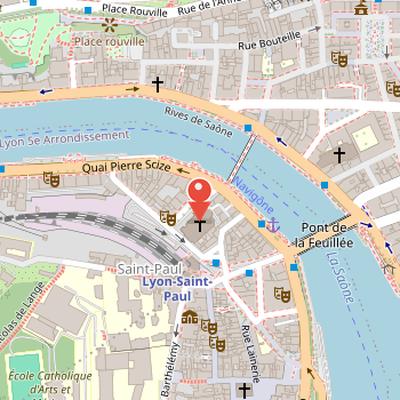
Église Saint-Paul is a Catholic church in Lyon, located in Vieux-Lyon in the Saint-Paul district. The building combines Romanesque and Gothic architecture and is associated with a long historical sequence. Its existence is attested in documents transmitted by Bishop Leidrade to Charlemagne in the 8th century, although no remains from that period survive.
Romanesque construction began in the second half of the 11th century and was completed in the 12th century. The church includes the Saint-Laurent portal, the lantern tower, and Romanesque sculptures such as modillions and metopes. In the 13th century, Gothic additions introduced elements including the bell tower-porch and lateral chapels. Later work included an 18th-century Doric portal and enlargement of the main apse by architect Cyr Decrénice. The church underwent major restoration in the 19th century, with further work between 1898 and 1904 and a last restoration in 2002. The lantern tower has been classified as a historical monument since 1920, and the church itself since 1996.
Nearby Objects
-
 Lyon-Saint-Paul station 70 m away
 -
 Sainte-Marie Lyon 130 m away
 -
 Rue Juiverie 150 m away
 -
 Salle Molière 200 m away
 -
 Palais Bondy 200 m away
Saint-Paul Church in Vieux-Lyon
The Church of Saint-Paul is located in Vieux-Lyon, in the Saint-Paul district of Lyon. It is described as a building in Romanesque and Gothic style. The church is notable for its lantern tower, which has been classified as a historical monument since 1920. The church itself was classified as a historical monument in its entirety in 1996.
History and Architectural Development
The history of the Eglise Saint-Paul is attested in documents transmitted by Bishop Leidrade to Charlemagne in the 8th century, although no surviving vestige from that period remains. The present building developed in several phases. Romanesque construction began in the second half of the 11th century and was completed in the 12th century. From this period come elements such as the Saint-Laurent portal, the lantern tower, and Romanesque sculptures including modillions and metopes.
In the 13th century, the church was modified with Gothic additions, notably the bell tower-porch and lateral chapels. A Doric portal was erected in the 18th century, and architect Cyr Decrenice was responsible for enlarging the main apse in the same century. The church was also the resting place of the theologian Jean Gerson in the 15th century.
The building underwent major restoration campaigns in the 19th century. Important works were carried out by Claude-Anthelme Benoit and his descendants in the 1840s. After the stone spire was destroyed in 1817, it was replaced by a wooden spire in 1875. The final restoration phase of the century took place between 1898 and 1904, when the plaster covering the interior since the 17th century was removed and the statues of the Four Evangelists by Jean-Francois Legendre-Heral were taken out. The last restoration of the entire building was completed in 2002.
Architectural Features of Saint-Paul
The church of Saint-Paul de Lyon includes several notable architectural elements that reflect different periods and styles. Its tower-lantern, known as the Tour-lanterne de l'eglise Saint-Paul, is part of the parish today. The church also has a Romano-Gothic nave and a Romanesque porch, along with a chapel. Among its decorative details are Romanesque metopes depicting animals, humans, and monsters. The facade includes a 19th century Neo-Gothic tympanum representing the conversion of Saint Paul on the road to Damascus. A lateral view of the church is also part of the documented features of the parish.