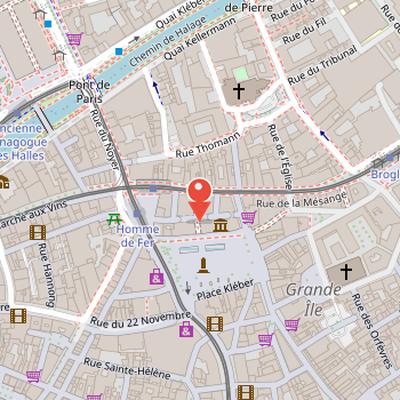
The Aubette, also known as l’Aubette de Strasbourg, is a long classical building closing the north side of Place Kléber in Strasbourg. Built from 1765 to 1778, it was originally a military building planned to contain lodgings and a guard corps. It served a military purpose for about a century, and its name is likely derived from an older meaning of the word aubette, understood as shelter.
The building later became part of a broader project of urban embellishment and modernization linked to the place d’Armes plan designed by Jacques-François Blondel. The scheme included façades modeled after the military building and a western semicircular arc intended for a performance hall. The Aubette currently contains several rooms, including a ciné-dancing and a foyer-bar. It is classified as a historic monument, with protection dating from 1929 and additional classifications in 1985 and 1989. Today, it belongs to the museums of Strasbourg city under the name Aubette 1928.
Nearby Objects
-
 Statue of Jean-Baptiste Kléber 60 m away
 -
 Place Kléber 60 m away
 -
 Le Cosmos 140 m away
 -
 Saint-Pierre-le-Jeune Protestant Church 200 m away
 -
 Temple Neuf 200 m away
History and Use of the Aubette
L'Aubette de Strasbourg is a long classical building that closes the north side of place Klber in Strasbourg. Built between 1765 and 1778, it was originally a former military building and later became a leisure center. For about a century, it served a military purpose and was planned to house lodgings and a guard corps. Its name likely comes from an old meaning of the word aubette, referring to shelter.
The building later developed into a leisure complex with several rooms, including a cin-dancing and a foyer-bar, and was inaugurated on an unspecified date. It has been classified as a historic monument since 1929, with additional classifications in 1985 and 1989. Today, it belongs to the museums of Strasbourg city under the name Aubette 1928.
Aubette in the Place d'Armes Project
The Aubette was part of the place d'Armes project designed by Jacques-Francois Blondel and included in a master plan to modernize and beautify the city. Its northern and southern facades were modeled after the Aubette military building, and its western semicircular arc was originally intended for a performance hall. This western arc was also designated for a large inn named Maison rouge. The program was delayed by pre-revolutionary conditions and financial shortages, and the project was only realized with the construction of the Aubette building. In use, it housed the general staff office and a cafe-concert on the first floor. After 1869, it housed the municipal museum of painting and sculpture.
Reconstruction and New Use
The Aubette and its museum were destroyed by a violent fire on January 24, 1870, leaving only the facade. The building also experienced the siege and bombardment of the city by German troops during the Franco-Prussian War of 1870. Reconstruction began in 1873 under the direction of the official city architect, Jean Geoffroy Conrath. The restored design preserved the facade, while adding sculpted decorations and a new slate roof with a broken pitch, different from Blondel's project. The facade was also adorned with medallions showing portraits of famous musicians, including Mozart, Haendel, Gluck, and Mendelssohn. Rehabilitation was completed in 1877. After reconstruction, the ground floor was occupied by shops, while the first floor housed the conservatory of music and a large concert hall.
Avant-Garde Leisure Complex
In 1922, the Aubette's right wing was taken over by concessionaires who planned a large leisure complex with ten rooms. The first interior plans were developed between 1922 and 1926, and the modernization project for the right wing was entrusted to Jean Arp and Sophie Taeuber-Arp. Construction works then began from 1926 to 1928 with the help of Theo van Doesburg.
The project applied aesthetic principles derived from neoplasticism to both space and decoration, and it used an abstract elementary vocabulary in the search for a new individual and collective art. The leisure area was conceived as a total artwork integrating all elements, and it was arranged on four levels: basement, ground floor, entresol, and first floor. The basement contained the American bar and caveau-dancing, decorated by Jean Arp. On the ground floor, Theo van Doesburg arranged the cafe-brasserie and restaurant, while Sophie Taeuber-Arp designed the bar and the Five O'Clock tea-pastry room. She also designed the billiard room in the entresol, and on the first floor she was responsible for the foyer-ball. Theo van Doesburg decorated the cinema-ball and festival hall on the same floor.
With this program, the Aubette became one of the most ambitious projects of the 1920s avant-garde.
Design, Loss, and Restoration
Aubette was described by enthusiastic commentators as the chapelle Sixtine de l'art moderne, reflecting the strong reputation of its avant-garde interiors from the 1920s. Its furniture is known today only from sketches and a few preserved pieces, but the surviving evidence shows a series-produced approach aligned with De Stijl theories. The design was streamlined and functional, emphasizing machine and technique over personal expression. Tables combined steel tube legs with tops made of small wood strips covered in plywood and linoleum. The furniture also explored multiple contrasts in line with Van Doesburg's research into plastic unity.
The building's later history was marked by changes in management and repeated alterations to its interior. In 1938, the Horn brothers stopped managing the property, and successors concealed the decorations because of wear and a lack of local support in Strasbourg. These decorations were rediscovered in the 1970s. Parts of the building were classified as historic monuments in 1985 and 1989. Restoration work on the salle de cine-bal took place from 1985 to 1994, followed by a second restoration from 2004 to 2006 for the staircase, salle des fetes, and foyer-bar. The left wing was also transformed into a commercial space.
Visiting Aubette 1928
Visits to L Aubette are part of the museums of the city of Strasbourg under the name Aubette 1928. The visits are free from Wednesday to Saturday, from 14 h to 18 h. School groups can also visit on Thursday and Friday mornings, but only by registration with the Educational Service of Museums. The visits are held in a building rented for private events.