The Paris Sewer Museum was established in 1975 to showcase the history of the Paris sewers, along with tools and machines associated with their operation. Its history is tied to guided visits that began during the Exposition universelle of 1867 under the Second Empire. These visits were used to present the sewers as a sign of the capital’s modernity and became a popular activity for leisure and study. Guided tours were led by sewer workers and attracted crowned heads, bourgeois visitors, and engineers.
The visits developed over time through several routes and forms of transport, including boats, wagon-vannes, and special small wagons built for visitors. Educational panels accompanied the tours and illustrated features such as sedimentation basins, collector deviations, valve waters, and pneumatic clocks. The museum is located at the intersection of rue de Rivoli and boulevard de Sébastopol near the metropolitan railway under the sewer crossing. The boat trip under Paris was discontinued in 1975, the same year the museum was established.
Nearby Objects
-
 Paris sewers 0 m away
 -
 Holy Trinity Cathedral 130 m away
 -
 Le Zouave 140 m away
 -
 Flame of Liberty 200 m away
 -
 Place Diana 200 m away
Guided Visits and Public Image of the Paris Sewers
Guided visits to the Paris sewers began during the Exposition universelle of 1867 under the Second Empire. Historique used these tours as propaganda to promote the modernity of the capital, and the sewer walks soon became a popular activity for leisure and study. The visits were led by sewer workers and attracted a varied public, including crowned heads, bourgeois, and engineers. They were organized two Wednesdays per month between Easter and October, with reservations for educational purposes.
The route ran from Chatelet to Madeleine via Concorde, using the collecteurs Sebastopol, Rivoli, and Asnieres. During the first part of the tour, women were invited to sit on boats while men followed on foot. The group then continued in a wagon-vanne with comfortable seats, pushed by four sewer workers. As demand increased, actual trains were organized in the sewer collecteurs, since the wagon-vannes were not suitable for ordinary sewer cleaning. Nine special small wagons were built, described as elegant and fitted with benches for ten people each.
With the construction of the first metro line, visits evolved again and included two sections via the collecteurs du Centre or Petits-Champs and Sebastopol. One route went from quai du Louvre to Chatelet by boat, then by electric traction wagon from Place du Chatelet to Arts et Metiers. These convoys carried about one hundred visitors through spacious, lit, and nearly odorless galleries. The tours also featured many panels illustrating sedimentation basins, collector deviations, valve waters, and pneumatic clocks. The Paris Sewer Museum is located at the intersection of rue de Rivoli and boulevard de Sebastopol near the metropolitan railway under the sewer crossing.
Second World War Use
During the Second World War, the historic sewers were closed to visitors. They were administered by the military occupation and were also used as shelters and as locations for resistance networks. This period marked a major change in their public role, shifting them from a site open to visits to a space shaped by wartime control and covert use.
From Historic Visits to the Museum
From 1946, historic visits to the Paris sewers began at place de la Concorde. These visits included a boat trip under Paris to Madeleine via the rue Royale collector. They were organized twice a month on Thursdays in May and June, weekly in unspecified months, and on the last Saturday of each month. Visitors were admitted according to available places, without reservation, and paid the entrance fee on descent.
In 1975, the historic boat trip was discontinued and the sewer system was adapted into a museum devoted to sewer history, tools, and machines. The museum was installed at the Alma plant site, with 500 meters of galleries open for guided tours. This marked a shift from episodic underground visits to a more permanent exhibition format focused on the technical and historical aspects of the system.
The museum was first renovated in 1989. Attendance later declined, and by summer 2018 the site was closed for a complete renovation of the visit route. The renovation was entrusted to the architects Frenak and Jullien and had a budget of 2 million euros. It included an accessible entrance for disabled persons and a new reception pavilion to replace the initial entrance. The museum was later reopened to the public on an unspecified date.
Access and Visitor Facilities
The Paris Sewer Museum is open every day except Monday, from 10:00 to 17:00, although the starting year for this schedule is not specified. The museum contains various spaces and is arranged with practical visitor services. A new building houses the ticket office and shop, and also includes stairs and an elevator to provide disabled access. At the entrance, visitors have access to toilets and lockers. The museum is also subject to flooding in case of high water levels, which affects its operation and physical condition.
Underground Galleries and Sewer Heritage
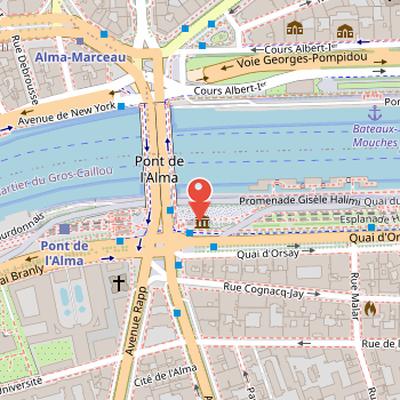
The museum is located along the Seine under the Bourguiba esplanade and along quai d'Orsay, and it introduces the Paris sewer network as a unitary, gravity-based system that is visitable and connected to daily usage. It also traces the history of sanitation in Paris, including past and present environmental issues.
The first space is named after Hugues Aubriot, provost of Paris merchants in 1370, who initiated the first vaulted sewer in Paris on rue Montmartre. A room follows that presents equipment, risks, and the role of sewer workers. The Bruneseau gallery is named after Pierre Emmanuel Bruneseau, Paris works inspector and creator of the Paris Sewer Service. Located under avenue Bosquet and crossed by a water canal, it displays historical sewer cleaning methods and addresses the main problem of sewers: cleaning and avoiding sedimentation.
An artificial gallery represents a simple sewer connection to a standard building. The extension of the Bruneseau gallery toward pont de l Alma shows the industrial site of the museum, including the Alma siphons, a pumping station, and the operation of a sewer network node managed by SIAAP. A collector named after the avenue it is under forms the junction point between the wastewater networks of the 7th and 8th arrondissements, and it precedes the Galerie Belgrand basin.
The Galerie Belgrand is named after Eugene Belgrand, engineer and deputy of Haussmann, and director of Paris water and sewer service. It presents various cleaning tools and valves for sewer maintenance, including cleaning balls used until the 2000s. The gallery named after Adolphe Mille, promoter of agricultural purification of sewage water, presents vegetable farming favored by fertilizer from Paris sewers at Asnieres, Acheres, and Bondy, as well as sewer regulation, control of water quality, and wastewater treatment in the Paris area.