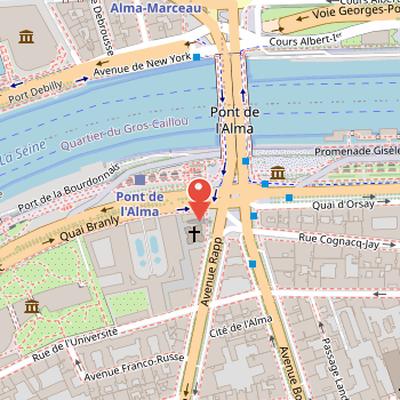
Situated on a 4.2-thousand-square-meter site in Paris's VII district, the Holy Trinity Cathedral complex consists of four buildings forming the Russian spiritual and cultural Orthodox center. Established on land purchased by the Russian government, the site lies close to prominent landmarks such as the Eiffel Tower, Branly Museum, Grand Palais, and the Paris Museum of Modern Art. Following Patriarch Alexy II's 2007 visit and subsequent discussions with the French government, the construction was approved to address the needs of Orthodox worshippers in Paris. The complex aims to provide both religious and cultural functions while harmoniously integrating into the surrounding urban environment. Ten architectural proposals, including Russian and French collaborations, were reviewed to ensure a design respectful to the locale and heritage.
Nearby Objects
-
 Paris Sewer Museum 130 m away
 -
 Paris sewers 130 m away
 -
 Le Zouave 200 m away
 -
 Place Diana 250 m away
 -
 Flame of Liberty 250 m away
Location and Composition of the Holy Trinity Cathedral Complex
The Holy Trinity Cathedral complex comprises four buildings, collectively known as the Holy Trinity Cathedral and the Russian Spiritual and Cultural Orthodox Center. Situated on a 4.2 thousand square meter site in the VII district of Paris, the complex occupies land acquired by the Government of Russia. Its location is notable for its proximity to major Parisian landmarks, being only a few hundred meters from the Eiffel Tower and close to institutions such as the Branly Museum, the Grand Palais, and the Paris Museum of Modern Art.
Church of the Three Holy Hierarchs: History and Usage
The Church of the Three Holy Hierarchs, located on Petel Street, was opened in 1931. Following the fall of the Iron Curtain, the church ceased to accommodate all worshippers, reflecting changes in its usage and capacity. Despite this, daily worship services continue to be conducted at the church. The broader context of Orthodox religious presence in Paris includes efforts by Patriarch Alexy II, who in October 2007 visited France officially and addressed the needs of Orthodox Parisians. During this visit, he met with President Nicolas Sarkozy and requested permission to build a new Orthodox cathedral in Paris, indicating ongoing developments in the community's religious infrastructure.
Site Selection and Project Planning
After receiving consent from the Presidents of Russia and France, the search for a location for the new center began, although it progressed slowly because French authorities initially could not propose a suitable plot. In March 2009, V. I. Kozhin signed the documents for Russia's acquisition of land intended for an Orthodox church and cultural and spiritual buildings. The purchase amount was not disclosed by mutual agreement, though influential French newspapers, including Figaro, reported a figure of 60 to 70 million euros. In October 2009, French authorities offered for sale a one thousand square meter plot on the Branly embankment. The site included meteorological service buildings designated for demolition. The construction agreement was confirmed by Dmitry Medvedev and Nicolas Sarkozy, and on June 11, 2010, Vladimir Putin and Francois Fillon visited the future Russian spiritual and cultural center site in Paris. The project was planned to include a cathedral and a spiritual and cultural center on the same territory. It was intended to serve as a link between Russia and France and to blend into the surrounding urban landscape. Ten final designs were selected, including two Russian-French projects, four Russian projects, and four French projects, and all were presented to Nicolas Sarkozy, Russian leadership, and Patriarch Kirill of Moscow and all Rus.
Design and Setting
Holy Trinity Cathedral was planned as a laconic white volume, complemented by a bell tower at the main corner and glass domes that would glow golden at night. The project embraced architect Nunez-Yanovsky's idea of the Russian Orthodox church as a city prototype, combining the cathedral with a surrounding garden and adjacent religious-cultural center. The garden was envisioned with birches, rowans, willows, maples, and lindens, beginning in front of the church and rising in terraces along the administrative buildings.
The design also called for transparent walls that would reveal the palace's side facade on the adjacent lot, and for a glass canopy covering the garden surrounding the church. In addition, a glass cover was intended to enclose the entire building, including the cathedral, and to appear suspended above the church and garden. This cover was meant to symbolize the Protection of the Mother of God. The glass was equipped with a self-cleaning thin water film over its entire surface, and solar panels were installed on the facade to heat water in winter.
The cathedral was to be made of white stone, brought from Russia despite its availability in France, and the bells were also planned to be cast in Russia.
Planning and Construction of Holy Trinity Cathedral
The Holy Trinity Cathedral project was announced in January 2012, when Russian Prime Minister V. V. Putin stated that construction would begin with the French company Bouygues. Its funding was allocated from the budget of the Russian Federation. According to Vladimir Kozhin, the Orthodox center was planned for completion within one year, while other records state that the construction period was estimated at about one and a half years, with completion expected by late 2015.
The application for construction of the Orthodox center was reviewed by Paris City Hall in 2012. The project then encountered strong criticism. Paris Mayor Bertrand Delanoe disliked the winning design, saying it spoiled the appearance of the embankment. Representatives of the Western European Exarchate of Russian Parishes of the Constantinople Patriarchate also opposed it. Other criticism focused on the project and construction not corresponding to the spirit of Orthodoxy and on what was described as excessive ambitions of the Russian Church. French Minister of Culture Aurelie Filippetti criticized the cathedral's size and construction risk, saying it threatened nearby buildings. Paris police also raised concerns about potential attacks from the cathedral terrace on the adjacent Alma Palace.
Russian ambassador Alexander Orlov asked French authorities to suspend the project review in November 2012. A construction permit was signed by Paris prefect Jean Dobigny on December 25, 2013, and the project was officially presented in January 2014. The construction work began on July 15, 2014, and separate calculations were required to prevent flooding of the Russian Orthodox Cultural Center on the Seine embankment. The complex laying ceremony was announced for June 6, 2014, and Bishop Nestor led the cathedral laying ceremony on April 14, 2015.
Legal Protection of the Construction Site
In summer 2015, former Yukos shareholders reportedly referred to French court exequatur on international rulings in an effort to claim Russian properties. On June 24, 2015, a Paris court judge decided that the construction site had diplomatic immunity. The same period also saw the French parliament pass an amendment to government property law intended to strengthen protection for foreign assets. The Russian Federation was not mentioned explicitly in the new law, although French media referred to the amendment as the Putin amendment.
Crosses and completion plans
On March 19, 2016, five crosses were ceremonially consecrated for the domes of the Cathedral of the Holy Trinity, and a large cross was installed on the main dome. The design and project for the crosses were carried out by the Russian company ZAO Innovative Construction Management (ICM), working in partnership with the French company Bouygues. In the same period, Sergey Prikhodko, head of the Russian government apparatus, estimated the cathedral's design and construction cost at 90 million euros. Completion and commissioning of the center were planned for autumn 2016, while the internal decoration was expected to take about two years and be funded mostly from off-budget sources.
Opening and Consecration
The official opening of the Russian spiritual and cultural center on the Branly embankment took place on October 19, 2016. The ceremony was attended by Russian Culture Minister Vladimir Medinsky, Paris Mayor Anne Hidalgo, Russian Ambassador Alexander Orlov, Bishop Nestor (Sirotenko) of Korsun, Bishop Anthony (Sevryuk), head of the Moscow Patriarchate's overseas institutions, and other guests. The cathedral then received its consecration on December 4, 2016, when Patriarch Kirill led the service at Holy Trinity Cathedral in Paris. Clergy from the Moscow Patriarchate took part, along with representatives of the Constantinople, Antioch, and Romanian Orthodox Churches. The service was broadcast live on the French Catholic channel KTO and the Russian Orthodox channel Soyuz, and large screens outside the cathedral allowed people who could not enter to watch. The cathedral was also linked to wider diplomatic tensions in the period before its opening. Presidents Francois Hollande of France and Vladimir Putin of Russia had been expected to present the cathedral, but the Russian president's visit to France was canceled after worsening Franco-Russian relations. French authorities proposed downgrading the visit to a Syrian issue working group meeting, and the Russian side then canceled the trip. Vladimir Putin later visited the Russian spiritual and cultural center during his France visit on May 29, 2017.