The Paris sewers form an underground network for collecting and evacuating runoff water and wastewater. Over centuries, Parisians developed this system in response to the city’s hydrological conditions, shaped by the Seine river and its springs. Historical descriptions also link the sewers to the urban image of dark, foul-smelling places in literature, including Les Misérables in 1832. The system changed significantly under Prefect Haussmann and engineer Eugène Belgrand, who developed the contemporary Paris sewer network and directed the doubling of all streets by an underground gallery.
Earlier sewer routes reflected the city’s terrain and waterways. Some carried water toward the Bièvre, while others drained into the Seine. Records from the 14th and 15th centuries describe diversions, masonry canals, and routes that crossed moats and former stream beds. These early sewers were entirely uncovered in places. Today, the Paris sewers can be visited at the Sewer Museum, where they remain part of the city’s urban heritage.
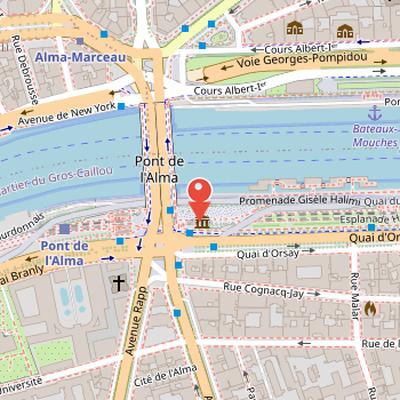
Nearby Objects
-
 Paris Sewer Museum 0 m away
 -
 Holy Trinity Cathedral 130 m away
 -
 Le Zouave 140 m away
 -
 Flame of Liberty 200 m away
 -
 Place Diana 200 m away
The Paris Sewer Network
The Paris sewer system is an underground network used to collect and evacuate runoff water and wastewater. It has often been described in literature as a dark and foul-smelling place, including in Les Miserables in 1832. The system changed significantly through the works of Prefect Haussmann and engineer Eugene Belgrand, who developed the contemporary Paris sewer network. Under their direction, all streets in Paris were doubled by an underground gallery. The sewers can now be visited at the Sewer Museum.
Hydrological Setting of the Sewer Network
The history of the Paris sewers is closely linked to the citys hydrological setting, which shaped the network over centuries. The Seine river and a springs system gave Paris distinctive water circulation characteristics. A Seine meander formed a semicircle north of modern Paris, beginning near the east of the arrondissement and passing near Bastille, Republique, Gare Saint-Lazare, before rejoining the Seine at Pont de l'Alma. Waters from the east of Sainte-Genevieve mountain, as well as from the Saint-Victor and Saint-Marceau suburbs, flowed toward the Bièvre following the slope of the terrain. Waters from the north and west of Sainte-Genevieve mountain and from Saint-Germain-des-Pres drained into the Seine through several sewers.
The Development of the Paris Sewers
Histoire records that the Paris sewer network developed through a long series of diversions, coverages, and masonry works that changed both its routes and its appearance. Around 1356, under King Jean II le Bon, sewer waters from Porte de Buci to Tour de Nesle were diverted into the city moats. These waters followed a vaulted sewer that began near the Ecole de medecine and emptied into the Seine below Palais des Arts. Another sewer collected waters from the area north-east of Saint-Gervais church to near Saint-Paul church, running along Rue Saint-Antoine from Birague fountain. It discharged into the Seine at the egout du pont Perrin near the current Rue du Petit-Musc, then into the Bastille moats after Charles V's enclosure was built. Its proximity disturbed French kings passing Hotel Saint-Paul, their residence.
In 1412, this sewer was diverted northward via Culture-Sainte-Catherine, Rue de l'Egout-Sainte-Catherine, and Rue de Saint-Louis at the present Rue de Turenne, then turned west along the Temple enclosure walls. It crossed the city moat at Porte de Temple through a masonry canal and entered beyond the moat through an opening at the counterscarp into the bed of the former Ménilmontant stream. Histoire also notes a canal collecting waters from quarters east of rue du Temple, which received another sewer from rue Saint-Denis near couvent des Filles-Dieu. This second sewer followed the current rue du Ponceau, crossed rue Saint-Martin, and extended to the area of the current Rue Notre-Dame-de-Nazareth, where a passerelle gave its name to passage du Pont-aux-Biches before the sewer entered the fosses. Both sewers were entirely uncovered.
Other routes were gradually built or transformed. Waters from the quartier des Halles crossed rue Saint-Denis and followed rue du Cadran to the sewer of rue Montmartre. That sewer, built in 1374 by prevot Hugues Aubriot, was the first vaulted underground masonry sewer. It continued as an uncovered ditch beyond the enceinte along rue du Faubourg-Montmartre and emptied into the grand egout near the current rue de Provence. By 1636, Paris had twenty-four sewers. Histoire says they clogged with mud and waste because of a lack of maintenance and gave off horrible odors.
Several sewers were later covered or diverted. The sewer of rue du Ponceau was covered in 1605 by Francois Miron, and the sewer of rue Turenne was covered at the beginning of the 17th century. In 1634, the sewer flowing from rue Saint-Martin to rue du Temple was covered and diverted under rue Neuve-Saint-Martin by a gallery under bastion Saint-Martin. It then passed through the current passage du Pont-aux-Biches and boulevard Saint-Martin to join the grand egout near the current rues de Lancry and du Chateau-d'eau. The sewer of rue Vieille-du-Temple was vaulted in 1619 up to rue des Filles-du-Calvaire and extended in 1619 to the fosses du rempart, then reconstructed in 1718. The sewer of rue du Faubourg-Montmartre was covered at the beginning of the 18th century.
Later works extended vaulted sewers under major spaces and roads: under Ecole Militaire in 1754, under Champs-Elysees and place de Concorde at the same time, and under rue de Rivoli under the First Empire. Until the early 19th century, sewers south of a line following streets Saint-Antoine, Rue Saint-Honore, Palais-Royal, and rue de la Chaussee-d'Antin drained directly into the Seine, while those north of this line drained into a single belt sewer. This belt sewer began opposite church Saint-Paul, followed rue Saint-Antoine eastward, turned north under the current rue de Turenne, and was covered in its first section at the beginning of the 19th century. It joined the ruisseau de Ménilmontant, passed under porte du Temple at the current place de la Republique, then under Boulevard des Filles-du-Calvaire and boulevard du Temple, parallel to rue des fosses du Temple at the location of the old rempart ditch. The ruisseau de Ménilmontant followed the locations of the current rues du Chateau d'Eau, des Petites-Ecuries, rue de Provence, La Boetie, and Marbeuf, emptied into the Seine near the current pont de l'Alma, and was canalized in 1740 and covered from 1760 onwards.
Expansion and Modernization of the Paris Sewer Network
At the beginning of the 19th century, sewers in Paris were still very few in number, and there was no network covering the whole city. Urine and feces were collected in poorly sealed cesspools, which contributed to the degradation of the most superficial groundwater and to the pollution of well waters. These cesspools were regularly emptied by emptiers, and the fecal matter was transported to roadways such as Montfaucon at the foot of Buttes-Chaumont, where it dried before being resold to farmers as fertilizer.
The great cholera epidemic of 1832 became a triggering event for a large sanitation operation, the first since the Roman period. At that time the sewer network was very limited and poorly known by the administration, which did not possess plans. Pierre Emmanuel Bruneseau, city works inspector of Paris, created a map and attempted cleansing of the network. Victor Hugo later honored him in several chapters of Les Misersables. In 1832 and 1833, one third of the existing sewers were created.
From 1820, sewers were built with ovoid sections in meuliere and cement, with less thickness than the previous massive stone rectangular bases. These new sewers had sufficient height for standing circulation and facilitated cleansing. At the same time, roadways were progressively redesigned from V-shaped channels to convex pavement with sidewalks and side gutters. Fire hydrants were established at block tops and opened twice daily for gutter watering and street cleaning, while water was directed to the sewer by drains located under sidewalks at low points instead of grates in the middle of intersections. Even so, improvements under the Restauration and July Monarchy remained insufficient, and by the mid-19th century sewers overflowed during showers and most streets still lacked sewers.
A larger sanitation project began in 1854 under the influence of Prefect Haussmann and the work of Eugene Belgrand. Collectors were installed under newly opened avenues, and the grand sewer was replaced by three large collectors under the Second Empire and five around 1900. The Biere river, which had served as the main sewer of eastern Left Bank neighborhoods until the mid-19th century, was diverted into large collectors. Later, Eugene Poubelle's 1894 decree required buildings to discharge household wastewater and excrement into sewer networks, helping to establish an all-sewer system that eliminated cesspools and their periodic emptying, along with unsanitary streets. Sewer discharge no longer emptied into Paris but downstream at Clichy, and Left Bank sewer networks joined at Pont de l'Alma before passing under the Seine via a siphon. Because sewer discharge polluted the Seine, Haussmann's successors began implementing sedimentation basins at Clichy in 1878.
Sewage Spreading and Treatment
Histoire describes spreading systems first established at Asnieres and Gennevilliers. From 1895, emissaries extended the system to Acheres, where sewer water was spread on fields at Acheres, Pierrelaye, and Triel-sur-Seine. In 1930, the first sewage treatment plants were established. The most important of these was the Acheres plant, named Station d'epuration Seine Aval. Other treatment stations were located at Valenton, Noisy-le-Grand, and Colombes. The city of Paris also houses a non-potable water supply network used for municipal services. Histoire additionally records an escaped crocodile that took refuge in the sewers in 1984, before authorities captured it quickly.
Structure and Operation of the Paris Sewer Network
The Paris sewer network, known as the reseau, is a unitary system that carries rainwater and wastewater in the same pipes. It operates mainly by gravity, with flow moving from east to west along the Seine valley. Five emissaries send wastewater to the Acheres plant west of the city center, while a sixth emissary sends part of the water to the Gresillons plant in Triel-sur-Seine.
The network extends through 2,400 kilometers of galleries that are accessible and maintained by sewer workers. Its management relies on the TIGRE computer system, which centralizes information on the physical state of the network. Sewer workers inspect each part of the system at least twice a year using portable terminals. Different cleaning methods are used according to the type of gallery: five-ton boat-shields secured by chains scour deposits in the main collectors, while wagon-shields clean narrower secondary collectors by riding on side benches.
The network also includes siphons that carry wastewater under the Seine, including at Pont de l'Alma and Pont de la Concorde. These siphons are cleaned either with balls or by stopping pumps so blockages can be removed manually. In deeper and wider collector sections called desanding basins, heavy solid particles known as batard settle before the deposits are periodically pumped out. In the narrowest galleries, flushing reservoirs clean the pipes by releasing water.
Stormwater is another major concern because it carries atmospheric pollutants and runoff from roofs and streets that must be treated before discharge. Large volumes of additional water can saturate the network and treatment plants and cause flooding in low areas. During heavy storms, sewer flow can reach the average flow of the Seine River. As an emergency measure, storm overflow outlets in the Seine can be used under authorized discharge declarations under the Environmental Code. Excess water can also be stored upstream in three reservoir tunnels and eight basins, with a combined capacity in the Paris region in 2011 of nearly 2,000,000 cubic meters. The Ivry Massena Tunnel, excavated between 2004 and 2009, is the most recent and largest stormwater reservoir in Europe. Located 30 meters beneath the 12th and 13th arrondissements, it is 6 kilometers long, 6 meters in diameter, and can store 180,000 cubic meters of water.
The sewer environment has limited biodiversity, with mainly fungi, brown rats, cockroaches, spiders, and a dwarf grasshopper. Stormwater and wastewater collection and transport on Paris city territory are managed by Paris City Hall and intercommunalities.
Management and Scale of the Paris Sewer Network
Since 1970, wastewater sanitation in Paris and surrounding areas has been ensured by SIAAP across Hauts-de-Seine, Seine-Saint-Denis, Val-de-Marne, Paris, and 180 communes in Ile-de-France. In 2009, the network discharged waters into SIAAP's interdepartmental emissaries and comprised 2,400 kilometers of sewers, including 1,900 kilometers managed by SIAAP and 500 kilometers co-managed with the departments. The system serves approximately 9 million inhabitants in the Ile-de-France region. SIAAP transports an average of 2.3 million cubic meters of wastewater each day, or 840 million cubic meters annually, for treatment in five plants. It also uses pretreatment plants in Clichy, La Briche, and Charenton. In total, SIAAP operates five treatment plants and employs 848 people, including 500 staff members.
Maintenance and Employment of the Paris Sewers
Under the Ancien Regime, the sewer workers known as les egoutiers were not supervised directly, and the city relied on private contractors to clean and repair sewers when needed. A 1721 decree of the Paris Parliament made adjacent property owners reimburse sewer cleaning costs. Before a plan drawn up in the 1830s, the locations of the sewers were poorly known. Maintenance remained subcontracted until the Prefecture of the Seine took charge in 1859.
The number of les egoutiers grew with the expansion of the modern network. There were 26 in 1824 and 90 in 1849, then 276 in 1865, 627 in 1873, 900 in 1885, and 945 thereafter. By the end of the 1970s, they numbered about 786 in total, including 108 chief egoutiers and 678 egoutiers. Numbers then declined from 1983 to 1984 because recruitment was limited, reaching about 300 around 2010.
Les egoutiers were civil servants of the Prefecture of Police from the First Empire until Haussmann's era. Until the 1880s, they were recruited by foremen who led teams of 11 or 12 workers, and applicants had to pass thorough medical exams. In 1879, they were divided into commissioned workers on daily duty, numbering 250, and auxiliaries called in as needed, numbering 330. Team leaders were accused of favoritism in hiring. Later, les egoutiers formed the first municipal employees' union and obtained a new recruitment system based on a registration number, family preference, and a guarantee of job stability.
Working conditions also changed over time. The daily wage rose from 2.25 F around 1840 to 3.75 F around 1880 for 12-hour workdays, and around 1900 it was 5.60 F for an 8-hour workday. They obtained full payment for sick days in 1893 and the 8-hour workday in 1899.
Work and Maintenance in the Paris Sewers
From the mid-19th century to the late 1970s, les egoutiers worked in teams of 5 to 8 men. These teams maintained and cleaned sewer sections averaging one-fifth of an arrondissement, and their work organization gave them good surveillance over familiar sectors as well as flexibility in daily management. This autonomy also encouraged solidarity and a resistance to bureaucracy. After 1977, however, they lost much of this independence because the city resumed recruitment and organizational changes were introduced following an unsuccessful strike in 1977.
Their tasks were divided into three categories: inspection, flushing, and sand extraction. Workers moved between neighborhoods by van and their activities were recorded by computer and managed by a central computer. In earlier practice, les egoutiers used a 2-meter long tool called a rabot with a right angle iron, developed wooden plank dams across sewers to flush out debris when the planks were lifted, and removed sand mixed with organic matter using shovels and chains of buckets, leaving large piles of debris on the surface.
The work also involved significant hazards. Les egoutiers were exposed to fauna such as rats, centipedes, and spiders, and since the late 20th century they have also been exposed to toxic products. In 2010, their life expectancy was 17 years lower than that of the general French population and 7 years lower than that of manual workers.
Sludge Reuse and Sewer Heat Recovery
The treatment of wastewater in Paris produces sewage sludge, called boues, which is reused after water purification. Débouches describes sludge output as an average quantity per cubic meter of wastewater treated, and identifies three main uses: as fertilizer, as fuel after drying, or for landfill. Fertilizer use includes spreading the sludge on fields around treatment plants or reselling it in pellet form. Energy recovery from sludge takes several forms: direct incineration at the Seine Centre and Marne Aval plants, conversion into fuel pellets at Seine Gresillons and Seine Amont, and collection of methane gas from sludge digesters as biogas for energy at the Seine Aval plant. Débouches also notes plans to co-methanize sludge with organic waste at the future Seine Moree plant.
In parallel, Paris and CPCU have experimented since 2010 with recovering heat from sewers. Since 2011, this heat has been captured through heat pumps and exchangers and fed into heat networks serving schools. Other heated facilities include pools, gyms, and administrative buildings. The recovery circuits are fully sealed for hygiene purposes. Débouches also mentions similar successful heat recovery systems in Levallois-Perret and Nanterre.
Public Access and Services
Autres services manages public access to the Paris sewage system on the left bank of the Seine near pont de l'Alma. It also operates the museum of sewers, which welcomes nearly visitors per year, and provides information on the history and operation of the Paris sewage network along the tour. In addition to visitor services, Autres services offers a free object recovery service for items lost in sewer entrances. The organization also maintains the sewer emergency service, reachable at 01 44 75 22 75 or via Paris city hall at 3975. Each year, it carries out up to interventions related to object recoveries, flooded basements, and suspicious odors.