Temple Neuf is a Protestant church on the Grande Île of Strasbourg and is affiliated with the Union of Protestant Churches of Alsace and Lorraine (UEPAL). The building was constructed after the fire of 24 August 1870 destroyed the old Dominican church that had stood on the site. The traditional spelling is Temple Neuf, with two capital letters and no hyphen.
The site has a long religious history. Dominican brothers settled in Strasbourg in 1224 and later established themselves at the present Temple Neuf location, where they built a convent and church from 1254. The church was consecrated in 1260. In the 13th century, the convent became a center of Rhenish mysticism and welcomed thinkers such as Meister Eckhart and Jean Tauler. The building history of the church reflects both its importance in Strasbourg and the successive changes in the city’s religious life. After Strasbourg adopted the Reformation, the convent was transformed into a place of education.
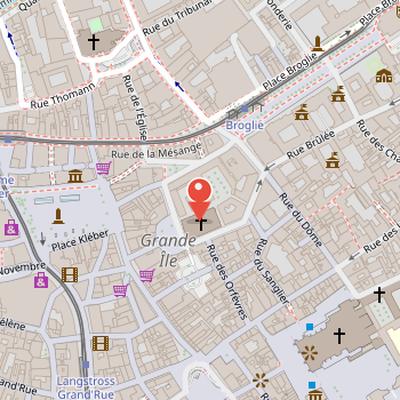
Nearby Objects
-
 Place Broglie 200 m away
 -
 Place Kléber 200 m away
 -
 Statue of Jean-Baptiste Kléber 200 m away
 -
 Le Cosmos 200 m away
 -
 Argentoratum 200 m away
Temple Neuf on the Grande Ile
Temple Neuf is a Protestant church affiliated with the Union of Protestant Churches of Alsace and Lorraine (UEPAL). It is located on the Grande Ile of Strasbourg. The building was constructed after the fire of August 24, 1870, which destroyed the old Dominican church. That earlier church had housed the Protestant parish of the Cathedral in 1681. The traditional spelling of the name is Temple Neuf, with two capital letters and without a hyphen.
Dominican Foundations at Temple Neuf
The site of Temple Neuf was occupied by Dominican brothers who had settled in Strasbourg in 1224, in a sparsely inhabited marshy district, before establishing themselves in the city center at the present location of Temple Neuf. From 1254, they built a convent and a church there, and the church was consecrated in 1260. In the 13th century, the convent became an important center of Rhenish mysticism and welcomed prominent thinkers such as Meister Eckhart and Jean Tauler. The Dominicans also had stormy relations with the cathedral chapter, city clergy, and the population, and a riot in 1287 forced them to leave Strasbourg temporarily. They returned in 1290 without yielding to city demands.
The church was enlarged in 1311 and 1312 with the support of Pope Clement V, and the work, begun in 1308, was consecrated in 1345. The enlarged building had a double nave and an original design, and it became the second largest church in Strasbourg after the cathedral. It also strongly influenced the spirit of Strasbourg inhabitants. After Strasbourg adopted the Reformation, the convents gradually closed, and the last four Dominicans left in 1531. The convent buildings were then transformed into a place of education, and Jean Sturm inaugurated the Haute Ecole there in 1538. This institution later became the University of Strasbourg.
From Protestant Refuge to Lutheran Consistory
According to Histoire, the church choir was used for French worship by Protestant refugees from France and the Spanish Netherlands, and Jean Calvin served as the first pastor of the choir from 1538 to 1541. During this period, the nave remained unused, but in 1546 the Strasbourg Magistrate used it as a warehouse for weapons, ammunition, and provisions. After Emperor Charles V imposed an Interim following his victory over the Protestant army in 1547, the cathedral was returned to the Catholic bishop for ten years, from 1549 to 1559. The Protestant parish that had previously met at the cathedral then received the former Dominican church. When Protestant worship returned to the cathedral in 1561, the church was closed and then used for about 120 years as a warehouse for various city construction materials.
The church reopened in 1681, when Louis XIV imposed the return of the cathedral to Catholic worship. It again served Protestants under the names Prediger-Kirche or Neue Kirche. Histoire describes the building as being in a great state of disrepair at that time, but notes that it was made usable quickly through donations and artisans working at reduced or free cost. A wide range of services was held there, including official ceremonies such as the funeral of Marshal de Saxe. The choir also housed the personal library of Jean-Daniel Schoepflin, as well as correspondence and an archaeological collection left to the City of Strasbourg. The Neue Kirche was ranked first among seven Lutheran parishes in Strasbourg, and its main pastor was always president of the Convent of city pastors. The church had no patrimony, and its maintenance was managed by Oeuvre Notre-Dame, which also covered pastor salaries, employee costs, and worship expenses.
During the Revolution, all worship was banned. The church was requisitioned for national defense, emptied of ornaments and furniture, and converted into a wheat barn. Pastors Blessig, Eissen, and Oertel of Temple Neuf were declared suspects or imprisoned in the Grand Seminary. After Robespierre's overthrow on 27 July and execution the next day, parishioners regained possession of the church after a complete cleaning. In 1802, the Lutheran church was granted the privilege of a Consistory alone because it had 27,000 registered members, and it remained a Consistory until 1994. Jean Laurent Blessig served as the first pastor until 1816, also acting as inspector and Directoire member, and a funerary monument by Landolin Ohmacht was installed for him in the church. By decree of 3 frimaire an XII, Oeuvre Notre-Dame continued to participate annually in worship and building maintenance.
Ceremony, Education, and Wartime Loss
Temple Neuf appears as a setting for official ceremonies, including the Gymnase tricentenary and the inauguration of the Gutenberg statue in 1840. Its religious life also featured sacred chant prominently through the work of Theophile Stern, who was active between 1803 and 1886 and performed many oratorios, including Haydn's Die Schopfung and Victor Elbel's Der Munsterbau. The church maintained a parish school until 1833, when schools became municipal. Jean Friese taught there from 1790 to 1806 and published works on pedagogy, literature, and history; he also prepared reading, moral poetry, arithmetic, and simplified astronomy materials for Temple Neuf students. During the war of 1870 between France and the German states led by Prussia, the conservator asked Strasbourg mayor Theodore Humann to secure the collections at the outbreak of hostilities, but the request was refused. Temple Neuf was then hit directly by shells during the Strasbourg bombardment on the night of 23 to an unspecified day, and its library, including the Hortus deliciarum by Herrade de Landsberg, was destroyed.
Reconstruction and Later Use
The church at Histoire became dilapidated after bombardment, which led to the decision to demolish it and rebuild. In 1871, the German government pledged an indemnity for the reconstruction, and architect Emile Salomon was appointed to establish the competition program. Salomon proposed a neo-Romanesque sanctuary inspired by paleo-Christian basilicas. The competition jury included Emile Boeswillwald, Gottfried Semper, Charles Auguste Questel, and four members of the Consistory. Thirty-five architects entered the contest, and five projects, including Salomon's, received prizes. The Consistory then commissioned Salomon to prepare the final reconstruction project.
Temple Neuf became known as the Temple de Salomon because of this project, although it also retained the names Eglise neuve and Neue Kirche in German. Construction began with the Salomon project and faced technical challenges because the terrain was unstable and required excavation to a depth of ten meters to secure the enclosure walls. The first stone was laid, and the project was inaugurated after three and a half years of work. The bell tower was inaugurated eleven years after the main opening. Jules Sengenwald financed the bell tower and the white stone chair, and Louis Stienne created a bust of Jules Sengenwald in the church.
Since 1945, demographic erosion has affected the parish as population movements shifted from the city center to the outskirts. The number of members declined to about 3000 in recent years, compared with four pastoral positions at the start of the century and one pastor today. In 2014, Temple Neuf was transformed into an open church during the week for passersby, offering rest and Christian discovery. It also hosts many concerts and has an important musical role.
Architecture and Interior of Temple Neuf
Temple Neuf is built of Vosges sandstone and follows a rectangular basilica plan without an apse. Its interior has a somewhat Byzantine aspect, especially at the galleries. The nave is long, wide, and high, while the collateral aisles are almost as high as the main nave and are supported by pillars. The aisles are intersected by galleries at a certain height, creating an interior composition that contributes to the building's distinctive spatial character.
The facade is strongly vertical in its lines and is surmounted by a tower. It is organized into three central compartments corresponding to the nave and two side compartments corresponding to the collateral aisles. A rose window with eight small columns below the tower marks the open sectors, and two more modest roses appear above the lateral compartments. The facade design also echoes at the back of the main nave.
Behind the nave, the building includes several rooms and meeting places, as well as the Tauler room, which is arranged for receptions on the upper floor. The interior furniture includes an altar surmounted by a white stone pulpit, and the Merklin organs, restored in 2009. Temple Neuf also contains several funerary monuments, including the tomb of Jean Tauler, the tombstone of auxiliary bishop Ortwein who died in 1514, two monuments by the sculptor Landolin Ohmacht dated 1760-1834, the monument for pastor Blessig who died in 1816, and the monument for Directoire president Bernard-Fr ed ric de Turckheim who died in 1831.
The Organ of Temple Neuf
The organ at Temple Neuf replaced the instrument by Jean-Andre Silbermann, which was destroyed during the war of 1870. It was constructed in 1877 by the builder Joseph Merklin and inaugurated by Alexandre Guilmant. The organ has 45 stops distributed over three keyboards and one pedalboard. Its case is listed on the Inventaire supplementaire des monuments historiques, while the instrumental part is classified as a historical monument. In 2019, the organ was restored by the manufacture Bluemenroeder in a project that required more than 9000 hours of work. The titular organists are Zoe Schade, Gilles Oltz, and Sayaka Hayano.