Saint-Pierre-le-Jeune Protestant Church is a Lutheran place of worship located at Place Saint-Pierre-le-Jeune in the historic center of Strasbourg, Bas-Rhin, in the Grand Est region of France. It has been a Lutheran church since 1524, when Wolfgang Capiton preached the Reformation there. The building was classified as a historical monument in 1862.
The site has a long religious history. A wooden chapel stood here at the end of the 6th century, probably built by Irish monks and dedicated to Saint Columban of Bangor. It originally served as an oratory for artisans, horticulturists, and servants along the Roman road between Strasbourg and Trier, in an area then outside the city walls. A second church was built around the year 1000, and the related chapter was later endowed by Bishop Guillaume. In 1682, Louis XIV restored the Catholic parish and divided the building’s use between Catholics and Protestants until 1893, when the separate Saint-Pierre-le-Jeune Catholic church was constructed. Charles de Foucauld was baptized in the baptistery at the front right of the church.
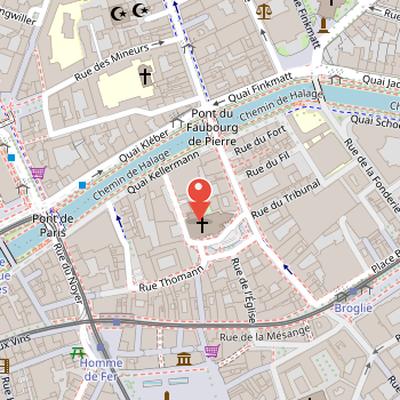
Nearby Objects
-
 Aubette 200 m away
 -
 Statue of Jean-Baptiste Kléber 250 m away
 -
 Place Kléber 250 m away
 -
 Place Broglie 250 m away
 -
 Temple Neuf 300 m away
History and Religious Use
Saint-Pierre-le-Jeune Protestant Church is a Lutheran place of worship located at Place Saint-Pierre-le-Jeune in the historic center of Strasbourg, in the Bas-Rhin department of the Grand Est region of France. The church has been Lutheran since 1524, when Wolfgang Capiton preached the Reformation there. In 1682, Louis XIV restored the Catholic parish and assigned the choir to Catholics and the nave to Protestants, so the two communities shared the building until 1893, when the German-built Saint-Pierre-le-Jeune Catholic church was constructed. The church is also associated with Charles de Foucauld, who was baptized in the baptistery at the front right of the building. It has been classified as a historical monument since 1862.
Early Origins and Religious Role
At the current church location, there was already a wooden chapel at the end of the 6th century. It was probably built by Irish monks and dedicated to Saint Columban of Bangor, who came to France around 590 with companions and evangelized the region. The chapel stood in the middle of a cemetery outside the city walls, in what is now the Faubourg-de-Pierre area. It also served as an oratory, or Leutkirche, for artisans, horticulturists, and servants along the Roman road between Strasbourg and Trier.
The site had a wider charitable role as well. Nearby buildings functioned as a hospice for pilgrims, homeless people, orphans, and poor sick people. Around the year 1000, a second church was built there and was also served by monks. Later, the brotherhood of Saint Columban's monks was transformed by Bishop Guillaume into a venerable Chapter, which was endowed with rich properties. These early phases show the long continuity of religious use at the site before the present church.
Chapter Life and Influence
The Chapter of Saint-Pierre-le-Jeune began with eight canons, later rising to fourteen in the time of Bishop Guillaume's successor and reaching fifteen by the end of the Middle Ages. Over time, its canonries included 14 vicariates and 19 chaplaincies. At first, the canons lived communally under the rule of Saint Chrodegang, but about a century after the Chapter was founded, communal life was gradually abandoned. Each canon then had an individual residence, mainly near the church.
The Chapter was structured around several offices. The provost, appointed by the pope, administered the Chapter's property and represented it before civil and religious authorities. The dean, elected by the Chapter, maintained discipline and organized the offices. The custodian administered the parish, while the pleban under the custodian was the priest. The cantor trained young canons in singing and led the liturgy, and the scholasticus directed the Chapter's school. Other canons were responsible for facilities, material matters, and burials.
Religious life was intensive, with daily chanting of the canonical hours and anniversary masses for donors, offered for the release of souls from purgatory and for death anniversaries. The Chapter also maintained a school originally intended for future canons, but later open to all parish members, including poor children with scholarships. Some canons studied at major universities in Germany, France, and Italy, especially Bologna, and they specialized in law rather than theology. Religious and political authorities also entrusted canons with ambassador, arbitrator, mediator, and executor roles. Around 1500, the Chapter included notable humanists, among them a friend of Geiler.
At the end of the specified century, the Chapter reached its peak wealth and influence, with well-educated members, a well-run school, and a rich library that led the diocese's chapters. At the same time, some canons accumulated multiple prebends and no longer took part regularly in offices, while others became involved in public scandals related to morals.
Reformation and Confessional Change
The history of Saint-Pierre-le-Jeune Protestant Church was strongly marked by the Reformation and the confessional changes that followed. In 1518, indulgences were offered on the church forecourt by a cardinal staying at the provostship for four weeks. From 1519, Luther's writings circulated in Strasbourg and influenced the parish, while Matthieu Zell, the cathedral pleban, helped spread Luther's message in the city. In 1524, parishioners asked Wolfgang Capiton, provost of the Saint-Thomas Chapter, to replace priest Veit Kumbach. Despite opposition from the canons, the city magistrate appointed Capiton as pastor. The canons then left Strasbourg in secret, taking the precious objects from the Chapter's treasury, although the Chapter remained Catholic, kept ownership of the church walls, and continued to use the choir for solemn sessions and canon installations.
Under Capiton, the parish developed evangelical practices described as worship in the language of the people, with preaching and congregational singing. Communion was celebrated every fifteen days, and pastors were appointed by the City Council after consultation with the parish. Capiton also married Agn s Ulrich in 1524, taught catechism to children every Sunday with two colleagues, published the first Strasbourg catechism in 1527, and taught Hebrew courses while writing several biblical commentaries. Around 1540, the first Strasbourg catechism was replaced by Luther's Small Catechism. After Capiton died of plague in 1541, Paul Fagius succeeded him and established the Christliche Gemeinschaft within the parish in 1545-1546. This group was marked by stricter discipline, doctrinal training, and a form of sharing, but the experience lasted only a few years.
From 1549, the parish had about fideles and was served by three pastors, with a preacher added in 1661 for the Sunday evening service. A morning prayer service was celebrated daily in addition to Sunday services. Catholic worship was reintroduced in the church during the Interim from 1549 to 1559, and Fagius had to leave the city. Protestant worship resumed in 1561. After Strasbourg's annexation to France in 1681, the choir of Saint-Pierre church was assigned to Chapter celebrations and to a Catholic parish. In early 1683, the choir was separated from the nave by a large wall. The Chapter returned from refuge in Molsheim to Strasbourg, resumed its activities, and a Catholic parish again celebrated worship services in the choir.
Revolution and Nineteenth-Century Religious Currents
The history of Saint-Pierre-le-Jeune Protestant Church was shaped by both the French Revolution and later Protestant movements in Strasbourg. In the years before the Revolution, Lorenz, a theology professor, drew Strasbourg followers through a piety influenced by the Moravian Brothers and linked to Zinzendorf. His approach emphasized a heart religion, based on personal attachment to Jesus, while rejecting rigid orthodoxy and the reduction of faith to rationalism. Within the Chapter, Jean-Baptiste Denis de Regemorte emerged as a leading figure and served as royal praetor from 1752 to 1761.
The French Revolution first aroused enthusiasm among Strasbourg Protestants, and pastor Leonhard of Saint-Pierre-le-Jeune opposed the sacking of the City Hall. During the radical phase of the Revolution, all churches in the city were closed. In 1793, Saint-Pierre-le-Jeune was turned into a depot for straw and hay, while the faithful continued to gather at the inn of La Charrue for worship until an unspecified date. Bells and other cult objects were requisitioned, the Chapter came to an end, and the canons dispersed. Among them, François Louis Rumpler accepted egalitarian Revolutionary ideas, used his personal fortune to acquire the buildings of Mont Sainte-Odile, and hid the relics of Saint Odile during the Terror.
In the nineteenth century, three currents marked Alsace's Lutheran Church and the parish of Saint-Pierre-le-Jeune: old rationalism, which evolved into the liberalism that dominated the century, and pietism, which resurged through the Awakening led by François Haerter.
Confessional Renewal and Parish Leadership
Histoire presents the confessional Lutheran renewal at Saint-Pierre-le-Jeune Protestant Church as embodied by Frédéric Horning, who served as pastor from 1846 to 1882. His influence on the parish was liturgical, catechetical, and diaconal. He emphasized the Church as a community united by the confession of faith, reintroduced old hymns, and promoted a form of piety centered on justification by faith. At the same time, he distanced himself from liberal moralism, pietist activism, and pietist sentimentalism.
The parish was also shaped by his son, Wilhelm Horning, described in Histoire as a prolific historian. Wilhelm Horning founded Maison Bethlehem, a retirement home linked to the parish, and for a few years he also founded an orphanage in Cronenbourg. He further managed the church restoration at the end of the nineteenth century, linking the Horning family to both the pastoral life and the physical renewal of the church.
Parish Life and Restorations at Saint-Pierre-le-Jeune Protestant
After the Protestants reintegrated the entire church, including the choir, at Saint-Pierre-le-Jeune, the Catholic choir was considered too small, and Protestants opposed a simultaneum for both cults. Strasbourg city therefore decided to build a new Catholic church on the former Caserne Finkmatt site, and the caserne was demolished for that purpose. Between 1897 and 1901, Saint-Pierre-le-Jeune church itself was entirely restored for Protestant worship.
The parish life described for the church was marked by a plurality of communities and organizations. Three parish communities coexisted in the Protestant church until an unspecified date, and two Horning pastors served alongside other pietist or centrist pastors, including Emile Nied and Christian Hackenschmidt. In the last third of the 19th century, several parish choirs appeared, and from 1847 two deaconess sisters began work. The parish also had two parish newsletters, two parish sisters, two sewing groups, two youth groups, and two Sunday schools.
In 1918, parishioners of German origin and one pastor left Strasbourg, leaving two personal parishes, one pietist or centrist and one orthodox Lutheran. The parish was affected by World War II, and thirty parishioners died during a bombing. After the war, the number of parishioners decreased, and the parish was reorganized with a single sewing group, a single youth group, and a reduction from two pastors to one. The parish in the city center nevertheless continues to provide religious and cultural services supported by a dynamic core.
Interior Painting and Restoration
Saint-Pierre-le-Jeune Protestant Church combines several distinct architectural and decorative elements, including a neo-Gothic main portal, a Romanesque cloister, and neo-Gothic frescoes in the nave and north transept. Among the interior paintings are depictions of Jean Baptiste, Saint Colomban, and Saint Pierre on the north transept. The church also preserves a number of notable frescoes and painted motifs, including the Navicella, a scene placed high on the western wall of the nave. Better preserved than the paintings on the aisles, it shows apostles in a boat on the Sea of Tiberias seeing Christ walking on water, and its name refers to Giotto's mosaic in the atrium of the Basilica Saint-Pierre in Rome. Another painted feature is a banner on a blue background showing thirteen horsemen and two foot soldiers approaching a hill with a cross, together with the words O Crux ave, spes unica from the hymn Vexilla Regis. The church also includes a fresco illustrating the weighing of good and bad deeds at the Last Judgment, with the Devil pressing on one scale and an Angel counteracting him.
The interior paintings were covered by thick whitewash when the church passed to the Reformation, and this whitewash was renewed in 1707, 1753, and 1822. At the end of the 19th century, the layers of whitewash were removed in an attempt to restore the original decor. From 1897, architect Carl Schafer directed restoration work, drawing inspiration from the illuminations of the Codex Manesse and, through his master, from medieval art. A new phase of work began in 2014 and is planned to last about ten years. Restoration has been complicated by the overlap between medieval layers and the layers added during Schafer's restoration.
The Organ in Saint-Pierre-le-Jeune
The history of the organ at Saint-Pierre-le-Jeune reflects the coexistence of two religious communities over two centuries. The instrument is first mentioned in 1404. Organs were located in both the nave and the choir of the church. In the nave, the organ was successively installed in a swallow's nest, then on a tribune at the rear of the nave, and finally on the rood screen. The swallow's nest position was on the wall of the third bay of the nave on the north side. When the Reformation began at Saint-Pierre-le-Jeune in 1524, the nave was assigned to Protestants.
The Organ and Its Repeated Replacements
The organ at Saint-Pierre-le-Jeune Protestant Church underwent a long sequence of repairs, reconstructions, and replacements. After damage during the Peasants' War, the Magistrate asked the Chapter to repair it in 1591, and Hans Klein of Donauwoerth was assigned to the task. Further major repairs were carried out by Dietrich Wagner in 1608, including work on the wind chests, bellows, and some pipes. In 1642, Hans Jacob Baldner reconstructed the organ with a manual keyboard, pedalboard, and fifteen stops.
Maintenance later became a point of disagreement. In 1719, after the Chapter declined maintenance costs, the parish leased a positive organ from Andre Silbermann. This instrument was taken back by Silbermann in 1725 and placed in Rosheim, while Jean Andre Silbermann later transferred it to Grendelbruch in 1760, after which its whereabouts are unknown. In the same year, Joseph Waltrin built a new organ for the Chapter after a lawsuit at the Sovereign Council of Alsace in Colmar. This new organ also had a keyboard, pedalboard, and 15 stops, but its adequacy for congregational singing accompaniment became the subject of dispute between Catholics and Protestants.
The organ was transformed again by Johann Peter Toussaint in 1771, when it was moved from the swallow's nest to a wooden tribune in the last bay of the nave against the west wall. Toussaint dismantled it in 1779 to make room for Jean Andre Silbermann's organ, and transferred it to the choir of the Temple-Neuf. In 1780, the organ commissioned from Jean Andre Silbermann by the Chapitre was installed on the wooden gallery at the back of the nave. In 1805, it was moved to the mixed church of Vendenheim, where it served as a Protestant organ until 1895.
The Organ in the Church Interior
The organ at Saint-Pierre-le-Jeune Protestant Church underwent a long series of changes that altered both its structure and its placement within the building. Its original form had one keyboard, a pedalboard, and 16 stops. In 1820, Johann Conrad Sauer added the Positif de dos in Strasbourg. The organ was then maintained several times by Martin Wetzel, who carried out cleanings and repairs in 1850, 1852, and 1859, while Charles and Emile Wetzel also performed a new cleaning in 1859. The case bears the inscription Vive la Republique democratique et sociale 1852.
The instrument was damaged when lightning struck the bell tower, and Charles Wetzel repaired the case after the strike. He also modified the stop composition in the same period. Following the bombardment of Strasbourg in 1870, he replaced two Grand Orgue montre pipes. Between 1897 and 1902, Edmond Alexandre Roethinger transferred the organ to the jub in the course of church restoration, and the case received a choir-side facade reproduction together with polychrome paintings at the jub. In 1917, the montre pipes, including the facade pipes, were exempted from German military requisition.
A major transformation took place in 1925-1926, when Georges Schwenkedel worked on the organ for Zann and Cie in Bischheim. The stop composition was modified again, the action was converted to pneumatic, and a side console was placed on the left. The first electric blower was installed in 1926. At that stage, the organ consisted of a Grand Orgue with 12 stops, an expressive recit with 7 stops, and a pedalboard with 5 stops.
The organ was later rebuilt mechanically by Ernest Muhleisen in Strasbourg-Cronenbourg in 1949-1950. During this reconstruction, the Positif de dos was restored and an expressive Recit was added, resulting in 40 stops. The organ then had 41 stops on 3 manuals and a pedalboard, and its tuning was done by Alfred Kern, who was part of the Muhleisen company. Alfred Kern also made some modifications in 1966 for Helmut Walcha's Bach recordings. A thorough restoration by Quentin Blumenroeder in Haguenau followed from 2012 to 2014, after which the organ received an electronic combination system and comprised 42 stops on 3 manuals and a pedalboard.
The church also had earlier organ installations in the Saint-Jean chapel and the Catholic choir. A new organ was installed by Martin Wetzel in the Saint-Jean chapel in 1837, with one manual, 6 stops, and a pedalboard with 2 stops. It was later placed on a gallery supported by two iron pillars in 1854, had its bellows removed in 1884 and connected by Charles Wetzel to the Silbermann organ bellows, was dismantled by Edmond Alexandre Roethinger in 1897, and sold by him in 1900 to fund a new motor for the Silbermann organ blower. In the Catholic choir, the church had three successive instruments, the first of which was built by Joseph Waltrin from Strasbourg in 1711 and included a Grand Orgue, an Echo, and a pedalboard with 10 stops.
The Church Organ and Its Successive Instruments
The church's organ history reflects several major replacements and transfers. In 1762, the 1711 organ was moved to the Protestant church of Blaesheim, and a Jean Andre Silbermann organ was installed in its place. That Silbermann organ had a Grand Orgue, Echo, and pedalboard with 16 stops. It was later modified by George Wegman in 1837 and by Stiehr and Mockers in 1848. In 1862, Stiehr and Mockers rebuilt it, but by 1865 it was sold to the Soultz-les-Bains Catholic parish, where it remains. Also in 1865, the church replaced it with an organ by Stiehr and Mockers. This second organ was later sold to Sainte-Famille parish in Schiltigheim in 1899, then transferred in 1968 to a Catholic parish near Caen. In 1968, the church installed a new organ by Roethinger in Schiltigheim. The Silbermann organ was restored by the Kern company in 2007.
Rood Screen and Angel Chapel
Tourisme reports that Saint-Pierre-le-Jeune Protestant Church welcomes more than 80,000 tourists every year. It is described as a rare Protestant church that preserves its rood screen, a feature that Catholic churches removed after the Council of Trent in the mid-16th century. In the chapel at the back of the choir, there is a two-meter-high polychrome angel sculpture. According to Tourisme, this sculpture was placed at the end of the 19th century during the church renovation by architect Carl Schaeffer. The chapel has since become a passage place for many visitors, who leave prayer papers in the basin held by the angel.
Pastoral Succession
Marie-Joseph Bopp listed the pastors of Saint-Pierre-le-Jeune Protestant Church in the early 1960s, covering the period from the Reformation to the Second World War. He also recorded the second and third pastors separately. Among those named were Friedrich Theodor Horning, who served from 1845 to 1882, and Paul Wilhelm Horning, who served from 1882 to 1908. Philippe Eber is the current pastor of the church.