Musée des Beaux-Arts Jules Chéret is a municipal art museum in Nice, located in a villa in Neorenaissance style. The museum’s collection focuses on works by French artists of the 19th and 20th centuries. Its history is closely linked to the development of Nice as a French city after 1860, when the town had no art museum. Emperor Napoleon III suggested establishing one during a visit to Nice and arranged for art loans from state collections. The first works were shown in the municipal library on Rue Saint-François de Paule, before the museum moved several times as the collection grew. It occupied the former Villa Thomson, its current building, in 1928. The villa was originally commissioned in 1878 by Russian Princess Elisabeth Kotschubei and later completed for American James Thomson by architect Constantin Scala.
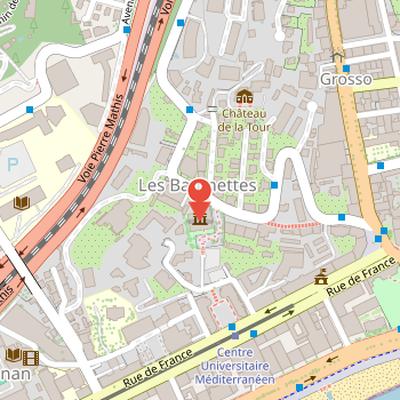
Nearby Objects
-
 Promenade des Anglais 400 m away
 -
 Église Saint-Pierre d'Arène 700 m away
 -
 Musée Masséna 800 m away
 -
-
 Russian Orthodox Cathedral 1100 m away
Museum Setting and Collection
The Musee des Beaux-Arts Jules Cheret is a municipal art museum in Nice. It is housed in a villa in the Neorenaissance style, giving the institution a distinctive architectural setting. The museum's collection focuses on works by French artists of the 19th and 20th centuries, reflecting a clear emphasis on modern French art within a historic building.
History of the Museum Building
When Nice became part of France in 1860 through the Treaty of Turin agreements, the city had no art museum. During a visit to Nice, Emperor Napoleon III suggested creating one, and he arranged loans of works from state collections to help form the initial display. The first museum presentation was installed in the municipal library on Rue Saint-Francois de Paule. As the collection expanded and space became insufficient, the museum moved several times. In 1875, the city rented a floor in Comtesse Rey Palace, and in 1892 the collection was transferred to a building on Rue Dubouchage. In 1901, it occupied a building on Avenue Notre-Dame, following a suggestion by Alexis Mossa, who directed the museum until his death in 1926. The museum moved again in 1928 to its current building, the former Villa Thomson. Leadership then passed to Gustav-Adolf Mossa, Alexis Mossa's son, who headed the museum until 1971. During World War II, the collection was stored in Verignon Castle, and the museum reopened on November 9, 1945.
From Private Villa to Municipal Museum
The building that now houses the Muse9e des Beaux-Arts Jules Che9ret was originally planned as a private residence for Russian Princess Elisabeth Kotschubei. In 1878, she commissioned a villa in the Italian Renaissance style in the Baumettes district, on a property of about one hectare west of the Old Town. Before the building was completed, Kotschubei sold it in 1883 to the American James Thomson, who had the Nice architect Constantin Scala finish the work.
Under Thomson, the residence was used for social life, including concerts and balls, and he lived there until his death in 1897. After that, the property and its expansive English garden were divided and built upon several times. The city of Nice bought the building in 1925 to use it as the city art museum. It then underwent several years of renovation to adapt the residence for museum use. Most of the decorative interior was removed during this transformation, with only the large staircase in the Belle c9poque style preserved, while the Pompeian style frescoes were taken out.
The museum opened on January 7, 1928, under the name Palais des Arts Jules Che9ret. Since December 17, 1976, the building has been listed as a Monument historique.
Collection and Artistic Focus
The museum's collection was formed partly through purchases by the city of Nice, while large parts also came from private donations and from the estates of various artists. It is chiefly focused on works by French painters and sculptors. Among its notable holdings is the painting Kreuzigung by Agnolo Bronzino, dated around 1540. The collection also includes only a few works by Italian artists, such as paintings by Francesco Guarino, Francesco Trevisani, and Francesco Cozza. Its Flemish and Dutch holdings are limited, but they include Allegorie der Erde and Allegorie des Wassers by Jan Brueghel the Younger and Angelika und Medoro by Abraham Bloemaert. One hall is dedicated to the French artist family van Loo, and the museum owns a Wedding of the Virgin by Charles Andre van Loo.
Collection and Artistic Scope
The collection of the Musee des Beaux-Arts Jules Cheret spans several centuries and artistic movements. It includes large-format works by Charles-Amedee-Philippe van Loo, among them La sultane commande des ouvrages aux odalisques and La sultane servie par des eunuques noirs et blancs, as well as 18th century paintings such as Tete de vieillard by Jean-Honore Fragonard and Les gorges d'Ollioules by Hubert Robert. Four monumental 19th century paintings by Nicaise de Keyser decorate the stairwell, giving this part of the museum a prominent architectural and visual role.
The museum also holds Barbizon school works, including La Clairiere, souvenir de Ville d'Avray by Camille Corot, and works by Charles-Francois Daubigny, Jules Dupre, Theodule Rousseau, and Narcisso Virgilio Diaz de la Pena. Its holdings were further strengthened by extensive works by Felix Ziem received from the artist's widow. Other 19th century strands represented include academic painters Alexandre Cabanel and Jean-Joseph Benjamin-Constant, as well as Orientalism paintings by Paul Desire Trouillebert, Felix-Auguste Clement, and Luc-Olivier Merson.
The collection extends into Impressionism and related currents through works by Eugene Boudin, Armand Guillaumin, Alfred Sisley, and Claude Monet. It also contains Naturalism paintings by Jules Bastien-Lepage, Marie Bashkirtseff, and Louise-Catharine Breslau. For the 20th century, the museum holds works by Nabis artists Edouard Vuillard and Pierre Bonnard, Fauves such as Louis Valtat, Charles Camoin, and Kees van Dongen, and works from Raoul Dufy's estate. Additional holdings include works by Henri Lebasque, Georges d'Espagnat, Marie Laurencin, Moise Kisling, Felix Vallotton, and Marc Chagall. The museum also has large work groups by Gustav-Adolf Mossa and Jules Cheret, together with sculptures by Jean-Baptiste Carpeaux, Francois Rude, Auguste Rodin, and 75 works from the estate of Michel de Tarnowsky.