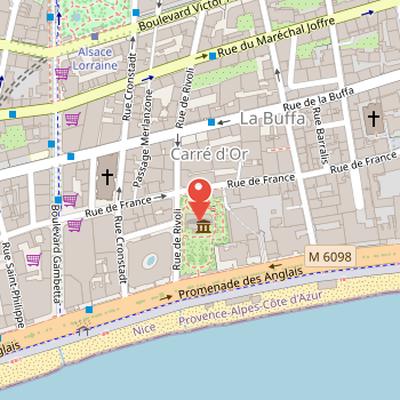
Musée Masséna is located in one of the last prestigious villas on the Promenade des Anglais in Nice. The villa was constructed in 1898 on the seaside by Victor Masséna, prince d’Essling and duc de Rivoli, and was designed by Hans-Georg Tersling and Aaron Messiah. Its architects were instructed to draw inspiration from large Italian neo-classical villas, and the building adopted an Empire style as an homage to Napoléon I. It was intended to host receptions.
In 1919, André Prosper Victor Eugène Napoléon Masséna sold the villa to the city of Nice for a price equal to the inheritance taxes paid, on the condition that the garden be opened to the public and that the villa become a local history museum named musée Masséna. The museum was inaugurated in 1921. Its gardens were designed by Édouard André, and the garden plan was later restored. The villa’s façades and roofs have been registered as historical monuments since 1975, and the property includes the villa, northern courtyard, southern garden, fences, belvedere terrace, and concierge pavilion.
Nearby Objects
-
-
 Église Saint-Pierre d'Arène 160 m away
 -
 Hyatt Regency Nice Palais de la Méditerranée 350 m away
 -
 Église reformée de Nice 600 m away
 -
 Jetée-Promenade de Nice 600 m away
Sale of the Villa and Public Access
Mussee Massena is located in one of the last prestigious villas on the Promenade des Anglais in Nice. In 1919, Andre Prosper Victor Eugene Napoleon Massena, prince d'Essling and duc de Rivoli, the son of Victor Massena, sold the villa to the city of Nice for a price equal to the inheritance taxes that had been paid. As part of the sale, he required that the garden be opened to the public and that the villa become a local history museum named Musee Massena. The garden bosquets were designed by the botanist Edouard Andre. Public access to the building is through a pavilion at number 65 rue de France, on the north side of the building.
Villa Architecture and Heritage Status
Musee Massena occupies a villa built in 1898 by Victor Massena, prince d'Essling et duc de Rivoli, on the seafront in Nice. The building was designed by architects Hans-Georg Tersling and Aaron Messiah, who were instructed to draw inspiration from large Italian neo-classical villas. It was modeled after the Rothschild villa in Cannes and adopted an Empire style as an homage to Napoleon I. The villa was intended for hosting brilliant receptions, reflecting its representative and ceremonial function.
The gardens were designed by the landscaper and botanist Edouard Andre. Between 2006 and 2007, the gardens and the northern courtyard were restored. The villa's facades and roofs have been registered as historical monuments since 1975. A later decree also registered the villa itself, the northern courtyard, the southern garden with fences and belvedere terrace, and the concierge pavilion, extending the protected ensemble.
Musee Massena: Restoration and Display
Musee Massena was inaugurated in 1921 in the Villa Massena in Nice and devoted several decades to local history. At the dawn of the 21st century, the museum underwent extensive renovation work and reopened after several years of restoration. Its garden was restored to its original plan designed by Edouard Andre, while powerful nighttime lighting highlights the historic facades. The new layout was designed by Nice architect Philippe Mialon.
The museum offers a permanent exhibition area of 1000 square meters. The first and second floors present a chronological and thematic history of Nice from 1792 to 1939. The salons contain early 19th century wooden paneling from the castle of Govone near Turin and are decorated mainly with Empire style furniture. The third floor houses the Cessole library, with thousands of documents on the history of the County of Nice, Provence, Savoy, and Northern Italy. The museum is fully accessible to people with reduced mobility.
Admission was free from 2008 to 2011, before fees were introduced in 2011 under a new municipal pricing policy. Between 2013 and 2019, the museum hosted four exhibitions under the artistic direction of Jean-Jacques Aillagon, with exhibitions exploring Nice's history and contributions from historians Guillaume Picon and Aymeric Jeudy.