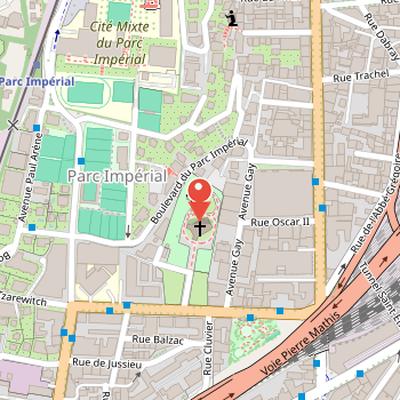
The Russian Orthodox Cathedral in Nice is an Orthodox church in Nice, France, located near boulevard Tzaréwitch on avenue Nicolas II. It belongs to the Korsun Diocese of the Russian Orthodox Church and is regarded as one of the city’s most famous landmarks. Media estimates have described it as the largest Orthodox church in Western Europe.
The cathedral’s history is closely linked to an earlier chapel and to the memory of Russian heir Tsarevich Nikolai Alexandrovich, who died in Nice in April 1865. After his death, Prince Pyotr Vyazemsky proposed buying the Villa Bermond and building a church there in his memory. The emperor acquired the villa, and the Nikolskaya chapel was founded and later consecrated in the presence of Grand Duke Alexander Alexandrovich. The marble chapel was built in Byzantine style on a high base, with David Grimm as architect, Francesco Botta as stonemason, A. K. Fischer responsible for wall painting, and bronze doors made in Lyon by Nicolas Rozière. The construction cost 140,000 francs, half of which was financed by the emperor. Later, the church of Saints Nicholas and Alexandra in Nice proved too small, leading to plans for expansion and a new church site on the former Villa Bermond land.
Nearby Objects
-
 Église Saint-Pierre d'Arène 950 m away
 -
 Notre-Dame de Nice 950 m away
 -
 Église reformée de Nice 1000 m away
 -
 Musée Masséna 1000 m away
 -
Location and significance
The Russian Orthodox Cathedral in Nice is an Orthodox church located near boulevard Tzariewitch on avenue Nicolas II. It belongs to the Korsun Diocese of the Russian Orthodox Church. The cathedral is regarded as one of the most famous landmarks of Nice, and media estimates describe it as the largest Orthodox church in Western Europe.
From Memorial Chapel to Expanded Church
The Russian Orthodox presence at the former Villa Bermond in Nice began with the death of Tsarevich Nikolai Alexandrovich, who died of a serious illness in April 1865 in the park of the Bermond mansion. In the same year, Prince Pyotr Vyazemsky published the memoirs Villa Bermond in Saint Petersburg and proposed buying the villa for Russia and building a church there in memory of the deceased grand duke. The emperor later acquired the villa, and the Nikolskaya chapel was founded there.
The chapel was consecrated in the presence of Grand Duke Alexander Alexandrovich. It was built in Byzantine style on a high base and faced with marble. Architect David Grimm designed the project, stonemason Francesco Botta worked on its construction, and A. K. Fischer painted the interior walls. The bronze doors were made in Lyon by Nicolas Roziere. The total construction cost was 140,000 francs, half of which was financed by the emperor. A special committee was created to care for the chapel.
The site also acquired local commemorative meaning: the municipality of Nice named a nearby street Tsarevich Boulevard in memory of the deceased. Inside the chapel, a black marble slab marks the spot where the Tsarevich's bed had stood.
By the early 1890s, the Russian church of Saints Nicholas and Alexandra in Nice had become too small. In 1896, the widowed Empress Maria Feodorovna arrived on the French Riviera and, at the request of the Russian community of Nice and in memory of the deceased heir, took patronage over the church expansion process. Prince George Leuchtenberg then appealed to Emperor Nicholas II to use state land at the former Villa Bermond for a new church site because the original site was unsuitable.
Construction Leadership and Foundation Ceremony
The history of the Russian Orthodox Cathedral in Nice records several changes in the leadership of its construction commission over time. Prince George Maximilianovich Romanovsky served as head of the commission from 1899. In 1907, the position was held by Ambassador A. I. Nelidov, and from 1909 it was held by Prince Sergey Mikhailovich Golitsyn. The laying of the church foundation was performed by Archpriest Sergey Lyubimov. The foundation ceremony also brought together a number of prominent figures, including Grand Dukes Mikhail Nikolaevich and Mikhail Mikhailovich, Prince George Maximilianovich Romanovsky, Duke of Leuchtenberg, Prince Ferdinand of Bulgaria, Grand Duchess Maria Alexandrovna, Duchess of Saxe-Coburg-Gotha, and Grand Duchess Anastasia Mikhailovna of Mecklenburg-Schwerin, who attended with her daughter Cecilie.
Construction and Consecration
The Russian Orthodox Cathedral in Nice was constructed according to a project by M. T. Preobrazhensky, a professor at the Imperial Academy of Arts in Saint Petersburg. Its construction was supervised by local architects Fomberto, then Barbe, Joseph Mars, and Henri Steckel, with the participation of Filippo Chiattia and Icavitz. Work was suspended in 1906 because of a lack of funds, and the project was considered for simplification that same year in order to reduce costs.
Funding later came from several major patrons. In 1908, Emperor Nicholas II donated 700 thousand francs from his personal funds, which made it possible to complete the upper part with its domes and the facade works. Other significant donors included Prince S. M. Golitsyn, who gave 350 thousand francs, as well as Rothschild, Tereshchenko, the Eliseevs, and Countess Apraksina. Empress Dowager Maria Feodorovna also provided partial funding and helped resolve difficult matters at court. The total construction cost exceeded 1.5 million gold francs.
In 1909, the cathedral was leased for 99 years to the church administration in Russia by the Ministry of the Imperial Court. It was assigned to the jurisdiction of the Metropolitan of Saint Petersburg, who managed all foreign parishes. The cathedral was consecrated by Bishop Trifon (Turkestanov), the first vicar of the Moscow diocese, two days before the name day of Emperor Nicholas II.
Property Disputes and Ownership Changes
Since 1923, the Russian Orthodox religious association ACOR managed church property in Nice under French law and was under the jurisdiction of Moscow Patriarch Tikhon. In 1931, Metropolitan Eulogius (Georgievsky), appointed by Patriarch Tikhon, transferred jurisdiction to the Patriarch of Constantinople, and the parish in Nice joined the Western European Russian Exarchate. The ownership rights of the property, however, remained unchanged after this transfer.
The legal status of the cathedral became the subject of a long dispute in the 2000s. The 99-year emphyteutic lease expired on January 1, 2008, requiring the property to be returned to its owner. In November 2005, the Russian government claimed rights to Russian overseas property, and in February 2006 the Russian embassy sent a bailiff to inventory the property based on a court decision. The dispute involved Russian Ambassador Alexander Avdeyev and parish priest Ioann Gate. During the same period, the Russian Orthodox Church representative said that the Moscow Patriarchate did not intend to interfere in the court process, while the Russian side lawyer Jean-Philippe Confino stated in November 2006 that Russia was ready to sign a new contract with the parish of the Constantinople Patriarchate. A former cathedral elder, A. Obolensky, later said that no lease offer had been received 13 years later. The French press was described as actively joining the polemic with an anti-Russian orientation, and in 2007 the council secretary of the exarchate, Mikhail Sologub, equated modern Russia with the godless Lenin regime.
On January 20, 2010, the court of first instance in Nice recognized the Russian State as the sole owner of the land plot with the cathedral and chapel. The association's lawyer noted that this was the first case of a foreign state owning a religious building in France, and the association intended to appeal. On the same day, a spokesman for the Presidential Affairs Department declared the intention to take the Nice cathedral under its management, and a representative of the Moscow Patriarchate said this concerned restoring historical justice. Archpriest Ioann Geit stated that there was political pressure and that the association legally won.
On May 19, 2011, the appellate court of Aix-en-Provence confirmed Russia's ownership of Nikolaevsky Cathedral, the land plot on Tsarevich Boulevard, and all objects on the plot, including the iconostasis. A bailiff then issued notice for immediate enforcement of the decision. At the end of October 2011, the higher court of Nice ordered the association of the Constantinople Patriarchate to vacate the church premises immediately and to hand over the keys to the representatives of the Russian state within seven days. After the appeal was rejected, the association expressed readiness to hand over the keys on November 30, 2011. On April 10, 2013, the Cassation Chamber of the French Republic finally rejected the association's complaint. A preliminary decision by the Presidential Affairs Administration of the Russian Federation to transfer Nikolaevsky Cathedral to the Russian Orthodox Church had also been reported in August 2011.
Restoration and Reopening
In August 2011, the Korsun Diocese sent Archpriest Nikolai Ozolin to Nice. He came from the Russian Parisian emigration. The history of the cathedral in this period was also shaped by the position of the diocese, which stated that the Orthodox cult association of Nice was not identical to the parish or to the community of Orthodox believers in the region. Before December 15, the Orthodox cult association continued to use the church.
On December 15, representatives of the Korsun Diocese and the Russian Federation General Consul in Marseille transferred the keys and all property to the Korsun Diocese. Restoration work was formally completed on the same day in 2015, and the church was reopened for believers. For almost a year and a half before that reopening, believers prayed outdoors in the cathedral park. The first liturgy was celebrated on December 19, the feast day of St. Nicholas the Wonderworker, the church's heavenly patron. The official reopening ceremony was postponed to January of the following year.
The grand opening was attended by many guests and worshippers. Bishop Antoniy (Sevryuk), head of the Moscow Patriarchate's overseas institutions department, performed the rite of small consecration, and Bishop Nestor (Sirotenko), head of the Russian Orthodox Diocese in France, co-officiated. After the service, speeches were given by Russian Ambassador to France A. K. Orlov and Nice Mayor C. Estrosi.
Later, on February 25, 2021, the court of first instance in Nice recognized three land plots near the cathedral as Russian state property. The plots are located on the eastern and southern sides and are part of the cathedral's historical territory. In spring 2023, a church-historical museum was opened in the crypt of the Nikolaevsky Cathedral. Representatives of the House of Romanov took part in the opening. The museum is dedicated to the Russian presence on the French Riviera, and its collection is being continuously expanded.
Architecture and Decoration
The Russian Orthodox Cathedral in Nice was built as a five-domed cathedral modeled on Moscow five-domed churches of the 17th century. It was constructed with light brown German bricks and designed to stand 50 meters high. The building was planned to accommodate 625 people. Its architectural decoration combined local and imported materials, including pink granite, blue ceramic tiles, and multicolored tiles from the Cantagalli company in Florence. The five gilded domes were covered with colored tiles made by the Bigot company, while the main dome was made of concrete by the Torran company and clad with hollow bricks and artificial stone. The cathedral also features six openwork gilded crosses made in Pistoia. On the west side, a bell tower and two tall white stone porches were added, each capped with tents and gilded zinc eagles. Two main diagonal entrances were placed at the southwest and northwest corners. Although the cathedral site was relocated to the former villa Bermon territory, the original building plan was retained, with the location originally intended to support convenient access from two streets.
Interior Decoration and Liturgical Furnishings
The cathedral's interior and liturgical fittings combined work by several workshops and artists, with a strong emphasis on carved, painted, and gilded decoration. The architecture and ornamentation included white stone window and door trims, lower cornices, and the bell tower, all carved by Italian masters. The bell tower was also decorated with mosaic icons, including a Spas image made in the Saint Petersburg workshop of V. A. Frolov from sketches by M. M. Vasiliev.
The cathedral had a three-tier iconostasis in an old Russian style, covered with basma and designed from a sketch by the Moscow artist L. A. Pyanovsky. It was manufactured in the workshop of jeweler I. P. Khlebnikov in Moscow. The icons for the iconostasis, painted in the style of Simon Ushakov, were executed by the Moscow icon painter Glazunov. The royal gates were made as a copy of the gates from the Church of Saint Elijah the Prophet in Yaroslavl, and the kiots were made in the same style. The church also featured a presanctified image of the Holy Trinity painted by Vasilyev.
Fresco decoration was only partly completed. Cartoons for the frescoes were prepared by L. A. Pyanovsky, who was inspired by murals of the Tolga Monastery, while the altar frescoes were based on cartoons by the young Italian artist De Signori. Other furnishings included utensils, an altar, and an epitaphion decorated with gilt bronze and blue enamel from I. P. Khlebnikov's workshop, vestments gifted by the emperor and sewn in the workshop of I. A. Zheverzheyev, small panikadila donated by the patron Rukavishnikov, and notable shrines. The cathedral also preserved a museum of the White Warrior and the Russian colony in Nice in the crypt until the 1990s. Among its bells were small bells donated by descendants of P. G. von Derviz from his house church in Valrose estate in Nice, as well as the heaviest bell, which was specially cast in Marseille.