Saint-Malo Cathedral is a Catholic cathedral in Saint-Malo, Brittany, France, and a national monument of France. Dedicated to Saint Vincent of Saragossa, it was built in a mix of Romanesque and Gothic styles during the episcopacy of Jean de Châtillon, between 1146 and 1163. The cathedral stands on the site of an ancient church founded in the 7th century and later rebuilt and transformed through several stages of local religious history.
The site’s earlier church was associated with Saint Malo and later came under the control of the Benedictine Abbey of Saint-Martin de Marmoutier before Jean de Châtillon rebuilt it completely around 1152 and made it a cathedral. Several elements of the 12th-century building remain, including part of the cloisters, the nave, and the transept crossing, while the choir was constructed in the 13th century. The cathedral suffered damage during World War II, when the steeple toppled onto the Sacred Heart Chapel, and an organ built in 1893 by Louis Debierre was destroyed. Restoration was completed in 1972, marked by a ceremony held on 21 May. The cathedral is also a stop on the Tro Breizh pilgrimage route.
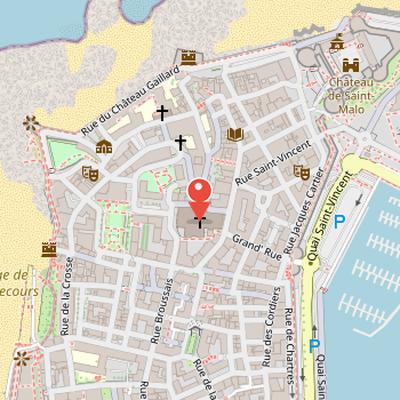
Nearby Objects
-
-
 Tomb of Chateaubriand 700 m away
 -
 Cemetery of Rocabey 1800 m away
History and Heritage
Saint-Malo Cathedral is a Catholic cathedral in Saint-Malo, Brittany, France, dedicated to Saint Vincent of Saragossa. It is recognized as a national monument of France. The building was constructed in a mix of Romanesque and Gothic styles during the episcopacy of Jean de Chastillon from 1146 to 1163, on the site of an ancient church founded in the 7th century. During World War II, the cathedral suffered damage when the steeple toppled onto the Sacred Heart Chapel, and an organ built in 1893 by Louis Debierre was destroyed. Restoration was later completed, and a ceremony marking this was held on 21 May 1972. The cathedral is also a stop on the Tro Breizh, a Catholic pilgrimage linking the towns of the seven founding saints of Brittany.
Early Religious History and the Church Site
According to local history, a hermit named Aaron d'Aleth founded a hermitage on the rocky outcrop where Saint-Malo now stands in the middle of the 6th century. A Welsh monk known as Maclow, Mac Law, or Malo later arrived and joined him. Malo devoted himself to preaching and became Bishop of Aleth, now Saint-Servan. Saint Gurval, Malo's successor, built a church in honour of Malo. This church was burned by Charlemagne's lieutenants in 811 and rebuilt by Bishop Helochar in 816. It was then named for the deacon saint Vincent d'Espagne, who had been martyred in 304 under Diocletian. In the middle of the 9th century, the Breton king Nominoe made Aleth the seat of the episcopacy and called it Pagus Alethensis. The church was later left in ruins by the Norman invasions of the 10th century. In 1108, the Benedictine Abbey of Saint-Martin de Marmoutier in Touraine received the church as a gift and converted it into a priory.
Medieval Origins and Later Transformations
Saint-Malo Cathedral became the seat of the bishopric through the action of Jean de Chatillon, also known as Jean de la Grille, who transferred the episcopacy from Aleth to Saint-Malo-de-l'Isle on the rocher of Aaron. Pope Eugene III agreed to the transfer in 1146, and the monastery of Saint Malo, founded in 1108, became Jean de Chatillon's official residence and then a cathedral replacing the former cathedral of Saint-Pierre at Aleth. Jean de Chatillon retook the church and rebuilt it completely around 1152, creating an episcopal area that included the ancient parish of Saint-Servan. The cathedral remained the ancient bishopric of Saint Malo from 1146 until 1801, when the Concordat of 1801 abolished the bishopric and divided its territory between the bishoprics of Rennes, Saint-Brieuc, and Vannes.
The present building preserves several elements from the 12th-century construction, including part of the cloisters, the nave, and the transept crossing. Other major phases followed over several centuries. The choir was constructed in the 13th century, while the tower began in the 12th century and was finished in 1422. The south side of the cathedral and the three chapels in the choir area date to the 15th century. Between 1583 and 1607, the north side was reconstructed and the north transept was enlarged. The south chapel was built in the 18th century, and the facade was reconstructed between 1772 and 1773.
The cathedral also incorporated architectural elements brought from other sites. A door from the courtyard of the Hotel-Dieu in the rue Saint-Sauveur was brought there in the early 17th century, and a portal from the Chapelle Sainte-Anne-des-Ursulines was placed in the south-west of the cathedral. Jean de Chatillon's tomb in the cathedral was fitted with a grill to ward off his many fervent admirers.
Interior Plan and Historic Furnishings
The interior of Saint-Malo Cathedral is built on a Latin cross plan and combines elements from several periods. The choir and south aisle are covered by ogival vaulting in Gothic style, while the north aisle uses groin vaulting. The ceiling of the south chapel has modern paneling. Several additions to the interior date from between the fifteenth and seventeenth centuries, including the Saint Julien wing on the south side, built between 1461 and 1486, and the Saint-Come wing on the north facade, designed by architect Thomas Poussin and built between 1593 and 1607. The Saint Julien wing includes the Porte de Velours, added in 1851.
The arms of the transept date to 1623 and contain four windows. Several stone capitals supporting the nave and transept crossing date to the twelfth century and are carved with grotesque figures and biblical scenes, although they are difficult to see from the ground because of their height. The interior also contains several tombs and reliquaries. Among them are a twelfth-century stone sarcophagus overlooking the ambulatory, containing relics of bishop Jean de Chatiillon, and a reliquary chest at the base of the chevet containing relics associated with Saint Celestin, given by Pope Pius VII to Monseigneur Courtois de Pressigny, the last bishop of Saint-Malo. The cathedral also preserves thirteenth- and fifteenth-century gisants, as well as a reliquary containing the skull of French explorer Jacques Cartier in a neighbouring chapel.
Other notable furnishings include statues of La Foi, Saint Maur, and Saint Benoit, created in 1743 by the Genoese sculptor Francesco Maria Schiaffino and originally installed in a Benedictine church later converted into the Saint-Malo Palais de Justice. One of the best-known devotional objects is the fifteenth-century marble statue Notre-Dame de la Grand'Porte, also called Miraculeuse Protectrice de la Cite Malouine, which is widely venerated in Saint-Malo. It stood for centuries in a niche above one entrance in the city's defensive walls, was restored and moved inside the cathedral near the sacristy entrance in 2003, and now has a copy remaining in the original wall niche.
Interior Stained Glass and Organs
The interior of Saint-Malo Cathedral is notable for its stained glass and its organs. The pipe organ now in use was built by Koenig in 1977 and inaugurated in 1980. It has four keyboards, one pedal, and 35 stops, and it replaced an older organ built in 1893 by Louis Debierre. That earlier instrument was made in the romantic style and was destroyed in 1944. In 2014, Koenig also built a new choir organ with two keyboards, one pedal, and 18 stops.
The cathedral's stained glass windows present scenes from the history of the city, the cathedral, and Brittany saints. Many of the nave windows were created by the French glass artist Max Ingrand. Among the historical scenes are the arrival of the Welsh monk Saint Malo at Aaron's hermitage around 560, shown in a south side nave window, and the blessing received by Jacques Cartier before his 1535 voyage to Canada. La Chapelle Saint-Aaron marks the site of the hermitage.
The north side nave contains three windows showing the martyrdom of Vincent of Saragossa in 304, the foundation of the See of Saint-Malo by Jean de Chatillon in 1152, and the Tro Breizh pilgrimage to seven founding Breton saints. Above the main entrance is a stained glass window depicting the Assumption of the Virgin. The Great Rose window was designed in 1968 by architect Raymond Cornon and replaced an earlier rose window destroyed in 1693 during an English attack. A 1970 window on the north side by Jean Gouremelin and Michel Durand depicts Breton saints Paul Aurelien, Tugdual, Corentin, Malo, Guillaume, Samson, and Patern. Other stained glass windows in the choir, chevet, ambulatory, and transept were created by Jean Le Moal and Bernard Allain.
Burials and Memorials
Saint-Malo Cathedral contains the tomb of the French explorer Jacques Cartier, who was born in St Malo on 31 December 1491 and died there on 1 September 1557. His tomb is located in a chapel off the ambulatory and north of the choir. The original grave was discovered and moved to its present location in 1949. A plaque in the cathedral states that the skull of Jacques Cartier rests there, and the cathedral also marks the spot where he knelt to receive the bishop's blessing before his voyage to Canada in 1535. The cathedral's memorial history also includes visits and burials connected with other figures: Honor de Mercier visited in 1891, and the remains of Rene Duquay-Trouin were moved to Saint-Malo from the Saint-Roch church in Paris on the three hundred year anniversary of his birth.
Tower History and Reconstruction
Rebuilding of the cathedral tower began in 1422, using the foundations of the earlier tower. In August 1858, Napoleon III and Empress Eugenie visited Saint-Malo, and Abbe Jean-Francois Huchet persuaded them to finance an arrow addition to the tower spire. This addition was intended to be visible from the sea, linking the tower to the citys maritime setting. A statue of Abbe Jean-Francois Huchet by Jean-Marie Valentin stands on the south side of the ambulatory in the cathedral, reflecting his role in this development. The tower was completely destroyed during the 1944 bombing and was replaced in 1972. The new design was based on a Norman church in Periers. The tower has four bells.
War Damage and Restoration
In early August 1944, Saint-Malo suffered heavy bombing and artillery fire from both German and American forces. On 6 August, shells fired from a German minesweeper decapitated the cathedral steeple. The fallen steeple toppled onto the Sacred Heart Chapel, causing extensive damage. The bombardment also destroyed an old organ built in 1893 by Louis Debierre. Restoration of the cathedral was then carried out under the direction of Raymond Cornon and Pierre Prunet, the official architects for historic monuments. The work lasted twenty-eight years and was completed and celebrated on 21 May 1972. Cornon also took part in reconstructions in Fougeres, Rennes, Quimper, Vannes, Nantes, and Vitre.
The Bishopric Transfer to Saint Malo
The bishopric was transferred in 1144 from the Old Cathedral of Saint-Pierre at Aleth to Saint Malo. After this change, the old cathedral at Aleth came under the protection of Saint-Servan. The former cathedral still exists today as ruins, marking the earlier ecclesiastical center before the transfer.