The Musée d’Histoire de la Ville et du Pays Malouin was a museum in Saint-Malo, Brittany, France, created in 1862. It was dedicated to retracing the history of the city and the main personalities who lived there. The museum has closed permanently. Its old collections will be reused for a maritime museum project scheduled to open in 2028. The new project, named L'Hydro - Musée maritime de Saint-Malo, will be located at the site of the former École nationale supérieure maritime. It is described as a history and society museum focused on the maritime history of the city. The former museum is associated with the old collections that will form part of this new institution.
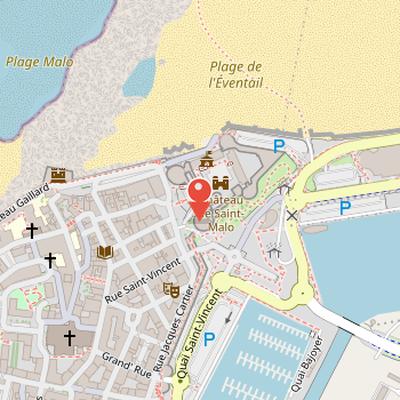
Nearby Objects
-
 Saint-Malo Cathedral 250 m away
 -
 Tomb of Chateaubriand 750 m away
 -
 Cemetery of Rocabey 1600 m away
History Museum in Saint-Malo
The Musee dHistoire de la Ville et du Pays Malouin was created in 1862 in Saint-Malo, Bretagne, France. It retraced the history of the city of Saint-Malo and presented the main personalities who lived there. The museum later closed its doors permanently. Its former collections are set to be reused in a maritime museum project called L'Hydro - Musee maritime de Saint-Malo, which is planned to open in 2028. This new museum will be located on the site of the former Ecole nationale superieure maritime and is described as a history and society museum bringing together collections on the maritime history of the city.
Exhibition spaces and collections
The Musée d’Histoire de la Ville et du Pays Malouin occupies the grand donjon on three levels, the tour generale on three levels, and the chapel of the chateau de Saint-Malo. Its rooms are arranged by theme and bring together paintings, models, and objects. The collections preserve materials concerning the history of Saint-Malo, local ethnography, and memories of cap-hornier captains in the tour Solidor. The chapel contains liturgical objects and portraits of ecclesiastics. From the top of the grand donjon, in the watchtowers, visitors can see a panorama of the surroundings of the walled city and the port. The museum also received an important deposit of archaeological furniture from underwater excavations of two 17th century shipwrecks, including La Dauphine, built at the royal arsenal of Le Havre in 1703 and lost on an unknown date, and L'Aimable Grenot, also lost on an unknown date. These wrecks were discovered on the rocks of the Natiere near the access channel to the port. The museum is also constructing a new maritime history museum on the silos site at quai de Terre-Neuve, at the end of bassin Duguay-Trouin.
Gallery Holdings and Maritime Displays
The museum's gallery combines paintings with objects linked to local maritime life. Among its works are Portrait de Chateaubriand by Anne-Louis Girodet, dated around 1809, La Prise du Kent dans le golfe du Bengale by Ambroise Louis Garneray from 1852, and Rene Duguay-Trouin by Johann Dominik Mahlknecht from 1827. The gallery also contains other paintings from an unspecified century. Alongside these works, it presents several maritime items, including a guindeau installed on boats at the beginning of an unspecified century and a foghorn installed on boats at the beginning of an unspecified century. Another display shows a doris used by fishermen from Saint-Malo at Terre-Neuve at the beginning of an unspecified century. The gallery also features a room of the chapel, adding an architectural and historical element to the museum's interior layout.