Place de la Concorde is a public square in Paris, in the 8th arrondissement at the eastern end of the Champs-Élysées. It is the largest square in Paris and has a history shaped by political change and urban redesign. Originally planned as the site of an equestrian statue of King Louis XV, it was commissioned in 1748 by the merchants of Paris to celebrate the king’s recovery from a serious illness. The square was designed by Ange-Jacques Gabriel and was finished by 1772.
At that time, the site was arranged as an octagon bordered by a twenty-meter-wide moat, crossed by stone bridges and surrounded by a stone balustrade. Stone stairways were placed at the eight corners, and the square was divided into flowerbeds. During the French Revolution, it was the site of public executions of Louis XVI, Marie Antoinette, and Maximilien Robespierre, and was temporarily renamed Place de la Révolution. It received its current name in 1795 as a gesture of reconciliation, and the original name was later reinstated for a period. A metro station is located at the northeastern corner and serves Lines 1, 8, and 12 of the Paris Métro.
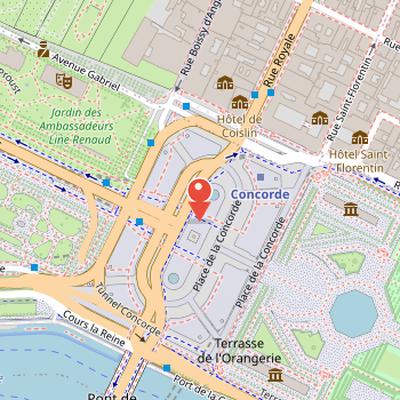
Nearby Objects
-
 Fontaines de la Concorde 20 m away
 -
 Luxor Obelisk 20 m away
 -
 Hôtel de Crillon 200 m away
 -
 Jeu de Paume 200 m away
 -
 Musée de l'Orangerie 200 m away
Names, Location, and Historical Role
Place de la Concorde is a public square in Paris, located in the 8th arrondissement at the eastern end of the Champs-Elysees. It is the largest square in Paris. The square was originally named Place Louis XV, later renamed Place Louis XVI, and temporarily called Place de la Revolution during the French Revolution. It became the site of public executions of Louis XVI, Marie Antoinette, and Maximilien Robespierre. In 1795, the square received its current name as a gesture of reconciliation during the revolution, although the original name was reinstated for a period after that date. A metro station is located at the northeastern corner of the square, serving Lines 1, 8, and 12 of the Paris Metro.
From Royal Esplanade to Monumental Square
Place de la Concorde was originally designed as the site of an equestrian statue of King Louis XV. The statue was commissioned by the merchants of Paris in 1748 to celebrate the king's recovery from a serious illness, and the chosen location was the large esplanade between the revolving gate, the Tuileries Garden, and the Cour-la-Reine. At the time, the Cour-la-Reine was a popular lane for horseback riding at the edge of the city, while the Concorde bridge and the Rue de Rivoli did not yet exist. The Rue Royale was then only a muddy lane descending to a marsh beside the Seine. Ange-Jacques Gabriel prepared the plan for the site, and the square was finished by 1772. It was formed as an octagon bordered by a moat twenty meters wide, crossed by stone bridges and enclosed by a stone balustrade. Gabriel also placed stone stairways at the eight corners so that visitors could descend into the square, which was divided into flowerbeds with the statue's pedestal at the center.
The statue itself, by Edme Bouchardon, showed King Louis XV on horseback as the victor of the Battle of Fontenoy. He was depicted dressed as a Roman general with a laurel wreath on his head. The pedestal was designed by Jean-Francois Chalgrin, and Jean-Baptiste Pigalle created four bronze figures representing Force, Justice, Prudence, and Peace for its corners. The statue was dedicated on 20 June 1763, but within a few days a placard was hung on it carrying a critical statement about the statue and pedestal. Later, Gabriel also planned and built two palatial buildings with identical facades on the north side of the square between 1760 and 1775. Their facades were inspired by those created by Claude Perrault for the Louvre. They were first intended for embassies, but the east building became a depot for Royal furnishings and then the headquarters of the French Navy, while the west building was divided into individual properties for the nobility.
Revolutionary History and Renaming
Place de la Concorde was a central stage for the French Revolution beginning in 1789. On 13 July 1789, a mob seized weapons at the Hotel de la Marine, including two old cannons that had been gifts from the King of Siam. These cannons fired the first shots during the storming of the Bastille on 14 July 1789. The square then became closely associated with revolutionary violence and political change.
The statue of Louis XV was pulled down and melted at a foundry on 11 August 1792. It was replaced by a statue of Liberty by Francois-Francois-Lemot, and the Place Louis XV was renamed Place de la Revolution. The first guillotine executions in the square took place in October 1792, with thieves who had stolen the royal crown diamonds from the Hotel de la Marine among the first victims. King Louis XVI was executed there on 21 January 1793, and Queen Marie Antoinette on 16 October 1793.
The guillotine was set up again on 11 May 1793 between the Statue of Liberty and the Tuileries Garden entrance, where it remained for thirteen months. In total, 1,119 people were executed at Place de la Concorde. Those executed there included Charlotte Corday, Madame du Barry, Georges Danton, Camille Desmoulins, Antoine Lavoisier, Maximilien Robespierre, and Louis de Saint-Just. The last executions at the square were of Prairial riot participants in May 1795.
The square was renamed Place de la Concorde in 1795 under the Directory, changed back to Place Louis XV after the Bourbon Restoration in 1814, renamed Place Louis XVI in 1826, and then returned to Place de la Concorde after the July Revolution of 1830.
Redevelopment of Place de la Concorde
Place de la Concorde was reshaped through a sequence of major works in the 19th century. The Concorde bridge was constructed in 1790 during the French Revolution, and in 1806 Napoleon Bonaparte began to construct the Rue de Rivoli along the edge of the square. Under King Louis-Philippe and prefect Claude-Philibert Barthelot de Rambuteau, the square was remade as part of a larger project directed by Jacques Ignace Hittorff, who was named chief architect in 1832.
Hittorff introduced several defining elements to the square. In October 1835 he installed the Luxor Obelisk, a gift from wali Muhammad Ali of Egypt, and it was hoisted into place before a huge crowd on 25 October 1836. In 1838 he commissioned James Pradier and Jean-Pierre Cortot to create eight statues representing the major cities of France. These statues were placed on columns that had already been put in place around the square by Gabriel. At the same time, a ring of twenty columns with lanterns was installed.
Between 1836 and 1840 Hittorff also erected two monumental fountains, Fontaine Maritime and Fontaine Fluviale, whose design was modeled after the fountains of St. Peter's Square in Rome. The square's appearance was further changed in 1853 under Napoleon III, when the deep moats around it were filled in. The west side of the Concorde bridge, at the entrance to the Champs-Elysees, was marked by the placement of the Marly Horses by Guillaume Coustou the Elder, following a suggestion by Jacques-Louis David.
History and Public Events at Place de la Concorde
Place de la Concorde has served as the entry point for two major international expositions in Paris. It hosted the Paris Universal Exposition of 1900, which left behind the Grand Palais and the Petit Palais, and the 1925 International Exhibition of Modern Decorative and Industrial Arts, which gave its name to the Art Deco architectural style. The square has also been the setting for major national celebrations, including the victory celebrations at the end of the First World War and the Liberation of Paris in the Second World War.
At the same time, the site has been marked by periods of unrest and violence. In 1934, a far-right demonstration against parliamentary corruption led to a riot that caused eleven deaths and two hundred injuries. During the Second World War, a captured French SOMUA S35 appeared in German service in a parade on the square in 1941, and in August 1944 crowds celebrating the liberation of Paris scattered under German sniper fire.
The square has continued to play a major ceremonial and sporting role in more recent decades. It was the focal point of the Bastille Day military parade down the Champs-Elysees, with the President of France and invited guests watching from the square. It also hosted four sports at the 2024 Summer Olympics: BMX freestyle, Breaking, Skateboarding, and Basketball 3x3, as well as the opening ceremony of the Paralympic Games in 2024. Temporary stands and sporting facilities were built while protecting items such as the Luxor Obelisk, and more than 25,000 people attended each day during the Olympics. The 2024 Paralympics opening ceremony was watched by 35,000 people. After the Games, vehicle traffic did not return to most of the square following plans for partial pedestrianisation and substantial redesign.
The Luxor Obelisk at Place de la Concorde
The centrepiece of Place de la Concorde is the Luxor Obelisk, an ancient Egyptian obelisk decorated with hieroglyphics that exalt the reign of pharaoh Ramesses II. It is one of two obelisks given by the Egyptian government to France in the 19th century. The other remained in Egypt because, at the time, its weight and the difficulty of moving it made transport to France impractical. The second obelisk was later formally returned to Egypt by President Francois Mitterrand on 26 September 1981.
The obelisk once marked the entrance to the Luxor Temple. In 1829, the wali of Egypt, Muhammad Ali Pasha, offered the 3,300-year-old monument to France as a diplomatic gift. It arrived in Paris on 21 December 1833 and was hoisted onto the pedestal that had originally supported the statue of Louis XV three years later. King Louis Philippe dedicated it on 25 October 1836, completing its installation in 1836.
The monument is a yellow granite column rising high, including its base, and its pedestal bears diagrams explaining the transportation machinery used to move it. In 1998, the government of France added a gold-leafed pyramidal cap to the top, replacing the missing original.
The Fountains of Place de la Concorde
The chief architect of the square moved ahead with two new fountains at Place de la Concorde after studying under the Neoclassical designer Charles Percier at the Ecole des Beaux-Arts and examining the architecture and fountains of Rome, especially Piazza Navona and Piazza San Pietro. Each fountain was nine meters high, matching the height of the earlier columns and statues around the square.
The Maritime Fountain stood on the south, between the obelisk and the Seine, while the Fluvial Fountain stood on the north, between the obelisk and the Rue Royale. The south fountain illustrated the seas bordering France, with figures of the Atlantic and the Mediterranean, as well as figures harvesting coral, fish, shellfish, and pearls. The north fountain was devoted to the great rivers of France, with allegorical figures of the Rhone and the Rhine, and scenes linked to harvesting flowers and fruits, grape growing, river navigation, industry, and agriculture. The north fountain also occupied the site where the guillotine that executed Louis XVI had been placed.
Both fountains shared a similar structure. Each had a stone basin with six figures of tritons or naiads holding fish that spouted water. Above this were six seated allegorical figures with feet on ship prows supporting the circular vasque pedestal, and four statues of geniuses in arts or crafts supporting the upper inverted vasque. Water shot upward and then cascaded down to the lower vasque and finally into the basin.
The Buildings Framing Place de la Concorde
The north side of Place de la Concorde, along Rue de Rivoli, is occupied by two palatial buildings designed by Ange-Jacques Gabriel. Rue Royale enters the square from the north and was also designed by Gabriel, who planned the harmonious facades of the buildings along this route, including the facade and interior of his residence at Number eight. The two major buildings on the square have nearly identical Neoclassical facades inspired by the Louvre Colonnade begun in 1667 by Louis Le Vau, Charles Le Brun, and Charles Perrault. Their fronts are decorated with sculpted medallions and garlands borrowed from the Louvre east front, and their colonnades are balanced by two sections with triangular frontons and Corinthian columns.
The eastern building, the Hotel de la Marine, was originally the royal Garde-Meuble containing royal furnishings. Marie Antoinette had a small apartment there, and in 1792 it became the headquarters of the French Navy during the Revolution. The Navy departed in 2015, and the building is now a national monument and museum. Its ceremonial rooms and the apartments of the original intendants before the Revolution have been restored. Since 2021, it has housed the Al Thani Collection of ancient art from early civilisations, brought together by Sheikh Hamad bin Khalifa Al Thani, cousin of the Emir of Qatar.
On the west side, the building is divided into four separate buildings that were originally occupied by members of the French Nobility.
Terraces and Cultural Landmarks
Place de la Concorde is bordered on the east by the two terraces of the Tuileries Garden, the park of the Tuileries Palace. Although the palace was burned by the Paris Commune in 1871, only few vestiges remain. The garden entrance is marked by a highly ornate gilded gateway designed by Ange-Jacques Gabriel, the architect to the square. This gateway opens onto the grand promenade of the garden, which extends east to the Louvre. It is flanked by two monumental equestrian sculptures by Antoine Coysevox, called Fame Riding Pegasus and Mercury Riding Pegasus. These works were made for the Chateau de Marly of Louis XIV and were installed at the Tuileries in 1719. The sculptures now in place are copies, while the originals are in the Louvre.
At the south end of the square, next to the Seine, stood the early west gateway of Paris, the Port de la Conference, built by Henry III of France and demolished in 1730. A revolving bridge originally gave entry to the gardens, in the location where the ornamental exists today.
The terraces overlooking the square are also home to two museums. Near the Rue de Rivoli at the north end is the National Gallery of the Jeu de Paume, built under Emperor Napoleon III as the imperial tennis court in 1861 and enlarged in 1878. During the Second World War it was used by Germans as a depot for looted art, then displayed Impressionist paintings of the Louvre from 1947 until 1986. Entirely rebuilt in 1997, it now presents temporary exhibitions of contemporary art. Closer to the Seine is the Orangerie Museum, built in 1852 by architect Firmin Bourgeois as a winter shelter for Tuileries citrus trees under Napoleon III. It was later converted into an art exhibition hall and has housed Claude Monet's eight Water Lilies paintings since 1927. It also displays the Walter Guillaume collection of impressionist paintings and works from the school of Paris.
The terrace overlooking the square displays important works of sculpture. Since 1998, four works by Auguste Rodin have been shown there: The Kiss, Eve, The Grand Shadow, and Meditation with arms. Modern works on display include Le Belle Costume by Jean Dubuffet and Le Grand Commandement Blanc by Alain Kirili. Two 18th century marble statues of lions by Giuseppe Franchi are also displayed on the terrace.
Planned Redesign of the Square
In January 2021, Anne Hidalgo, the Mayor of Paris, first proposed a redesign of place de la Concorde. The plan is intended to increase pedestrian space, reduce car traffic, and add more green space and trees. Traffic would be directed around the outside edges of the square, with a major reduction in the number of traffic lanes. The redesign would also create four large areas of trees and greenery in the corners around the obelisk and monuments, while leaving open space in the centre. Additional green space is also included in the project, and work is scheduled to begin in 2026.