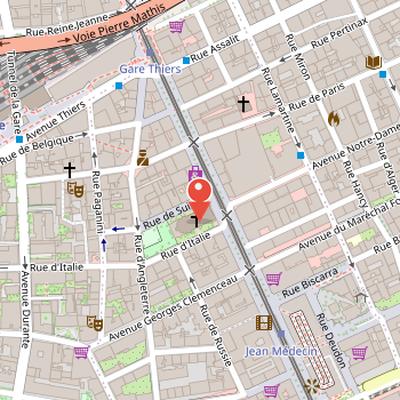
Notre-Dame de Nice is a Roman Catholic church located on Avenue Jean Médecin in the center of Nice, a port city in southeastern France. Built in the 19th century in the neo-Gothic style, it is the largest church in Nice and belongs to the Diocese of Nice. Its patronal feast is the Assumption of the Virgin Mary, observed on August 15.
Plans for a new large church in Nice were developed in 1862. Construction began in 1864 under the Paris architect Charles Lenormand, after fundraising campaigns carried out across France and among Mediterranean tourists. The church was completed in stages, with the nave and side chapels finished up to nave height by 1865 and consecrated by Bishop Jean-Pierre Sola on May 3, 1868. Work was delayed by the Franco-Prussian War, and the city of Nice took ownership of the indebted project in 1876. The church was declared completed in 1879 and solemnly consecrated on March 12, 1925. Pope Paul VI elevated it to a minor basilica on April 16, 1978. Its design was inspired by Notre-Dame de Paris and Saint-Serge in Angers, with two square towers, a large rose window, and a facade that refers to the main portal of Notre-Dame Cathedral in Paris.
Nearby Objects
-

-
 Église reformée de Nice 500 m away
 -
 Musée Marc-Chagall 750 m away
 -
 Place Masséna 750 m away
 -
 Casino Municipal de Nice 800 m away
Location and Religious Role
Notre-Dame de Nice is a Roman Catholic church located on Avenue Jean Medecin in the center of the port city of Nice in southeastern France. It was built in the 19th century in the neo-Gothic style. The church belongs to the Diocese of Nice. Its patronal feast is the religious feast of the Assumption of the Virgin Mary, observed on August 15.
Construction and Later Recognition
Plans for a new large church in Nice were developed in 1862, and construction began in 1864 under the Paris architect Charles Lenormand. The project faced opposition from Nice mayor Francois Malaussena over church funding, but financing was secured through appeals across France and among Mediterranean tourists. By 1865, the nave and side chapels had been completed up to nave height. The church was consecrated by Bishop Jean-Pierre Sola on May 3, 1868, while construction continued primarily between 1864 and 1868 as the largest church in Nice.
Work was delayed by the Franco-Prussian War of 1870/1871, and in 1876 the city of Nice took ownership of the indebted project. The church was declared completed in 1879. The city also converted the parsonage into a public school. Later, the church received a solemn consecration on March 12, 1925, and was elevated to a minor basilica by Pope Paul VI on April 16, 1978.
Architecture and Facade Design
Notre-Dame de Nice adopted the Marian patronage of the old Marian cathedral on Nice's castle hill. Its basilica was designed in a neo-Gothic style inspired by Notre-Dame de Paris and Saint-Serge in Angers, reflecting the desire to Frenchify Nice after annexation from the Kingdom of Sardinia. The church facade refers to the main portal of Notre-Dame Cathedral in Paris, but the Paris model was reduced by about half and the elaborate facade program was not fully completed.
The east facade is dominated by two square towers, each 31 meters high. The lower level opens in a three-portal arrangement with funnel openings between flying buttresses. A large rose window depicts scenes of the Assumption of Mary, and the patroness statue crowns the middle portal gable, following the Marian iconography of the Miraculous Medal. Between the facade towers, a Marian statue on the nave gable represents Mary as the Immaculate Conception assumed into heaven.
The two towers were originally intended to be crowned by octagonal spires, as in the Paris model designed by Eugene Viollet-le-Duc, but these spires were not built because of poor ground conditions in Nice. The sculptural facade decoration modeled on Paris was also left incomplete. In 1944, the statue Our Lady of Liberation was made on the trumeau of the central portal as thanks for freeing Nice in World War II. Avenue Notre Dame runs directly to the main facade of the church.
Architecture and Interior Decoration
Notre-Dame de Nice is described as a hall church with an apse oriented to the southwest. Its choir is inspired by the Abbey of Saint-Serge in Angers, and the three naves have the same vault height. The church contains twelve side chapels and seven apse chapels, giving the interior a highly articulated layout.
The stained glass program reflects several phases of decoration. The choir windows from 1868 depict the coronation of Mary, surrounded by angels, apostles, and Old Testament patriarchs. The original nave windows were dedicated to the Christianization of France, but they were replaced in 1956 by modern stained glass with abstract forms. The historical chapel windows are donations from individuals dating to the late 19th century.
The apse chapel, originally dedicated to the Sacred Heart of Jesus in stained glass, is now dedicated to the Virgin Mary. It contains a modern statue of the Virgin Mary from 1960. Among the painted works in the church are a 19th-century copy after Bartolome Esteban Murillo depicting the Holy Kinship and another painting showing the Assumption of Mary.
Stained Glass Program
The stained glass program at Notre-Dame de Nice includes New Testament scenes from the life of Jesus in the side chapels and in the front apses. The glazing of the rear five choir apses was made by the Metz glassworks Marichal. The facade's large rose window presumably comes from a workshop in Lorraine. At its center, the rosette shows the Greek letters Alpha and Omega as a symbol for Christ, while the surrounding segmented fields contain medallions depicting the twelve apostles.
The Organ of Notre-Dame de Nice
The church received its first organ in 1870, built by the organ building company Merklin from Lyon. A new organ was constructed in 1987 by Kern of Strasbourg, which reused nine registers from the earlier Merklin instrument. The present organ has 39 registers on three manuals and pedal, and it uses mechanical key and stop actions.
The Bell Ensemble
Notre-Dame de Nice has a bell ensemble that includes the large Marien-Glocke, which weighs 1020 kg and has hung in the South Tower since 1868. Three additional bells were added in 2010 and were cast by the Paccard bell foundry from Annecy. These new bells hang in the North Tower, the right facade tower. They are named after invocations of Mary in the Lauretan Litany. One of them, the Mater-admirabilis-Glocke, was cast on June 11, 2010, at Massena Square in Nice, and its name is connected to a stolen statue called Notre Dame de Nice-Mater admirabilis. The consecration of the new bells was celebrated on June 13, 2010.
The 2020 attack at Notre-Dame de Nice
On October 29, 2020, a church at Notre-Dame de Nice was the site of an Islamist terrorist attack. The assault lasted a total of 28 minutes and resulted in three people being murdered. The perpetrator was a Tunisian who had traveled illegally to France and carried out the attack with a knife. During the incident, he repeatedly shouted "Allahu Akbar." The attack ended when police overpowered him near the crime scene.