Muséum de Toulouse, officially abbreviated MHNT, is a natural history and ethnology museum located in the Jardin des Plantes de Toulouse, in the Busca-Montplaisir district. It houses a collection of more than two and a half million pieces and is the second largest museum in France after the Muséum national d'histoire naturelle of Paris.
The museum’s history includes preventive archaeology carried out during early renovation works, which revealed traces of Gaulish occupation and later High Roman Empire presence. In 1950, the museum became a scientific center with 19 rooms open to the public. Between the two wars, it received important collections, including ornithology material from Victor Besaucèle, ethnology and shell collections from Gaston de Roquemaurel, and the Dupuy malacology collection. In 1971, under Claudine Sudre, it established a pedagogical service and a children’s library. After the public closure of its premises in 1997, a new institutional design was proposed in 1999. Today, the museum includes modern exhibition spaces, the botanical garden of the Paul-Sabatier University, and functions as an educational site for reflection and debate on natural history, humans, and the environment.
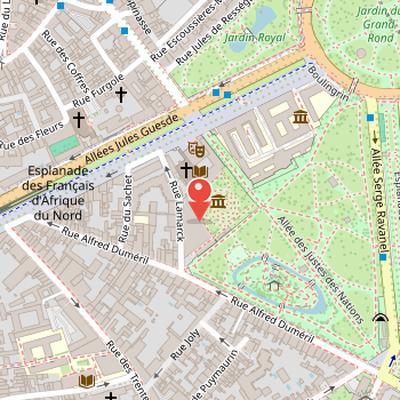
Nearby Objects
-
 Saint Exupère Church 70 m away
 -
 Sorano Theatre 90 m away
 -
 Jardin des Plantes 160 m away
 -
 Église du Gésu 250 m away
 -
 Château Narbonnais 350 m away
Location and Scale of the Muséum de Toulouse
The Muséum de Toulouse, officially abbreviated as MHNT, is a natural history and ethnology museum located in the Jardin des Plantes de Toulouse, in the quartier de Busca-Montplaisir. It houses a collection of more than two and a half million pieces. The museum covers an area of approximately, not counting the external sites. By collection size, it is the second largest museum in France after the Muséum national d'histoire naturelle of Paris.
History and Renewal of the Musuem de Toulouse
Preventive archaeology carried out during early renovation works revealed earlier occupation on the site of the Musuem de Toulouse. The excavations identified Gaulish presence through parcel ditches, a pit, and a sleeper beam, while evidence from the High Roman Empire included a masonry foundation and scattered antique furniture. The museum itself became a scientific center in 1950, when 19 rooms were open to the public. Between the two wars, its collections expanded through several important acquisitions, including ornithology collections from Victor Besaucile, ethnology and shell collections from Gaston de Roquemaurel, and the Dupuy collection in malacology. In 1971, under Claudine Sudre, the institution established a pedagogical service and a children's library. The museum premises were closed to the public in 1997 after building weaknesses were detected. In 1999, a new institutional design was proposed based on the Musuem national d'histoire naturelle de Paris, with a historic headquarters in central Toulouse and several complementary sites around the city. The renovation works lasted a decade.
The Museum Today
The Musuem de Toulouse today has been reworked as both a museum and a public space for reflection. It reopened for children's groups and for the public on Saturdays, and its area was doubled through expansions on adjacent lands. The present arrangement provides 3000 square meters of exhibition space on three floors, and it also incorporates the botanical garden of the Paul-Sabatier University. Its modern scenography was designed by architect Xavier Leroux-Cauche, while a project by architect Jean-Paul Viguier was intended to unify the historical, modern, and botanical exhibition components.
The museum has completely reinvented both its intellectual project and its physical architecture. It functions as an educational tool and as a place for reflection and debate on natural history, humans, and the environment. A scientific committee led by Professor Georges Larrouy, with French and international specialists, supports this approach. The museum focuses on visitors by linking scientific knowledge with civic appropriation, and it offers an itinerary intended to raise awareness of major contemporary issues. All exhibitions, activities, and animations are based on this awareness-raising ambition.
The museum's website is presented as both a showcase and an alternative place for visits, debates, and exchanges. It is also a member of the national network of natural history collections.
Ethnology Collections
Ethnologie at the Muséum de Toulouse conserves extra-European ethnographic collections from Oceania, Africa, America, and Asia. The formation of the older collections is linked to numerous 19th century explorations, expansions, and France's colonial past. More recent holdings have been enriched through field study missions and new collections, showing that the museum's ethnology holdings continue to develop over time.
Palaleontology Collection
The paleontology collection at the Musuem de Toulouse contains tens of thousands of specimens. Its fossils span a very broad time range, from the Archean to the present. The collection includes specimens of very different sizes, from a few millimeters to several meters, including the Megaceros. It also contains several molds, some measuring up to ten meters long, as well as several holotypes and paratypes.
Charles Louis Eugene Trutat and the Toulouse Museum
Charles Louis Eugene Trutat was a French photographer, pyreneist, geologist, and naturalist born in Vernon, Eure, France, and later died in Foix, Ariege, France. He served as director of the Museeum d'histoire naturelle de Toulouse. His Trutat collection comprises over photographs preserved in the phototheque of the museum, linking his work directly to the institution's historical holdings.
Scientific Names and Latin Vocabulary
At the Muséum de Toulouse, each species is shown with a two-word Latin or Latinized name written in italics. The first word identifies the genus and begins with a capital letter, while the second word gives the species details. The museum presents Asphodelus ramosus as the scientific name of Asphodele ramifie, and Columba palumbus and Columba livia for the pigeon ramier and the pigeon des villes. The displays also include a game with three rollers that links an image, a definition, and Latin etymology. In this context, quadrumane is explained through the Latin words quatuor, meaning four, and manus, meaning hand. The lion species is presented through twelve propositions that move from general to more specific features. Other terms are also broken down by origin: carnivore is explained through caro, carnis and vorare, while felide is linked to retractile claws and to the Latin feles, is.