Jardin des Plantes is a public garden in Toulouse, the capital of the Occitanie region in southern France. Formerly a botanical garden, it retained its name after losing its official botanical status. It forms part of a group of three public gardens in southeastern Toulouse, alongside Grand Rond and Jardin Royal.
Owned by the municipality of Toulouse and managed by the city’s Green Spaces service, the garden is located in the historic Busca district southeast of the city center. It covers seven hectares and has an irregular triangular shape. Its borders include allée Serge-Ravanel to the east, rue Alfred-Duméril to the west, and buildings along allées Jules-Guesde to the north. The garden has six entrances and is connected by a footbridge over square Boulingrin to jardin du Grand Rond. It is also bordered by several nearby institutions, including École de médecine, Muséum d'histoire naturelle, théâtre Daniel-Sorano, and église Saint-Exupère.
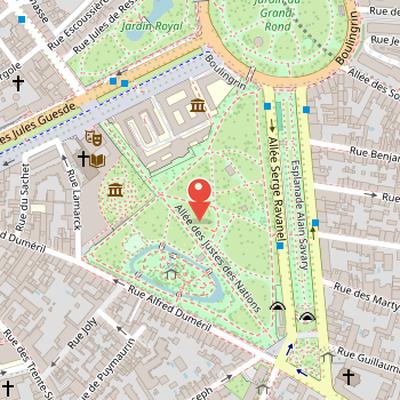
Nearby Objects
-
 Muséum de Toulouse 160 m away
 -
 Sorano Theatre 200 m away
 -
 Saint Exupère Church 200 m away
 -
 Grand Rond 350 m away
 -
 Église du Gésu 400 m away
Public Garden Status and Administration
Jardin des Plantes is a public garden in Toulouse, the capital of the Occitanie region in southern France. It was formerly a botanical garden and kept its name after losing its official botanical status. The garden is part of a group of three public gardens in southeastern Toulouse, together with Grand Rond and Jardin Royal. It is owned by the municipality of Toulouse and managed by the city's Green Spaces service.
Location and Access
Jardin des Plantes is located southeast of the city center, in the historic Busca district. It covers seven hectares and has an irregular triangular shape. The garden is bordered by allee Serge-Ravanel to the east, rue Alfred-Dumeril to the west, and buildings along allees Jules-Guesde to the north. It has six entrances and is connected by a footbridge over square Boulingrin to jardin du Grand Rond.
Several public institutions and buildings stand around it, including the Ecole de medecine, the Museum of Natural History, the theatre Daniel-Sorano, and the church Saint-Exupere. The site is served by the Tisseo public transportation network. Nearby services include the Linéo L9 line and bus line 44 on allee Serge-Ravanel and allee Frederic-Mistral, as well as bus lines 44 and 66 on allees Jules-Guesde. Metro access is available via Palais-de-Justice station on line B, and tram access via the terminus station of line T1.
The garden is also served by several VeloToulouse bike-sharing stations near its entrances, including Guesde-Ozenne at 35 allee Jules-Guesde, Mistral-Fleurance at 18 allee Frederic-Mistral, Dumeril-Lamarck opposite 58 rue Alfred-Dumeril, and Demoiselles-Mistral at 8 allee des Demoiselles.
Origins of Botanical Gardens
The first botanical gardens developed as hortus sanitatis, created to cultivate medicinal plants. They were closely associated with universities and medical teaching institutions, where they served as training places. In France, the Jardin des simples of Montpellier was created in 1593, followed by the Jardin des plantes medicinale s of Paris in 1635. Over time, cultivation extended beyond therapeutic species, and botanical gardens gradually became hortus botanicus.
From Medical Garden to Academy Property
The history of the Jardin des Plantes in Toulouse is tied to the scientific societies that shaped its first uses and later changes. The society of sciences of Toulouse was founded in 1729 and received support from the capitouls. In 1734, it obtained land on rue Saint-Bernard near porte Matabiau for a botanical garden. This early garden was open to poor people seeking medicinal plants, and botanical courses were given there to medical students and to the public.
In 1746, the society of sciences merged with the society of belles-lettres to become the Academie royale des sciences, inscriptions et belles-lettres by letters patent from Louis XV. Two years later, Francois Garipuy proposed to Jean Le Nain a project for a public medicinal garden outside Toulouse, between the couvent des Carmes dechaux and the oratoire du Crucifix, but the project was not retained. The academy then sought to acquire a seat, a library, and collections, and in 1750 its members vowed to obtain the old hotel de la Senechaussee on rue des Fleurs. Henri-Auguste de Chalvet-Rochemonteix obtained the sale of the hotel de la Senechaussee and two gardens to the academy by council decree.
In 1756, the plants from the botanical garden of porte Matabiau were relocated to the larger garden attached to this new property. A greenhouse was also built in 1756 to shelter tropical plants. The garden's plant species were classified first by Tournefort's method and then, after 1780, by Jussieu's method. Near the end of the 18th century, the botanical garden held about plants that were local or acclimated. In 1785, damage to the greenhouse and a cold wave killed frangipani, pineapple, banana, and sweet potato plants.
The French Revolution brought major changes in 1789. In 1793, the National Convention decided to abolish all royal academies, and the Toulouse Academy of Sciences, Inscriptions and Belles-Lettres was dissolved and expelled from the Hotel de la Senechaussee. Its botanical garden assets were confiscated and dispersed in Toulouse.
From Convent Grounds to Public Garden
In 29 Prairial Year II, the Haute-Garonne department directory proposed moving the botanical garden to the Frescati domain and to the former Carmes Dechausses convent. The project was sent to the National Convention education committee, and Ferriere had already moved some plants into the convent before approval. The existing buildings on rue de la Senechaussee could not hold all the plants, including those seized from emigr`s properties. Work began in Prairial Year II on repairs to the sacristy and refectory, together with the construction of a greenhouse for potato cultivation.
After the thermidorian Convention decided to restore chapels and churches to Catholic worship, the department directory assigned the Carmes church to the inhabitants of Faubourg Saint-Michel, while the botanical garden kept the sacristy and the western chapels. The department directory then drew up an expansion plan for the garden, with limits marked by the Montaudran path to the west, the Esplanade to the north, and the Grande Allee to the east. The town obtained the concession of the whole Carmes Dechausses convent and garden and built a new entrance facing the Esplanade.
In 1806, Napoleon decreed that the church of Carmes Dechausses was to be returned to worship under Saint Exupere. An engineer of the regie and architect Pascal Virebent then marked out the land for the church and for the Jardins des Plantes. A decree granted the city the garden land and buildings, including the natural history cabinet. Before 1814, construction had begun on an artificial mound to the west of the garden; it was used as an artillery point during the battle of Toulouse in 1814. Between 1817 and 1818, the mound was raised and a canal was dug along allee des Demoiselles, fed by waters from the canal du Midi near pont des Demoiselles to fill a reservoir pond.
The old Carmes Dechausses convent buildings were restored in 1823 and 1824, alongside the construction of a new greenhouse. In 1829, the municipality tried to buy the Pre du Glacier land to enlarge the Jardin des Plantes, but the land was sold in 1840. After 1886, the botanical garden was moved to an enclosed area northwest of the garden beside the Museum. The garden was enlarged toward the Grande Allee, but it shrank near allee Jules-Guesde because of the construction of the Faculte de medecine in 1885. In 1887, it was transformed into a public garden for the international exhibition.
Changes in the Garden's Animal Life
Until 1976, Jardin des Plantes in Toulouse housed animals such as seals, bears, and monkeys. After that date, the range of animals present in the garden changed, and only gallinules, ducks, geese, swans, and peacocks remained. This shift marks a clear change in the garden's use and animal life over time.
Patrimoine et lieux d'interet
The Patrimoine et lieux d'interet area of Jardin des Plantes, Toulouse brings together several historic elements, including ancient or renovated buildings and a museum dating from the end of the 19th century. Among the main architectural features are two gates of different periods: the Eastern entrance gate, reconstructed in 1886 from an old Capitole gate, and the Northern gate, designed by Jacques-Pascal Virebent in 1806 on rue Theodore-Ozenne. Construction of the Northern gate began on 15 ventose of the year XIII.
The site also includes a number of named works and monuments. These include La cascade de l'ile, dated 1877, and the Porte de la Commutation by Jean Aleman from 1575-1576. Sculptural works are represented by L'Apollon du Belvedere by Jean-Francois Lorta from 1787, Atalante by Pierre Lepautre from 1704, Hippomene by Guillaume Coustou from 1712, Diane by Alexandre Falguiere from 1882, La Femme au paon by Alexandre Falguiere from 1890, and the Monument au Capitaine Bernet by Georges Vivent and Paul Bonamy from 1938.
The area also contains a linden tree dedicated to Franco-Slovene friendship, with a plaque placed in front of it and unveiled in the presence of Veronika Stabej, Slovenian Ambassador to France.