L’église Saint-Exupère is a parish church in the old Saint-Michel neighborhood of Toulouse, on the right bank of the city. Built in Baroque style, it features a small octagonal bell tower containing a carillon of 14 bells. The church was begun in 1620 as a chapel for the Discalced Carmelites and inaugurated in 1623 under the name Saint-Joseph by Jean-Louis de Bertier, bishop of Rieux. It was decommissioned during the French Revolution and returned to worship after the Concordat, before being consecrated in 1807 under the name Saint Exupère, bishop of Toulouse. The building was later designated a historic monument, along with its façades and the courtyard roofs of the remaining cloister galleries. Its interior includes painted wooden statues by Thibaud Maitrier, works by Jean-Baptiste Despax and Antonio Verrio, 17th-century plasterwork, 18th-century painted canvases, baptismal fonts, and an organ made in 1887 by the Théodore Puget company.
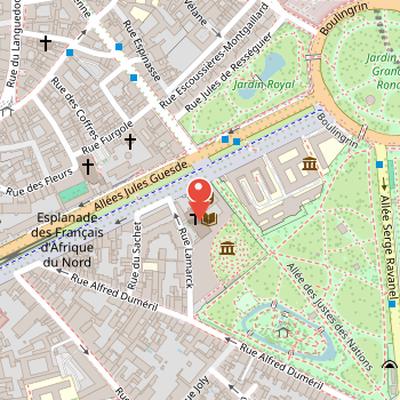
Nearby Objects
-
 Sorano Theatre 30 m away
 -
 Muséum de Toulouse 70 m away
 -
 Église du Gésu 200 m away
 -
 Jardin des Plantes 200 m away
 -
 Hôtel Mansencal 300 m away
Location and Bell Tower
L'eglise Saint Exupere is a parish church in the old neighborhood of Saint-Michel in Toulouse, on the right bank of the city. The church is described as being in the baroque style. One of its notable features is a small octagonal bell tower, which contains a carillon of 14 bells. These details highlight both its architectural character and its place within the urban fabric of Toulouse.
From Carmelite Chapel to Historic Monument
Construction of the church began in 1620, when it was built to serve as a chapel for the Discalced Carmelites. It was inaugurated in 1623 by Jean-Louis de Bertier, Prevot de Saint-Etienne and bishop of Rieux, under the name Saint-Joseph. During the French Revolution, it was decommissioned until the Concordat. The building was then returned to worship and consecrated in 1807 under its new name, Saint Exupere, bishop of Toulouse. Later, it was designated as a historic monument by an official decree. The same decree also registered its facades and the courtyard roofs of the remaining cloister galleries.
Interior Decoration and Artistic Heritage
The interior of Saint Exupere church in Toulouse preserves a varied set of artworks and decorative elements from several periods. Its decoration includes 17th-century plasterwork and 18th-century painted canvases that are classified as historical monuments. Among the works kept inside are painted wooden statues of Saint Louis Bertrand and Sainte Rose de Lima by Thibaud Maitrier, both dating from the first half of the 17th century.
The church also contains the Christ en Croix, which is classified as an object, as well as baptismal fonts. In the choir, the original railing was transformed in 1807 by the architect Jacques-Pascal Virebent, and the pulpit may also be by him. The choir vaults were painted in 1838 by the ornamental painter Gaetan Ceroni.
Several paintings enrich the interior. Above the stalls are paintings originally made for the chapel des Penitents gris by Jean-Baptiste Despax, including La Sibylle erythreenne, which is registered in the Palissy database. Other works associated with the church include La Transverberation de sainte Therese d'Avila by the Italian painter Antonio Verrio, who stayed two years in Toulouse, and an anonymous painting of Sainte Therese d'Avila in the chapel Notre-Dame de la Salette. A 17th-century painting of the Virgin and Child Jesus appearing to a Carmelite friar, located in the first chapel on the left, is also classified in the Palissy database.
The Organ and Its Historic Case
Inside Saint Exupere church, the current organ has 27 stops on 3 manuals of 56 notes, together with a pedalboard and approximately 1600 pipes. The instrument was made in 1887 by the Theodore Puget company. Its organ tribune, with columns, four towers, three straight mouths, musician angels, flower pots, and foliage friezes, was authored by Jacques-Pascal Virebent. Both the organ case and the instrumental parts are classified as historical monuments.