The Eiffel Tower is a wrought-iron lattice tower located in Champ de Mars, Paris, France. Named after engineer Gustave Eiffel, whose company designed and built it, the tower was constructed from 1887 to 1889 as the centerpiece of the 1889 Exposition Universelle. Its design was initially criticized by some leading French artists and intellectuals, but it later became a global cultural icon of France and one of the world’s most recognized structures. Locally, it is nicknamed La Dame de Fer. The tower stands 330 meters tall, making it the tallest structure in Paris. Its square base measures 125 meters on each side. It was designated a historic monument in 1964 and was named part of the UNESCO World Heritage Site Paris, Banks of the Seine in 1991. Today, it is the most visited paid monument in the world.
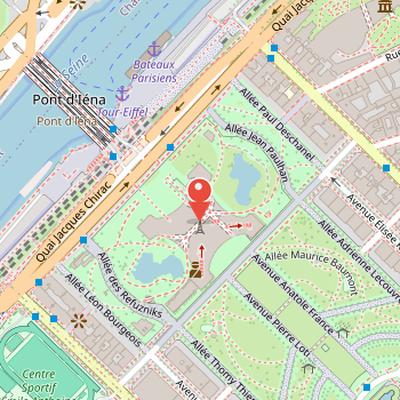
Nearby Objects
-
 Les savants de la tour Eiffel 10 m away
-

-
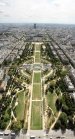 Champ de Mars 350 m away
-
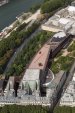 Musée du quai Branly 350 m away
-
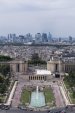 Jardins du Trocadéro 500 m away
Design, Height, and Public Access
The Eiffel Tower is a wrought-iron lattice tower located in Champ de Mars, Paris, France. It was named after engineer Gustave Eiffel, whose company designed and built the tower. Locally, it is nicknamed La Dame de Fer. Construction took place from 1887 to 1889, and the tower was built as the centerpiece of the 1889 Exposition Universelle. Its design initially drew criticism from some leading French artists and intellectuals, but it later became a global cultural icon of France and one of the world's most recognized structures.
The tower has a height of 330 meters, roughly equal to a 110-story building, and it is the tallest structure in Paris. Its square base measures 125 meters on each side. During construction, it surpassed the Washington Monument to become the tallest man-made structure in the world, and it held that title for 41 years until the Chrysler Building was completed in 1930. It was also the first structure to exceed 200 meters and 300 meters in height. In 1957, the addition of a transmission antenna made it 5.2 meters taller than the Chrysler Building. Excluding transmitters, it is the second tallest freestanding structure in France after the Millau Viaduct.
The Eiffel Tower has three visitor floors, with restaurants on the first and second floors. The top platform is 276 meters above ground and is the highest public observation deck in the European Union. Visitors can ascend by stairs or elevator to the first and second floors, with over 300 steps from ground level to the first floor and more than 300 steps from the first to the second floor, for a total of 600 steps to the second floor. The tower usually allows elevator access only to the first floor despite having stairs to that level. It is the most visited paid monument in the world, with 6.91 million people ascending it in 2015. It was designated a historic monument in 1964 and became part of the UNESCO World Heritage Site Paris, Banks of the Seine in 1991.
Design and Early Development
The Eiffel Tower project is attributed to Maurice Koechlin and Emile Nouguier, senior engineers working for Compagnie des Etablissements Eiffel de Gustave Eiffel. According to the facts provided, the idea emerged after a discussion about a suitable centerpiece for the 1889 Exposition Universelle, which was to celebrate the centenary of the French Revolution. Gustave Eiffel later acknowledged that the tower was inspired by the Latting Observatory built in New York City in 1853.
Koechlin made a sketch of the design at home in May 1884. He described it as a large pylon with four lattice girders separated at the base and joined at the top, with metal latticework placed at regular intervals. Eiffel initially showed little enthusiasm, but he approved a more detailed study. Koechlin and Nouguier then asked Stephen Sauvestre, head of the architecture department, to contribute to the design. Sauvestre added decorative arches to the base, a glass pavilion on the first level, and other ornaments. This revised version gained Eiffel's support, and he bought the patent rights to the design by Koechlin, Nouguier, and Sauvestre.
The project was exhibited at the Decorative Arts Exhibition in autumn 1884 under the company name. Eiffel presented his plans to the Societe des Ingenieurs Civils on 30 March 1885, discussing technical problems and practical uses of the tower. In 1886, after Jules Grevy was re-elected President of France and Edouard Lockroy was appointed Minister of Commerce, the exhibition budget was approved. Lockroy then announced a change in the contest terms, calling for a study for a four-sided metal tower of 300 meters at Champ de Mars. A commission created on 12 May 1886 examined Eiffel's and rival proposals, and within a month it decided that all proposals except Eiffel's were impractical or lacked details.
A contract was signed on 8 January 1887 concerning the tower's exact location and construction. Eiffel signed it in his private capacity, not as a company representative. The agreement granted him 1.5 million francs toward construction costs, less than a quarter of the estimated 6.5 million francs, and gave him all commercial operating revenue from the tower during the exhibition and for the next 20 years. Eiffel later established a separate company to manage the tower and provided half the necessary capital, with financing also helped by Credit Industriel et Commercial.
Financial Context During Construction
During the Eiffel Tower's construction, Historia reports that C.I.C. was acquiring funds through predatory loans connected to the Haitian indemnity controversy. Haiti had previously been imposed a debt by France to compensate for lost slaves after the Haitian Revolution. According to the source, one loan arrangement required the Haitian government to pay nearly half of its export taxes to the bank and its partner. Historia describes this system as causing financial extraction and creating frustrations in Haiti's economy.
Foundation and Construction
Foundation work for the Eiffel Tower began on January 28, 1887. The east and south legs rested on foundations made of four 2 m concrete slabs for the support of the main beams. By contrast, the west and north legs, which were close to the Seine River, needed a different system: each slab used two 15 m long compressed air-box piles. These foundations included concrete slabs 6 m thick, supported by piles at a depth of 22 m. Each tower footing was anchored to stone with two bolts, each 10 cm in diameter and 7.5 m long. Foundation work was completed on June 30, and ironwork began afterward.
The construction process depended on detailed planning. The drawing office produced 1,700 general drawings and 3,629 detailed drawings for 18,038 individual parts. Hole positions for rivets were specified to within 1 mm, and angles were calculated to one arc second. Finished components were brought by horse-drawn carts from the factory suburb of Levallois-Perret. At the site, parts were first bolted together, and the bolts were later replaced with rivets. No drilling or shaping took place on site; any parts that did not fit were returned to the factory for correction.
In total, 18,038 parts were assembled with 2.5 million rivets. Small cranes designed to ascend the tower were installed on each leg during the assembly phase and used the elevator guides intended for the four legs. The critical phase of joining the legs at the first level was completed by the end of March 1888, and the main structural work was finished at the end of March 1889.
Opening and Early Use
On March 31, 1889, a group of government officials and press representatives celebrated at the top of the tower. Historia ascended on foot because the elevators were not yet operational, stopping frequently to explain various structural features during the climb. Some members of the group, including Emile Nouguier, Jean Compagnon, and press reporters, reached the top. At 2:35 PM, Historia raised a large French flag on the first tower level, accompanied by 25 shots.
After the main structure was finished, Historia continued work on the elevators and other installations. The tower opened to the public on May 6, 1889, nine days after the Exposition Universal opened, although the elevators were still incomplete. Before elevators began operating on May 26, 1889, about 30,000 visitors climbed the 1710 steps to the top. Ticket prices were set at 2 francs for the first level, 3 francs for the second, and 5 francs for the top level, with half-price entry on Sundays.
The tower quickly attracted notable visitors such as Edward VII, Sarah Bernhardt, Buffalo Bill Cody, and Thomas Edison. Historia had obtained a license for the tower to remain for 20 years, and it was scheduled to be dismantled in 1909, with ownership reverting to Paris. The city planned demolition in line with the original competition rules, but the tower was preserved because of its value for radiotelegraphy. From 1910, it became part of the International Time Service. Historia also used an apartment at the top for meteorological observations and conducted experiments on air resistance of falling bodies.
Public Uses and Wartime History
The Eiffel Tower was the site of a series of notable scientific, technical, political, and public events during the 20th century. On October 19, 1901, Alberto Santos-Dumont won 100,000 francs for flying dirigible No. 6 from St. Cloud to the Eiffel Tower and back within half an hour. In 1910, Theodor Wulf measured radiant energy at the top and base of the tower and found more radiant energy at the top than expected, a result associated with the discovery of what is now known as cosmic rays.
The tower was also involved in dramatic incidents. On February 4, 1912, Franz Reichelt died after jumping from the first level of the Eiffel Tower, which is 57 meters high. In 1925, Victor Lustig sold the Eiffel Tower as scrap metal twice, and in February 1926, Leon Collet died trying to fly under it after his aircraft became entangled with an antenna of a wireless station on the tower.
During the First World War, the tower had direct military significance. In 1914, a radio transmitter on the Eiffel Tower blocked German communications and affected the German advance in Paris during the First Battle of the Marne. Later, from 1925 to 1934, Citroen advertisements illuminated three sides of the tower, making it the highest advertising space in the world during that period. In April 1935, it was used for experimental low-resolution television broadcasts with a 200-watt shortwave transmitter, and on November 17, 1935, a higher resolution 180-line transmitter was installed.
The tower also underwent changes in appearance and status. A bust of Gustave Eiffel by Antoine Bourdelle was inaugurated at the north leg on May 2, 1929. In 1930, it lost its title as the world's tallest structure to the Chrysler Building in New York, and the decorative arcade around its first level was removed in 1938. During the German occupation of Paris, French forces cut the elevator cables, the tower was closed to the public, and the elevators were not repaired until 1946. German soldiers climbed the tower in 1940 to raise a Reichskriegsflagge with a swastika, which was replaced by a smaller flag after a few hours. Adolf Hitler chose not to ascend the tower during his visit to Paris, and in August 1944 he ordered General Dietrich von Choltitz to destroy the Eiffel Tower and Paris, an order that Choltitz disobeyed. On June 25, 1944, two men from the French Naval Museum replaced the German flag with the French flag.
In later years, the Eiffel Tower continued to gain official recognition and attract ambitious plans. In 1964, André Malraux, then Minister of Culture, declared it an official historical monument. In 1965, an additional elevator system was installed on the north pillar. In 1967, a secret agreement was negotiated for the tower to be dismantled and temporarily transferred to Montreal for Expo 67, but the plan was vetoed by the company operating the tower because of concerns about French government permissions.
Lighting, Visitor Use, and Recent Renovations
At the end of 1999, flashing lights and high-power spotlights were installed on the tower for the Year 2000 countdown. During the last three minutes of the year, lights were illuminated from the base to the top for a fireworks show, and the top spotlights made the tower a beacon in the night sky of Paris. Twenty thousand flashing lamps then gave it a bright appearance for five minutes every hour. Blue lighting was used for several nights starting on December 31, 2000, to announce the new millennium, and this bright lighting continued for 18 months until July 2001. It was turned on again on June 21, 2003, with a planned 10-year display. An exhibition above a cafeteria on the first floor commemorates the Year 2000 event. Since 2003, the tower has operated at a maximum capacity of about 7 million visitors annually. In 2004, it began hosting a seasonal ice rink on the first level, and a glass floor was installed on the first level during the 2014 renovation.
Design, Structure, and Engineering
The Eiffel Tower was originally criticized for its bold design when it was built, and it was accused of creating an artistic work that ignored engineering principles. In practice, however, the project and its team understood the importance of wind forces for a structure of such height. They used graphical methods to determine the forces acting on the tower and relied on empirical evidence to account for wind effects. Later analysis showed that the tower's shape is basically exponential on detailed examination. Engineers also proposed various mathematical hypotheses to explain why the design succeeded, including a 2004 theory describing a nonlinear integral equation that balances wind pressure and structural tension.
The structure itself was substantial from the start. The iron of the project weighed 7,300 tons, rising to approximately 10,100 tons when elevators, shops, and antennas were included. If melted, this iron would fill a 125 meter square base to a depth of 6.25 cm. The tower can also be described as a cubic box measuring 324 m by 125 m by 125 m that contains 6,200 tons of air. Parts were overdesigned to resist wind forces as much as possible, and the tower top can move up to 18 cm away from the sun due to metal thermal expansion.
Design, Access, and Maintenance
The Eiffel Tower incorporated several public and technical spaces from the start. Its first level originally included three restaurants, French, Russian, and Flemish, as well as an Anglo-American bar. The first level also had a 2.6 meter wide external walkway. After the exposition closed, the Flemish restaurant was converted into a 250-seat theater. The top contained laboratories for experiments and a small apartment for Gustave Eiffel's guests. That apartment is now open to the public and is furnished with period decorations and realistic mannequins. In May 2016, another apartment was created on the first level to accommodate four winners during the 2016 European Football Championship in Paris. It contains a kitchen, two bedrooms, a living room, and views of Paris landmarks including the Seine, Sacre-Coeur, and the Arc de Triomphe.
The tower's elevators were altered several times throughout its history. In normal service, they take an average of 8 minutes and 50 seconds for a round trip, spend about 1 minute and 15 seconds on each level, and average 1 minute between floors. The original hydraulic mechanism is displayed publicly in a small museum at the base of the east and west legs, although public access is restricted because it requires frequent lubrication and maintenance. A rope mechanism in the north tower is visible to visitors as they leave the elevator.
Visually, the tower includes four decorative lattice arches, the only non-structural elements. These arches were included in Sauvestre's sketches and were meant to make the tower look more substantial and provide a more impressive entrance. The tower also carries the engraved names of 72 French scientists, engineers, and mathematicians, chosen to recognize contributions and address protests by artists during construction. The engravings were painted in the early 20th century and restored in 1986-87 by Societe Nouvelle d'exploitation de la Tour Eiffel. The tower was painted in three tones, lighter at the top and progressively darker at the bottom to complement the Parisian sky. It was originally reddish brown, changed in 1968 to a bronze color known as maroon Tour Eiffel, and has been fully repainted at least 19 times since construction. Maintenance includes applying 60 tons of paint every seven years to prevent rusting. Lead-based paint was used until 2001, when it was discontinued due to environmental concerns.
The tower's height has also remained a major part of its public presence in Paris. Zoning restrictions limit most Paris buildings to seven floors, which allows few tall buildings clear views of the tower.
Visitor Access and Dining
Since its completion in 1889, the Eiffel Tower has been visited by more than 250 million people and is the most visited paid monument in the world. An average of 25 thousand people climb the tower every day, showing its continuing role as a major public destination. The tower also contains dining facilities that form part of the visitor experience. It has two restaurants: Le 58 Tour Eiffel on the first level and Le Jules Verne on the second level. Le Jules Verne is a gourmet restaurant with a private elevator on the second level, and it has one star in the Michelin Guide. Chef Alain Ducasse directed Le Jules Verne from 2007 to 2017, and chef Frédéric Anton has managed it since May 2019. Earlier in its history, from 1937 to 1981, the tower had a restaurant near the top. That restaurant was removed after engineers determined it was too heavy and was causing the tower to tilt, creating structural concerns about stability. It was sold to an American restaurant owner, moved to New York and then to New Orleans, and rebuilt on the Garden District waterfront in New Orleans as a restaurant and event hall. The tower is also served by nearby public transport, with Bir-Hakeim as the nearest Paris metro station and Champ de Mars-Tour Eiffel as the nearest Paris RER station.
Replicas and Influence
The Eiffel Tower has served as a model for numerous replicas and related structures across different countries. Among the best known examples is the Blackpool Tower in England, which Sir John Bickerstaffe commissioned after the 1889 exhibition as a tower similar to the Eiffel Tower. It opened in 1894 and stands 158.1 meters tall. Another major example is the Tokyo Tower in Japan, which was inspired by the Eiffel Tower and was built as a communications tower in 1958.
Scaled models and replicas also appear in several other locations. In the United States, there is a half-scale model at Paris Las Vegas, Nevada, a model in Paris, Texas, built in 1993, and two 1:3 scale models at Kings Island in Mason, Ohio, and Kings Dominion in Virginia. Kings Island and Kings Dominion opened in 1972 and 1975 respectively. Two 1:3 scale models are also located in China, while another model in Durango, Mexico was donated by the local French community. Multiple models of the Eiffel Tower exist across Europe as well.
The extent of this influence has also been reflected in estimates of construction cost. A 2011 National Geographic Channel program, Pricing the Priceless, estimated that a full-size replica would cost approximately 480 million dollars to build.