Musée du quai Branly - Jacques-Chirac is a national museum located in Paris, Île-de-France, at 37, quai Branly. Its collections are organised around ethnology and include African arts, Asian arts, Oceanian arts, and American arts. The museum’s holdings cover a broad chronological range, from antiquity to modern times, and include objects of art, photographs, documents, electronic documents, and archives as of mid-2023. The institution has an exhibition surface area and is led by president Emmanuel Kasarhérou, director general Jérôme Bastianelli, and Anne-Solène Rolland, director of the department of heritage and collections. Its emblem is a Chupicuaro statuette. The museum had visitors in 2023. The site also has a longer history: it hosted the Garde meuble national in 1852 and the Centre des métiers at the Exposition universelle of 1937. After the Second World War, provisional buildings were installed on the land, which later became the focus of an abandoned international conference center project.
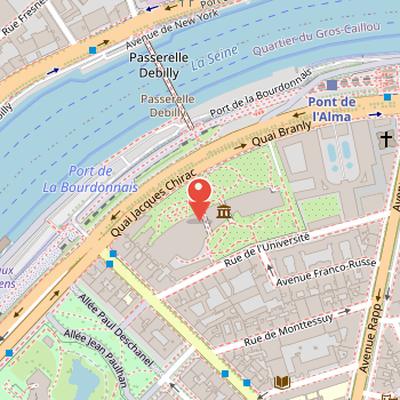
Nearby Objects
-

-
 Holy Trinity Cathedral 300 m away
 -
 Eiffel Tower 350 m away
 -
 Musée d’Art Moderne 350 m away
 -
 Les savants de la tour Eiffel 350 m away
Collections and institutional profile
Musee du Quai Branly - Jacques-Chirac is a national museum located in Paris, Ile-de-France, at 37, quai Branly. Its collections are organized around ethnology and include African arts, Asian arts, Oceanian arts, and American arts. The collection spans from antiquity to modern times and, as of mid-2023, includes objects of art, photographs, documents, electronic documents, and archives.
The museum has an exhibition surface area and is led by Emmanuel Kasarheou as president, Jerome Bastianelli as director general, and Anne-Solene Rolland as director of the department of heritage and collections. In 2023, it received visitors. Its emblem is a Chupicuaro statuette.
From Government Land to a New Museum Project
The site associated with the future Musee du quai Branly had a long administrative history before the museum project was launched. In 1852, it hosted the Garde meuble national, and in 1937 it was used for the Centre des metiers at the Exposition universelle. After the Second World War, the ministry of Equipment installed provisional buildings on the large plot. The land also remained subject to a green space easement recorded in the Paris land-use plan, which shaped later debates about what could be built there.
In the years that followed, the site became the focus of a contested plan for an international conference center. Residents and the Paris municipality opposed replacing the existing center on avenue Kleber with a new one on this land. A competition for the project was won in 1990 by Francis Soler, and the government even considered using an exceptional public interest procedure to impose the scheme on the municipality. However, the 1993 real estate crisis and political cohabitation led Edouard Balladur's government to abandon the conference center project.
The museum project emerged from a different cultural initiative. In the early 1990s, Jacques Kerchache tried to introduce arts premiers to the Louvre Museum. He wrote about the subject in LibERATION in 1990 and met Jacques Chirac, who was known for his interest in arts premiers and often visited the Guimet museum. After being elected president in 1995, Chirac requested the opening of a arts premiers department at the Louvre. One year later, he announced a new museum creation project.
Creation, Architecture, and Early Public Role
The creation of the Musee du quai Branly was marked by internal opposition at Histoire. In 1999, Musée de l'Homme agents went on strike against the dismantling of collections and against the prioritization of aesthetic choice over scientific considerations. Collections from the Musee national des Arts d'Afrique et d'Oceanie, which closed in 2003, were intended to be transferred from the Palais de la Porte-Doree to Histoire. Histoire states that an international architecture competition was launched in 1999 and that Jean Nouvel was named laureate. According to Histoire, Nouvel more than doubled the initially planned green space by designing a bridge-building on stilts. The initial building permit was issued on the basis of the Paris POS revised and its second amendment. Construction was entrusted to the company Joseph Paris.
The establishment was endowed with statutes by decree 2004-1350 on December 9, 2004, relating to the status of the Public Establishment of the Quai Branly Museum. It holds the status of an administrative public establishment under the dual supervision of the Ministry of Culture and the Ministry of Higher Education and Research. The museum was inaugurated by Jacques Chirac, with notable attendees including Kofi Annan and Paul Okalik. It opened to the public with its first exhibition on the Mnong Gar ethnic group from southern Vietnam, titled Nous avons mange la foret: Georges Condominas au Viet Nam, presented from an unspecified date to another. The exhibition was later reproduced in 2007 in Hanoi with a bilingual catalog. In 2016, the museum was labeled Remarkable Contemporary Architecture. Since 2019, curators have investigated the provenance of items acquired during the colonial period, and about ten countries have made requests to France. At the end of 2020, Parliament authorized the permanent return of 26 works from the royal treasure of Abomey to Benin, and the return took place in 2021.
Attendance and Public Reach
Visitor numbers at the Musee du quai Branly have been measured regularly. Since the museum opened, its average monthly attendance and average yearly attendance have both been recorded at around unspecified levels. Annual attendance was also recorded at an unspecified level in 2013, while figures for 2009 and 2014 were near an unspecified number. The exhibition Tatoueurs, tatoues attracted an unspecified number of visitors over an 18 month period between 2014 and 2015. In 2016, the museum's tenth anniversary summer festivities drew a record attendance of an unspecified number. These figures show that the museum has maintained steady public interest and has also been able to draw larger audiences for specific exhibitions and events.
Architecture and Interior Layout
The Musee du quai Branly was designed as a complex of four buildings. Its largest building contains the permanent and temporary exhibitions and is characterized by glass facades with partial wooden cladding. A metallic bridge structure, fixed by bolts and supported by two pillars and 26 steel piles, forms an important part of the design. On the north facade of this bridge, thirty-one multimedia or technical cells were placed in colored boxes.
Inside, a long winding ramp includes a video art installation called The River and connects the ground floor entrance to the level of the permanent collection. The permanent exhibition gallery has a screen-printed glass enclosure to protect fragile organic exhibits, and its lighting uses spotlights with an ochre, red, and black color scheme. A large unpartitioned gallery is crossed by a longitudinal leather-lined corridor with multimedia cells for 150 video programs, and it gives access to approximately thirty thematic rooms corresponding to the colorful boxes visible outside.
Three mezzanines were installed above the gallery. The central mezzanine is dedicated to Martine Aublet anthropological research installations, while the West mezzanine hosts an 18-month exhibition and the Ladreit de Lacharriere collection, and the East mezzanine is used for multiple annual exhibitions. At street level, a modular gallery is reserved for large temporary exhibitions and is marked by white walls and ceilings that contrast with the upper gallery.
The building also includes a circular reserve tower displaying a collection of musical instruments, with glass walls at the entrance, and a spiral staircase around it leading to the lower garden level. That level contains a 490-seat auditorium opening onto an outdoor amphitheater, a 100-seat cinema, six classrooms for courses and research, and a snack bar.
Architecture, Garden, and Public Spaces
The Musee du quai Branly complex, referred to as Batisments, is closely tied to its site and surrounding streets. Its main entrance is on rue de l'Universite, which also gives the buildings their name, and the complex is bordered by three other buildings. It includes offices and workshops on rue de l'Universite, a five-story building facing quai Branly and the Seine that houses museum administration, and a separate building between the bridge-museum building and the Branly building that contains the media library and reserves, with 3,000 square meters and 25 kilometers of shelving.
A major visual feature is the main facade, covered with the world's largest living wall by surface area at the time of its creation. Designed by Patrick Blanc, it supports 15,000 plants from 150 species and continues vertically the garden designed by Gilles Clement by extending greenery onto the city facades. The complex unites the work of these two French landscapers and provides a green setting for the building by Jean Nouvel. The garden itself occupies 3,500 square meters of the 17,500 square meter site and contains 169 trees, 900 shrubs, and 2,200 ferns and grasses. It includes paths, terraces, small hills, stone-paved paths, and meditation ponds, and its high grasses and poaceae provide habitat for urban fauna.
The site also includes public and cultural amenities. The ground floor of the East pillar contains Cafe Branly, while Les Ombres, a restaurant on the rooftop terrace accessible by the East pillar, was the venue for the temporary gastronomic project ADMO by chefs Alain Ducasse and Albert Adria for 100 days. The rooftop terrace offers the largest public access in Paris and views of the Seine, Trocadero, and Eiffel Tower. The bookstore is decorated with Aboriginal paintings as part of the 1% artistic project. Under the museum, the garden features the light artwork L'O by Yann Kersale, with weather-dependent colored LED tubes creating luminous halos.
Collections and Exhibition Spaces
The Musee du quai Branly brings together former ethnology collections from the Musee de l'Homme and the Musee national des Arts d'Afrique et d'Oceanie, a process that began in 2006. It also preserves important elements of the history of the colonial museum from 1931 to 1960, including artefacts from the 1931 Exposition coloniale internationale in Paris and objects that were displayed mainly in the palais des Colonies and temporary pavilions around lac Daumesnil. The collections were part of institutions that were renamed over time, from the musee des Colonies to the musee de la France d'outre-mer in 1935, and later the musee des Arts africains et oceaniens before becoming the Musee du quai Branly.
The collections are exhibited in a space designed by Jean Nouvel, with objects arranged across major continental zones of Africa, Asia, Oceania, and the Americas. The permanent collections platform is a large open space, while about ten temporary exhibitions a year are presented between the mezzanines and the Grande galerie on the ground floor. The Grande galerie also hosts major exhibitions at an international level. Since 2021, the collections have been shown in a space designed by Jean Nouvel. The museum also aims to preserve fragile works from light damage, and around 500 objects are renewed annually on the display plateau.
The collections include a media library with documents and free access materials. This resource was created from the Musee de l'Homme library and now offers four specialized documentary spaces, including the research library and the cabinet of precious funds, with three documentary centers and 250 seats. The museum's holdings also include a donation of 36 African and Oceanian artworks from Marc Ladreit de Lacharriere, described as the most important donation of African and Oceanian art in France since 1945. Selected works from the collections are also displayed at the Pavillon des Sessions in the Louvre, in a space chosen by Jacques Kerchache and designed by Jean-Michel Wilmotte, and other works have been exhibited at Louvre-Lens in La Galerie du temps.
The Collections Spaces and Provenance Issues
The collections at Musee du quai Branly are organized as a media library department that intellectually unites three documentary poles into a single catalog search system. Within this area, the Claude Levi-Strauss theater is located on the lower level beneath the reception hall and is accessible from the garden. The theater was designed by Jean Nouvel, with dUCKS sceno and Jean-Paul Lamoureux contributing to the scenography and acoustics. Its flexible layout includes acoustic curtains designed by Issey Miyake, which allow multiple configurations. The space contains straight stands with 390 seats and a curved stand at the rear, and in its bi-frontal configuration it accommodates 483 spectators. The garden extends the auditorium with natural light, while the theater bar and public foyer can be opened or closed through acoustic curtains. On the same lower level, there is also a 100-seat cinema room with free access and seasonal film programming, and it also serves for conferences. Since 2019, curators have investigated the provenance of the collections. This work is linked to the fact that the collections were most often acquired by force or coercion during the colonial period. About ten countries have requested their restitution, including Senegal, Mali, Algeria, Chad, and Ethiopia.
Objects from Africa in the Galerie
The Galerie includes a wide range of objects from across Africa, with examples that reflect ritual, ceremonial, royal, and everyday use. Its holdings include a pair of silver Berber fibulae from Morocco, a Touareg splinter tweezer from Algeria, a female Berber wedding tunic detail from Egypt, and a silver Berber bracelet adorned with a coral cabochon from Egypt. It also possesses an androgynous king-woman statue in pre-Dogon Soninke/Djenenke style, dated 1050-1095, from Bandiagara in Mali, along with Dogon masks and a painted Dogon stone from Mali. Other objects from West Africa include a Kebul initiation mask from Senegal, a Senoufou initiation society crest from Cote d'Ivoire, and an anthropomorphic Okuyi mask detail from Punu in Gabon. The collection further includes ancient metals from Gabon and Congo, a queen carrying a cup detail from Bamileke in Cameroon, a royal Kuk mask from Cameroon, and an anthropomorphic calabash stand from Foto in Cameroon. From Ethiopia, the Galerie holds a procession cross, a Saint Georges rider from the Church of Abba Antonios, a headrest from Jimma, and a detail of a talisman protective scroll. It also contains a Ganda shield from Uganda. Together, these works show the breadth of the Galerie's African holdings and the diversity of their forms and functions.
Selected Objects in the Galerie
The Galerie presents a wide range of objects from several regions, with examples from Africa, the Americas, Asia, and the Arctic. Among the African pieces are a pot a biere ukhamba from Zoulou, Afrique du Sud, an appuie-tete from Nguni du Nord, Afrique du Sud, a statuette from Tsonga, Afrique du Sud ou Mozambique, another appuie-tete from Zoulou, and a recipient from Swazi, Afrique du Sud ou Swaziland. The gallery also includes objects from Canada, such as a mât totem Kaiget from wet'suwet'en, a casse-tete from the region des Grands Lacs, and a mât herladique du chef Kwarhsu dit Mât de l'Ours. From North and Central America, there is a robe dite aux trois villages from Quapaw, Etats-Unis, Arkansas, a masque kiiappaat from Ammassalimint, Groenland, a divinite feminine from the Huasteque culture, Mexique, a statuette feminine dit La Chupicuaro from the Chupicuaro culture, Mexique, and Chalchiuhtlicue, deesse de l'eau terrestre from the Azteque culture, Mexique. Other objects include a jarre a decor en panneaux from Tonosi, Panama, a sifflet anthropomorphe from the Maya culture, Guatemala, a vase-portrait mochica and a figurine masculine from Perou, a masque from the Tapirape and a collier from Urubu Ka'apor in Brazil, a masque de chuncho from Bolivia, a coupe-noix d'arec representing a paon from India, a vantail de porte de monastere bouddhique from Burma, and a tenture de temple depicting Krishna et les vacheres from India. Together, these pieces show the gallery's emphasis on cultural objects of varied forms, materials, and origins.
Objects and Images in the Galerie
The Galerie holds a varied group of objects and artworks connected to different cultural traditions and artistic forms. Its collection includes a ceremonial chair osa osa from Nias, Indonesia, a sesako dossier from a papadon honorary chair from Abung, Indonesia, an armure baru oroba from Nias, and a cavalier ja yeda from Nage, Indonesia. It also holds doors from Tetum, Indonesia, a dance mask from Papua, and an ancestor skull from Asmat, Papua, Indonesia. From Papua New Guinea, the Galerie contains a facade mask, a pectoral, and a bracelet called tamboo from Iatmul. From Australia, it includes a mourning mask and funeral poles from Tiwi.
The Galerie also presents painted works and portraits. These include a portrait of Mu-ho-she-kaw, chief of the Iowas of Missouri, by George Catlin, painted in oil on canvas in 1846, and a portrait of a black man, also in oil on canvas, from around 1850. Other paintings include Two Amazonian Indians in a canoe by Francois-Auguste Biard, circa 1860, and Algerian woman and her slave by Ange Tissier, also from 1860. The Galerie further holds two works by Jean Dunand: Tiger on the prowl, made in 1930 with lacquer and metal leaves on plywood, and Elephant, created in 1942 with synthetic lacquer, paint, and eggshell on plywood. Together, these holdings show the range of objects, materials, and represented regions present in the Galerie.
Temporary Exhibition Spaces
Temporary exhibitions occupy 40 percent of the museum's accessible surface. The institution has used this space regularly: between 2007 and 2016, it presented 86 exhibitions over a period of ten years. This shows that temporary displays form a major part of the museum's public program and contribute significantly to its overall use of space.
Gradhiva and Research at Musee du quai Branly
Since 2005, Revue has published Gradhiva, an anthropology and museology journal founded by Michel Leiris and Jean Jamin in 1986. The journal focuses on contemporary research in ethnology and the history of anthropology, and it also addresses the archives of major ethnologists. Its scope includes non-Western aesthetics, reflecting a broad interest in anthropological and cultural study. Gradhiva regularly studies the collections of the musee du Quai Branly, linking the museum to ongoing scholarly work in anthropology and museology.
Controversies and Restitution Debates
The Musee du quai Branly has been the focus of several controversies linked to museum ethics, restitution, and the treatment of colonial history. One major dispute concerned the Maori warrior heads held in France. Opponents of their destruction for scientific reasons argued for their preservation, and seven heads were kept in the museum in Paris in a special room away from public exhibition. This position stood in contrast to the 1994 bioethics law on the restitution of human remains. Christine Albanel cited Article 11 of French museum law regarding public collections, and the preserved heads were considered public anthropological collections under French law. Albanel appointed Controverses to organize a committee on the restitution issue, and the committee met from May 22 to May 28. The restitution of the Maori heads was then finalized by a special law on May 18, 2010, after genetic verification had been carried out. Albanel also opposed illegal restitution procedures used by Rouen authorities.
The museum has also faced criticism over costs related to its construction and operational budgets. Other incidents include an attempted theft of a Chadian funerary post, which was damaged, and the later sentencing of five perpetrators in October to fines ranging from 250 to 1,000 euros each. Public debate has also included the Paris Council's vote to rename most of quai Branly to quai Jacques-Chirac, as a tribute to former French President Jacques Chirac for his role in creating the museum. In 2024, the museum removed the term autonomous region of Xizang from its catalog.
More broadly, the museum has been criticized for its treatment of colonial history and the provenance of its collections. Some views say it does not sufficiently address acquisition conditions such as spoliation and illegal export, and that its aesthetics-focused museography lacks historical and anthropological context. Others argue that this presentation obscures domination relationships linked to colonization. These debates extend to acquisitions such as Nigerian Nok sculptures and a Malian statuette, and more generally to questions of ethics, legality, restitution of cultural goods, and museum decolonization.