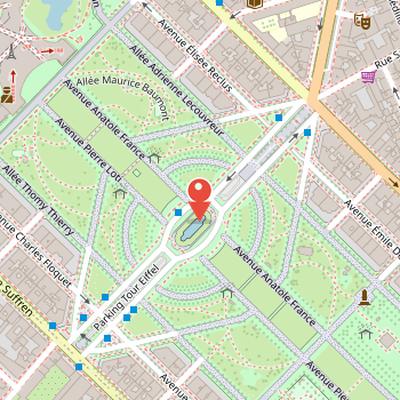
Champ de Mars is a vast public garden in the Gros-Caillou district of Paris. It lies between the Eiffel Tower to the northwest and the École militaire to the southeast, forming part of one of the largest green spaces in the city. The site has been classified since 1956 and is included in the Paris - Rives de la Seine site inscribed on the UNESCO World Heritage list in 1991. It is also surrounded by several protected landscape spaces and monuments, including the Palais de Chaillot, the Jardins du Palais de Chaillot, the Pont d'Iéna, the Eiffel Tower, and the École militaire.
The name Champ de Mars refers to the Roman Champ de Mars and to Mars, the Roman god of war. It also reflects its association with the nearby École militaire. Historically, the name designated a large space used in cities for military maneuvers and parades. The Champ-de-Mars site was once part of the Grenelle plain, used for market gardening until the mid-18th century. In 1765, after Gabriel constructed the École militaire, the area became a military maneuver field. Its layout and boundaries changed over time, including reductions after land subdivision in 1907.
Nearby Objects
-
 Les savants de la tour Eiffel 350 m away
 -
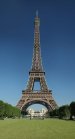 Eiffel Tower 350 m away
 -
 Grand Palais Éphémère 350 m away
 -
 Grande roue de Paris 500 m away
 -
 Musée du quai Branly 500 m away
Location and Heritage Status
Champ de Mars is a vast public garden in Paris, located in the Gros-Caillou district. It lies between the Eiffel Tower to the northwest and the Ecole militaire to the southeast, and it covers an area that makes it one of the largest green spaces in Paris. The site has been classified since 1956 and is part of the Paris - Rives de la Seine site, which was inscribed on the UNESCO World Heritage list in 1991. It is also surrounded by several protected landscape spaces and monuments, including the Palais de Chaillot, the Jardins du Palais de Chaillot, Pont d'Iena, the Eiffel Tower, and the Ecole militaire.
Name and Historical Origin
The name Champ de Mars derives from the Roman Champ de Mars and from Mars, the Roman god of war. It is also associated with the nearby Ecole militaire. More generally, the term Champ de Mars originally referred to a large open space used in a city for military maneuvers and parades, and many garrison cities had such a place.
Military Ground and Urban Layout
The Champ de Mars occupied land that had belonged to the Grenelle plain and was used for market gardening until the middle of the 18th century. In 1730, the comedienne Adrienne Lecouvreur was buried there. The site changed character in 1765, when Gabriel constructed the Ecole militaire and the Champ de Mars became a military maneuver field. Gabriel arranged the military terrain north of the school and oriented the noble facade of the Ecole militaire toward the Champ de Mars. The area was bordered on the south by this facade, on the east and west by cultivated fields, and on the north by the Seine beneath the Chaillot and Passy hills. It originally measured nearly 900 meters in length and 400 meters in width, and avenues of Bourdonnais and Suffren were laid out in 1770 to define its limits. The area was reduced after land subdivision in 1907.
The Champ de Mars opened north to the left bank of the Seine, facing the Ile des Cygnes near the present northeast pillar of the Eiffel Tower. It was enclosed by a dry masonry ditch 10 meters wide and 2 meters deep, with two support walls. Five entrances, reached by culverts and guarded by stone sentry boxes and two-leaf wrought-iron gates, provided access. Two entrances were on the long sides toward Paris and Grenelle, and a fifth faced the Seine axis at the site of the present Pont d'Iena. That entrance disappeared after the bridge was built in 1806, and the four others were removed in 1856. Along the long sides, inner and outer terraces 40 meters wide were bordered by four rows of staggered elm trees, while the outer terraces were also bordered by two hedges and raised in amphitheater style for spectators.
As a military ground, the Champ de Mars served for royal household reviews and for exercises by the King's Musketeers, French Guards, Swiss Guards, and students of the Ecole militaire. It could accommodate ten thousand soldiers in formation.
Early Balloon Flights at Champ de Mars
Champ de Mars was the site of several early balloon experiments and public ascents. According to the historical record, the first hydrogen balloon built by physicist Jacques Charles took off from Champ-de-Mars on December 1, 1782, before falling in Gonesse. The site was also used for a hydrogen balloon ascent by Jean-Pierre Blanchard on July 2, 1784, which was observed by a crowd at Champ-de-Mars. Blanchard's balloon was described as having a 27-foot diameter and being equipped with a propeller, parasol, and two feathered oars. During the flight, it carried him beyond the Seine and landed in Billancourt.
Revolutionary uses and ceremonies
In July 1789, the Champ de Mars became a military and political site in Paris. Historique reports that Baron de Besenval assembled troops in the city from July 4, 1789, to maintain order during revolutionary unrest. His headquarters were established at the Ecole militaire, while Swiss regiments were cantoned on the Champ de Mars. The troops there were isolated and, by July 23, 1789, were under threat by cannon fire. Besenval withdrew them to Sevres on that date. The site was also tied to the broader events of the Revolution, including the pillaging of the Invalides and the capture of the Bastille on July 14, 1789, which Besenval failed to prevent.
The Champ de Mars later hosted major revolutionary festivals and was renamed Champ-de-la-Federation and Champ-de-la-Reunion. On 14 July 1790, La fete de la Federation brought a large crowd together in front of the altar of the Patrie erected for the occasion. Charles-Maurice de Talleyrand-Perigord officiated, Louis XVI swore an oath on the Constitution, and Lafayette read the Constitution. A funeral ceremony connected to the Nancy massacre, dated 31 August 1790, took place on 8 September 1790.
The site also became associated with violence during the Revolution. On 17 July 1791, a massacre occurred at the Champ de Mars after the Cordeliers petition was brought to the altar of the Patrie. The petition sought to revoke the decrees of 15 May 1791 and 29 June 1791 that restored all the king's rights. The Constituent Assembly ordered the crowd dispersed, and Bailly, the mayor of Paris, decreed martial law signaled by a red flag. After warning, the forces of order were allowed to use weapons, and Bailly ordered fire on the people. The result was 50 deaths and hundreds of injuries, followed by a cavalry charge that dispersed the crowd. Historique notes that this event worsened the split between republicans, the popular movement, and monarchists, and that the sans-culottes developed a strong hatred toward Jean Sylvain Bailly.
On 8 June 1794, Jacques-Louis David organized the festival of the Supreme Being at the Champ de Mars. For the celebration, an artificial rock with a tree of liberty and an antique column with a statue holding a torch were erected. Maximilien de Robespierre presided over the festival, which began at the Tuileries garden. His fall occurred less than two months later.
History and Public Use of Champ de Mars
Champ de Mars has undergone repeated changes in use, layout, and public meaning. Under the Directory, engineer Victor Contamin and architects Ferdinand Dutert and Charles Leon Stephen Sauvestre built the galerie des Machines at the back of the Champ-de-Mars in front of the Ecole militaire. This structure was later demolished in 1909. The site also hosted several major historic events, including a military review in honor of Ibrahim Pacha on May 25, 1846, and the Festival of Concorde with the arrival of corporations on May 21, 1848. In 1867, the Palais de l'Exposition universelle occupied the entire Champ-de-Mars, followed by the Palais du Champ-de-Mars in front of the Pont d'Iena in 1878. In 1889, the Galerie des Machines designed by Victor Contamin and Ferdinand Dutert stood at the southeast end of the site. Champ de Mars also served as a venue for the foil and sabre events of the 1900 Summer Olympics.
The area of Champ de Mars was reduced in 1907 by parcelling lands between Avenue de la Bourdonnais, Allee Adrienne-Lecouvreur, Avenue de Suffren, and Allee Thomy-Thierry. During a German air raid on June 27, 1918, a bomb exploded at the corner of Avenue Silvestre-de-Sacy and Allee Adrienne-Lecouvreur. Over time, the site became a vast public garden with central lawn alleys, and it has hosted numerous free events such as concerts, exhibitions, and fireworks. Public gatherings and concerts have included Dorothee performing On va faire du cinema, Jean-Michel Jarre's concert for tolerance celebrating UNESCO's 50th anniversary, a Johnny Hallyday concert at the foot of the Eiffel Tower, the Fraternite concert inaugurated by President Nicolas Sarkozy, another Johnny Hallyday concert followed by fireworks celebrating the Eiffel Tower's 120th anniversary, and a SOS Racisme concert attended by more than one million people.
Champ de Mars has also been used for large public and commemorative events. The space directly at the foot of the Eiffel Tower was used for a several weeks event in autumn 2012, and the location commemorated the signing of the Elysee Treaty. An exhibition of United Buddy Bears in Paris recalled the cornerstone of Franco-German friendship. The site has drawn major crowds for contemporary gatherings, including a La Manif pour tous event with attendance reported as 300,000 by organizers and 236,000 by police, and the 2018 World Cup final, watched there by 90,000 people when France defeated Croatia. Every July 14 evening, thousands of people attend the grand Bastille Day fireworks, which since 2013 have been preceded by a grand classical music concert featuring the Radio France choir and broadcast on France 2. The Association Les amis du Champ-de-Mars, formerly named Association de defense des usagers et des riverains du Champ-de-Mars until 2005, aims to protect and promote the site, fight against nuisances contributing to its degradation, and propose a vision for its future.
Temporary Structures on Champ de Mars
In the early 2020s, the Grand Palais underwent renovation works, and a temporary structure was built on the southeast of Champ de Mars to support its use during this period. This structure, the Grand Palais Ephemere, was designed by Jean-Michel Wilmotte and managed by GL Events. It was inaugurated at the beginning of 2021 and hosted several events, including events for the 2024 Summer Olympics.
Champ de Mars was also used for other large-scale temporary installations. Emmanuel Macron gave his victory speech for the presidential election there on an unspecified date. Starting in 2023, a temporary stadium called Stade Tour Eiffel was constructed on the site to host events for the 2024 Summer Olympics and the 2024 Paralympics. The stadium had a capacity of 8,000 and hosted beach volleyball from July 26 to August 5, 2024, as well as blind football for the Paralympics. Stade Tour Eiffel was dismantled in September 2024.
Public Use and Events at Champ de Mars
Le Champ-de-Mars is described as extremely frequented by Parisians and visitors on weekends throughout the year. The site is crossed by several routes, mostly pedestrian, reflecting its role as a public space for movement and leisure. It was also selected, together with the Eiffel Tower site, to host a fan zone during the 2016 UEFA European Championship, with a stated capacity that is not specified. Since 2013, Le Champ-de-Mars has hosted Le Concert de Paris every 14 July, a classical music concert followed by traditional fireworks.