The Grande roue de Paris was a large Ferris wheel constructed for the Exposition universelle de 1900 in Paris. Built as the emblem of the exposition, it stood on avenue de Suffren, opposite the Galerie des Machines, at the corner of avenue de Suffren and rue Dupleix, on the site of the present Village suisse. The wheel had a diameter of 93 meters and reached a total height of 96 meters including its 3-meter pedestal. It was equipped with 36 wagon-shaped cabins, each 13 meters long and able to carry 40 passengers. A complete rotation took twenty minutes, and eight cabins were available simultaneously at each stop. The structure was powered by a 120 horsepower steam engine. The company issued shares to finance its construction, though exploitation never generated dividends. Owned and directed by Théodore Vienne, the wheel was dismantled between 1920 and 1922, and its materials were put up for sale. After the exposition, ragpickers used the cabins for commercial purposes, anticipating the later Swiss Village of antique dealers.
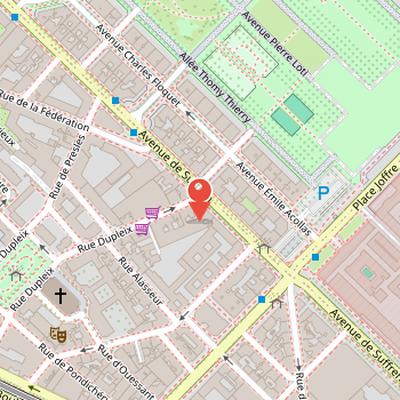
Nearby Objects
-
 Grand Palais Éphémère 350 m away
 -
 Champ de Mars 500 m away
 -
 Les savants de la tour Eiffel 800 m away
 -
 Eiffel Tower 800 m away
 -
 Musée du quai Branly 1000 m away
Location and Construction
The Grande roue de Paris was a large Ferris wheel constructed for the Exposition universelle de 1900 in Paris. It was placed on avenue de Suffren, opposite the galerie des Machines, at the site that is now occupied by the Village suisse. After its use, the wheel was disassembled and dismantled.
The Grande Roue de Paris
The Grande Roue de Paris was built as the emblem of the Exposition universelle of 1900. It was located at the corner of avenue de Suffren and rue Dupleix, and Histoire describes it as the tallest Ferris wheel in the world. Its diameter was exactly 93 meters, and its total height reached 96 meters including a 3-meter pedestal.
The wheel had 36 cabins, each 13 meters long and shaped like wagons. Each cabin could carry 40 passengers, and eight cabins were available at the same time at each stop. A complete rotation lasted twenty minutes, and the wheel was powered by a 120 horsepower steam engine.
The company issued shares to finance its construction, but exploitation of the wheel never generated dividends. Théodore Vienne was the owner and director of the Grande Roue de Paris. The structure remained in use until it was disassembled from 1920 to 1922, when the materials were put up for sale.
Commercial Use of the Cabins
According to Histoire, huts were built near the Swiss Village of the exposition for shops and stalls. The cabins of the Grande Roue de Paris were also used by ragpickers for commercial purposes. This reuse of the cabins is presented as anticipating the future Swiss Village of antique dealers, linking the structure to later forms of commercial activity in the same area.
Dismantling and Afterlife
Photographs preserved by the Bibliotheque nationale de France document the dismantling of the Grande Roue de Paris between 1920 and 1922. The ride was still intact in 1919, but by 1920 dismantling had begun, along with the sale of materials. Records from that year also place work behind the Village suisse near the Champ de Mars, where nine nacelles remained on the wheel before being dismantled. Further images from 1921 show the removal of the nacelles and the gradual progress of the dismantling process. In 1922, the work continued on the ground, with photographs recording the pylons and the final completion of the dismantling.
The documented history also notes a later use for some of the cabins. According to The New York Times, they were converted into houses for war homeless after the First World War, and Norman D. Anderson's book similarly states that the cabins became homes for homeless people. The site later did not form part of the 1937 Exposition universelle in Paris, and the record for the tallest grande roue was only broken in 1989, when Cosmo Clock 21 at the Yokohama exposition surpassed it.