Olympia is a concert hall and theatre building in the 9th arrondissement of Paris, France, at 28 Boulevard des Capucines. It stands north of the Place Vendôme and is equidistant from La Madeleine and the Opéra Garnier. Built in 1892, it opened in 1893 under one of the two co-creators of the Moulin Rouge venue. The building hosted many opera, ballet, and music hall performances before theatrical activity declined in the late 1920s, after which it was converted into a cinema. It reopened as a venue in 1954 with Bruno Coquatrix as executive director and became a popular place for rock bands from the 1960s onward. Olympia was threatened with demolition in the early 1990s but was saved by a preservation order. It was demolished and rebuilt in 1997 during an extensive renovation project, with its facade and interior preserved. The venue was renovated again in later years and remains in use today, identified by its giant white-on-red glowing letters.
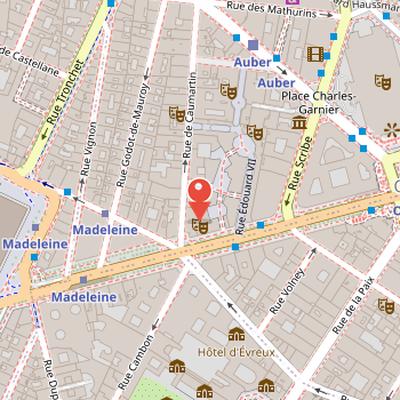
Nearby Objects
-
 Salon Indien du Grand Café 80 m away
 -
 Boulevard de la Madeleine 150 m away
 -
 Hôtel Ritz Paris 250 m away
 -
 La Madeleine 300 m away
 -
 Palais Garnier 300 m away
History and Venue Identity
Olympia is a concert venue in the 9th arrondissement of Paris, at 28 Boulevard des Capucines. It stands equidistant from La Madeleine and the Opera Garnier, north of Place Vendome. Built in 1892, it opened in 1893 under one of the two co-creators of the Moulin Rouge venue. In its early years, Olympia hosted opera, ballet, and music hall performances, but theatrical use declined in the late 1920s and the building was converted into a cinema. It later reopened as a venue in 1954 with Bruno Coquatrix as executive director.
From the 1960s onward, Olympia became known as a popular venue for rock bands. The building was threatened with demolition in the early 1990s, but it was saved by a preservation order. It was then demolished and rebuilt in 1997 as part of an extensive renovation project, with the facade and interior preserved during the rebuilding. Further renovations followed in 1930, 1938, 1954, 1956, 1979, 1997, and 2019. Vivendi acquired the venue in 2001, and it remains a popular performance space.
Olympia is recognized by its giant white-on-red glowing letters announcing its name. It has a seating capacity of 1,985 and a concert capacity of 2,824. The venue was closed from 1916 to 1918 and again from 1944 to 1946.
Early History and Transformation
In 1880, Josep Oller purchased the grounds and converted them into a horse racing venue. By 1882, he had created innovative mechanisms linking the exit of horses with ticket distribution. The site later became home to Montagnes Russes, which was considered one of the first wider amusement parks in history. In 1892, the Prefect of Police ordered its closure and ban, citing fear of a conflagration, and the park was demolished that same year. Also in 1892, a steel building foundation was constructed and erected on the Montagnes Russes location under the supervision of architect Leon Carle.
From Operettas to Revues
The music hall at the steel building originally staged operettas and pantomimes, and it featured performers such as Loie Fuller, La Goulue, and Leopoldo Fregoli. In 1898, brothers Emile and Vincent Isola became commercial tenants of Olympia and other theaters, later taking similar roles at the Folies Bergere in 1901 and the Gaite-Lyrique in 1903. The program continued to include ballet and pantomime-ballet works, with Trianon Ballet presented in 1908 and Les Aventures de Mlle Clo-Clo in 1909. Ballets choreographed by Curti, including Paquita and L'Enlevement de Psyche, also debuted on the London stage in 1909 and 1910, and Papillon d'Or was first performed at the Empire Theater with music by Leopold Wenzel. By 1911, after fourteen ballets had been staged since Ruez's arrival, Cottens and H. B. Marinelli ended their responsibilities, and Nitokris became the last pantomime-ballet staged at Olympia that year. Jacques Charles, trained by the Isola brothers, became the new executive director in 1911 and transformed Olympia into a temple of the revue. From 1911 to 1913, three revues included choreographic segments by Leo Staats and featured Natalia Trouhanowa and Stacia Napierkowska. By 1912, Olympia was also presenting American music hall performers alongside French singers such as Lucienne Boyer, Mistinguett, Damia, Frehel, Georgius, and Yvonne Printemps.
Twentieth-Century Transformations
At the beginning of the First World War, Olympia closed for a short period. During the war, Josep Oller remained the commercial property landlord, but he struggled financially because of late and non-payments of rent. In 1915, Volterra and Beretta purchased Olympia with their financial gains, and that same year the theater highlighted chansons with performers such as Boyer, Damia, and Frhel. Volterra was fired in 1917. Olympia then generated a personal profit of 1 million de francs. Franck later revealed new talents such as Marie Dubas and brought back artists from the early century.
The Great Depression forced Olympia into bankruptcy, and in the 1930s the theater explored French cinema, celebrating filmmakers such as Jean Renoir, Maurice Tourneur, and Henry Wulschleger. The period also coincided with plundering of cultural heritage, especially French of Jewish faith. Haik left Paris for North Africa because he was Jewish, and the Nazis confiscated his property and films and took control of Les Films Regent, which he had created in 1934. Siritzky, who controlled business operations of movie theaters such as Marivaux, Max Linder Cesar, and Moulin Rouge, was also active as an impresario of Edith Piaf in the 1940s, and as a songwriter, conductor, and jazz saxophonist. He was the agent of Leo Marjane and Lucienne Boyer.
When Coquatrix took over as manager and executive director, Olympia was in a pitiful state. In 1955, renowned jazz musicians Billie Holiday, Sidney Bechet, Louis Armstrong, and Ella Fitzgerald were received every Wednesday and Saturday, and Becaud returned to Olympia and caused the first scenes of collective hysteria. Boris was named executive director in the same year. By 1990, Societe Generale owned the building. Boris led a support committee to negotiate with the Societe Generale CEO regarding the reconstruction project, while politician Jacques Toubon objected to the procedure that canceled Olympia's protection. A real estate project initiated in 1993 required 1 milliard of new francs for the Edouard-VII area demolition and reconstruction, including Olympia starting in 1995. A gala evening broadcast live on television on 14 April 1997 marked support for the closure months, and demolition began in spring 1997. The reconstruction project was managed by the architecture firms Anthony-Emmanuel Bechu and Fernando Urquijo-Gino Valle-Giorgio Macola. In August 2001, Paulette and Patricia Coquatrix sold the Olympia brand to Jean-Marie Messier. Arnaud Delbarre was named executive director in 2002, and by 2015 Olympia drew 700,000 attendees per year. Simon Gillham became president in 2016. On 30 November 2016, Olympia was used for movie projection and hosted the premiere of the biopic Dalida, with the screening broadcast live in 220 venues in France and Belgium.
Façade and Interior Renovations
Olympia underwent several renovation campaigns that transformed it from a music hall into a movie theater and later updated its exterior for artist announcements. One major phase assigned three architects to different tasks: Paul Farge coordinated and monitored the works, Gabriel Morice supervised the structural system inside the building, and Jean-Paul Mongeaud designed and built a new neon-lit facade measuring twelve meters high and eight meters wide. Fonsque from the Paz and Silva company created the neon tubes drawn by Mongeaud, while Paz and Silva also made two neon side panels extending over the full height of the facade. The facade was illuminated in red, blue, and green with four hundred meters of neon tubes, and it was described as the most significant illuminated sign in Europe. A blacksmith artisan produced the ornamental steel structure, and Pelegry and Lavignac designed the ceilings and wall decorations. The interior was equipped with quality acoustics, indirect lighting, Gallay brand velvet armchairs in dark green and light green, a Cavaill Coll organ, a modern sound installation by Western Electric, and air conditioning installed by Willis Carrier.
Later renovations by Siritzky further emphasized the building as a cinema. These works demolished the facade from the ground floor to the second floor at twelve meters high, fitted the roof with a massive steel fairing inspired by a ship's bow, redesigned the exterior entrance, and added one thousand five hundred meters of neon lights and fifteen thousand lamps using two thousand amperes. The theater was described as having modern-harmonious lines with intense electric lighting. Under Coquatrix, the exterior facade was redone for artist name announcements, with red neon lighting for the Olympia lettering and the artists' names. The octagon shape of the O was based on the aerial view of Paris ring road, and Henri Rigal was responsible for envisioning the interior layout and decoration.
The Billiard Room at Olympia
Over the years, renovations at Olympia regularly replaced only the armchairs, while preserving the overall character of the billiard room. In 2019, the authentic original billiard room was opened to the public after being preserved and renovated. Classified as a Monument historique, the room retains ceramics and mural panels, and the renovation also included carved woodwork. The mural panels depict the Falls of Clyde, Warwick Castle, and the Tower of London. The room was also noted as one of Edward VII's preferred places in Paris.
Notable Performances at Olympia
Olympia has hosted a number of notable performances that became closely linked with the hall's public profile. In 1900, the quick-change artist Fregoli was billed at the top of the program for seven months. Later, the venue became an important stage for a performer who achieved great acclaim there, giving several series of recitals from January 1955 until October 1962, and remaining the most commercially successful solo performer at Olympia. This artist first appeared at the hall in early 1956 during auditions organized by Eddie Barclay and Bruno Coquatrix, was discovered and chosen to sign a contract at those auditions, and also supported Charles Aznavour in concert at Olympia in 1956. A first own concert followed in 1959.
The same performer returned regularly every three to four years, singing for 30 nights in a row in 1961, 1964, 1967, 1971, 1974, 1977, and 1981. These concerts were completely sold out, and the last Olympia appearance came in 1981, before the hall went bankrupt in 1983. After the 1967 concert, live recordings were issued under the Olympia name, beginning with Olympia 67 and continuing with later releases such as Olympia 71, Olympia 74, Olympia 77, and Olympia 81. Concerts from 1961 and 1964 were also preserved on new CD releases.
Olympia was also the site of a farewell concert series in October 1966. In December 1970, Tabu Ley Rochereau became the first sub-Saharan African artist to headline a two-day show at the hall, and the positive reception led to an extended contract with 14 supplementary shows. Another notable performance made two appearances per evening for three months while in poor health at the end of life.
Notable Performances at Olympia
Olympia has hosted a wide range of notable performances across several decades, with many concerts later issued as live recordings or albums. In May 1972, it was the setting for two concerts by the Grateful Dead on 3 and 4 May during their first major European tour, and songs from these performances were later released on the live album Europe '72. The venue also featured a rare instrumental loop set by Robert Fripp and Brian Eno in May 1975, with tape recordings from that performance later released 36 years afterward as 28 May 1975 Olympia Paris, France.
Other major appearances included a concert on 3 and 4 May 1979 with Lebanese singer Fairuz, which was later launched as a live album. In 1981, during the De Niña a Mujer album period, the performer was on stage at Olympia when fans came up and trampled the performer. Jeff Buckley performed at Olympia in 1995, and that performance was later released in 2001 as Live at L'Olympia. Dave Gahan's Olympia performance was also issued on DVD in 2004 as Live Monsters.
Mireille Mathieu is especially closely associated with the venue. She began performing there in 1965 as the opening act for a Sacha Distel and Dionne Warwick show, then returned for performances in December 1967, December 1969, January 1970, February and March 1973, 1998, 2002, and 2005. Her 1968 live album Mireille Mathieu en direct de l'Olympia was based on a performance at the venue, and she also celebrated her 40th and 50th anniversaries there, with a CD and DVD released from the 40th anniversary live performance.