The Palais des Beaux-Arts de Lille is an art museum in the northern French city of Lille. Opened in 1809, it presents collections covering prehistory, antiquity, and visual arts from the Middle Ages to the present. Its holdings include paintings, sculptures, drawings, photographs, applied arts, coins, and city models.
The museum has been located at Place de la République since 1892 and occupies its own museum building. The building has been renovated and expanded multiple times, and it has been a listed Monument historique since 1975. The museum’s origins date back to 1775, when the Académie des Arts opened in Lille. In 1793, an exhibition of 20 paintings was held at the academy, although it was accessible only to academy students. After the 1801 Chaptal decree, Lille was included among the provincial museums founded in France. The museum was founded by the city in 1803 and opened to the public in 1809 in the chapel of the Couvent des Récollets.
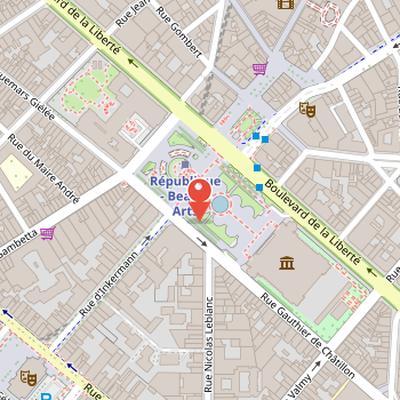
Nearby Objects
-
 Place de la République 70 m away
 -
 Statue of Louis Faidherbe 140 m away
 -
 Théâtre Sébastopol 300 m away
 -
 Synagogue de Lille 400 m away
 -
 Saint-Michel Church 450 m away
Palais des Beaux-Arts de Lille: Building and Collections
The Palais des Beaux-Arts de Lille is an art museum in the northern French city of Lille. It opened in 1809 and has been located at Place de la Republique since 1892. The museum is housed in its own building, which has been renovated and expanded multiple times over the years. Since 1975, the building has been listed as a Monument historique.
The museum holds collections covering prehistory, antiquity, and visual arts from the Middle Ages to the present. Its holdings include paintings, sculptures, drawings, photographs, applied arts, coins, and city models. This range of material makes the institution a broad repository of art and historical objects within the city.
From Municipal Collection to Palais des Beaux-Arts
The idea of founding an art museum in Lille dates back to 1775, when the Académie des Arts opened. The museum did not open until decades later, in the context of the French Revolution, when confiscated artworks were gathered in a central storage site in the former Couvent des Recollets. In 1792, Louis Joseph Watteau proposed making the collection publicly accessible as a museum, and in 1793 an exhibition of 20 paintings from the Couvent des Recollets and other locations was shown in the Académie des arts. This exhibition was limited to academy students.
A major step came with Napoleon Bonaparte's 1801 Chaptal decree, which founded 15 provincial museums, including Lille, and assigned nationalized artworks to them. The city founded its museum in 1803, and it opened to the public in 1809 in the chapel of the Couvent des Recollets. In 1850, the museum moved to the new city hall designed by Charles Benvignat, where it occupied the entire second floor. Under curator Edouard Reynart, the collection expanded from 188 works in 1841 to 715 works in 1875, and in 1873 two Francisco de Goya paintings were acquired.
Because of a lack of space in city hall, the city planned a new museum building named Palais des Beaux-Arts. Funding came from a city lottery in 1882 that raised 2.8 million Francs, and an architectural competition was won by Edouard Berard and Fernand Delmas. Construction of the Beaux-Arts style building began in 1885, and it opened in 1892, although one wing remained unfinished because of limited funds. The museum was closed in 1895 because of building defects, then reopened in 1898 with renewed heating and ventilation systems.
The building suffered significant damage from shelling in 1914 during the First World War, and after the German occupation of Lille some artworks were stolen and parts of the collection were sent to Brussels in 1917 and 1918. Following extensive repairs led by Emile Theodore, the museum reopened to the public in 1924. In 1932 work began on roofing the courtyard to create additional exhibition space, and the atrium designed by Louis Mollet was inaugurated in 1935. The museum remained undamaged during the Second World War.
Later acquisitions continued to strengthen the collection, including a significant donation of Impressionist works from Maurice Masson in 1949 and an additional important collection from Denise Masson in 1974. The museum closed again in 1991 for urgent renovation needs, then underwent a six-year renovation costing 220 million Francs under architects Jean-Marc Ibos and Myrto Vitart. It reopened in 1997 in the presence of President Jacques Chirac. Today, the museum covers 22,000 square meters, including 12,000 square meters of exhibition space.
Major Exhibitions
The Palais des Beaux-Arts de Lille has hosted a number of major exhibitions as part of its cultural programming. In 2004, during Lille's year as a European Capital of Culture, it presented a large exhibition of works by Peter Paul Rubens. That exhibition drew 301,287 visitors and became the museum's most successful show. The museum also organized major exhibitions dedicated to Berthe Morisot in 2004, Philippe de Champaigne in 2007, Louis-Leopold Boilly in 2011, and the Egyptian Pharaoh Sesostris III in 2014.
Archaeological and Historical Collections
The collections of the Palais des Beaux-Arts de Lille include material originating in the Musee d Archeologie et de Numismatique, founded in Lille in 1824, as well as holdings transferred to the museum in 1892. They present objects from Prehistory and Antiquity, ranging from the Stone Age to Gallo-Roman culture. Among the prehistoric pieces are a flint discovered in Quiievy from the Lower Paleolithic period, a blade core from the Neolithic period found in Le Grand-Pressigny, a deer antler axe excavated in Lille, and a decorated sickle from the Bronze Age found near the Belgian border in Wattignies.
The museum also holds an extensive ancient Egyptian collection, made up mostly of transfers from state collections. These include objects from the excavations of Albert Gayet at Antinoupolis in the early 20th century, Nubian finds rescued by a University of Lille III team during the construction of the Aswan Dam, a funerary mask from the Faiyum region, the upper part of a ushabti of a woman from Amarna, a sarcophagus and a gold necklace from Mirgissa in present-day Sudan, a sandstone relief with ibis heads from the reign of Pharaoh Ramses II, a child sarcophagus from the 18th Dynasty, and a mummy portrait of a Roman soldier.
The ancient Greek collection consists mainly of ceramics, including a lekythos perfume vase with a Hermes depiction, a black figure vase with eye decoration and possibly a depiction of Dionysus, and a black figure exaleiptron with figurative representations of the Trojan War. The collections also include an Etruscan black amphora from the 7th century BC transferred from the Louvre. Gallo-Roman culture is represented through numerous finds from northern France, including a stone with Latin inscriptions identified as a miliarium, a bronze bust of Sol Invictus from Bavay, and three bronze statuettes from Thiennes representing Mars, Mercurius, and probably Jupiter.
Paintings in the Collections
The collections at the Palais des Beaux-Arts de Lille include a wide range of paintings from different European traditions and periods. Among the oldest works are apostle portraits of Paul, Matthew, and Judas Thaddaeus by the Catalan artist Ramon Destorrents from the late 14th century, as well as a Trinity painting by the Spanish artist Jacomart from the early 15th century. The collection also contains a small winged altarpiece from the circle of the Lombard painter Cristoforo Moretti, showing the crucified Jesus, Mary with child, and several saints.
Italian Renaissance painting is represented by works such as an Entombment of Christ by Girolamo Marchesi, a Madonna and Child by Ambrogio di Baldese, and another Madonna and Child by the Florentine artists Bartolomeo di Giovanni and Bastiano Mainardi. Dutch painting is represented by The Road to Paradise and The Fall of the Damned by Dirk Bouts. The Venetian 16th century holdings include a portrait of a Venetian senator by Jacopo Tintoretto, along with works by Paolo Veronese such as The Virgin and Two Angels Mourning Christ, The Martyrdom of Saint George, and a Paradise Study. The collection also includes Jesus in the Olive Grove and Saint Francis by El Greco.
Dutch and Flemish Works in the Collections
The collections include a substantial group of Baroque works, especially Dutch and Flemish paintings. Among the portraits are Portrait of a Lady and Portrait of a Gentleman by Jan Anthoniszoon van Ravesteyn, as well as Seated Woman by Frans Hals and Head of an Old Man by Jan Lievens. Jan Lievens is also represented by a depiction of St. Francis, while Hendrick ter Brugghen is included through religious motifs such as Derision of Christ. Other historical and allegorical works in the holdings include Arrival of a Rich Man in Hell by David Teniers the Younger and The Triumph of Silenus by Gerrit van Honthorst. The collections also feature genre scenes such as Student at His Desk - Melancholy by Pieter Codde and A Woman and a Maid by Pieter de Hooch, together with a skating scene by Jan van Goyen. Landscape and still life painting are represented by Hills with Wheat Field by Jacob van Ruisdael and After the Hunt by Jan Baptist Weenix. The collection also displays the Vanitas motif Skull and Leg Bones in a Niche by Bartholomäus Bruyn the Elder and Church Interior in Delft with Grave of Wilhelm the Silent by Emanuel de Witte.
The Painting Collections
The collections of the Palais des Beaux-Arts de Lille include a notable group of paintings by Jacob Jordaens, among them Portrtait eines Mannes, Christus und die Pharisaeer, Jager inmitten einer Meute von Jagdhunden, Ruckkehr des verlorenen Sohnes, Raub der Europa, Studie mit funf Kuehen, Der verlorene Sohn in der Not, and Versuchung Magdalenas. The museum also holds several works by Peter Paul Rubens, including Prometheus in Ketten, Kreuzabnahme, Martyrium der heiligen Katharina, Der heilige Franziskus erhalt das Christuskind von Maria, Maria Magdalena in Ekstase, Heiliger Bonaventura, and Heiliger Franziskus in Ekstase. Other holdings include works by Anthonis van Dyck such as Maria von Medici im Exil, Kreuzigung, and Das Eselswunder, as well as an Alpenlandschaft by Joos de Momper. The collections also feature Pieter Brueghel the Younger's Volkszahlung zu Bethlehem and Bekehrung des Paulus, a 17th-century Heiliger Hieronimus by Jusepe de Ribera, and Verspottung Christi by Lucas Cranach the Elder.
The Collections of the Palais des Beaux-Arts de Lille
The collections of the Palais des Beaux-Arts de Lille are especially rich in French painting from the 18th century and also include significant works by foreign artists. Among the French works are Portrait de Jean-Baptist Forest by Nicolas de Largilliere and a landscape by Philippe de Champaigne. The 18th-century holdings include paintings by Charles-Antoine Coypel, Jean-Marc Nattier, Jean Simeon Chardin, Francois Desportes, Jean-Baptiste Oudry, Jean-Baptiste Greuze, Jean Francois de Troy, Claude Joseph Vernet, and Jacques-Louis David. The collection also includes several works by Lille-born painter Jean-Baptiste Wicar and post-Bourbon works by Louis-Leopold Boilly, including Portrait presume de Robespierre, Le Triomphe de Marat, and a self-portrait. Foreign 18th-century works are also present, such as Schlafende Nymphe by Sebastiano Ricci, Architektonisches Capriccio by Francesco Guardi, several flower still lifes by Rachel Ruysch, and the self-portrait of Christian Seybold.
The 19th-century collections are also substantial and include both French and foreign painting. They feature Jacques-Louis David's Napoleon in imperial attire, works by Francisco de Goya, and English landscapes by John Constable and William Turner. Romantic and Barbizon school painting is represented by Eugene Delacroix, Jean-Baptiste Camille Corot, Theodore Rousseau, Charles-Francois Daubigny, Jean-Francois Millet, Pierre Puvis de Chavannes, and Narcisso Virgilio Diaz de la Pena. The museum also holds works by Gustave Courbet, Johan Barthold Jongkind, Albert Anker, Alexandre Cabanel, Jules Bastien-Lepage, Jean-Jacques Henner, Rosa Bonheur, Augustin Theodule Ribot, and a large group of works by Emile Auguste Carolus-Duran, including numerous portraits and scenes such as Dame mit Hund, Dame en noir, and Henri Ragnault mort sur le champ de bataille.
Later 19th-century and early modern works include portraits by Jean Beraud, Edouard Manet, and Eugene Carriere, along with Impressionist landscapes and portraits by Claude Monet, Alfred Sisley, Pierre-Auguste Renoir, Henri de Toulouse-Lautrec, and Vincent van Gogh. The collections also include a painting of cows by Jordaens similar to van Gogh's Kuhe, and a permanent loan of Georges Seurat's pointillist landscape Landschaft bei Grandcamp from the Paris Musee d'Orsay. Symbolist art is represented by Odilon Redon, while early 20th-century works include paintings by Emile Bernard, Henri Le Sidaner, Emile Claus, Felix Vallotton, Edouard Vuillard, and Pierre Bonnard. The holdings continue into modern art with Pablo Picasso, Fernand Leger, Marc Chagall, Sonia Delaunay, Bernard Buffet, Serge Poliakoff, Eugene Leroy, and Jan Fabre's large mosaic Une baie pour les yeux de la foi, made of beetle back plates forming a large stamp of Belgian Congo.
Graphic Works in the Collections
The collections include a broad group of graphic works, among them drawings, pastels, watercolors, etchings, prints, and photographs. Because of conservation reasons, these works are shown in thematically changing presentations rather than in a fixed display. The holdings are especially strong in drawings from several European traditions and periods.
Among the Italian works are drawings from the Renaissance and Baroque periods. The collection includes several drawings by Raffael, among them a Christus study, a study for Alba Madonna, and the pen drawing Der sitzende Apollo spielt die Leier. Other Italian highlights include Das Martyrium des Heiligen Sigismund by Giorgio Vasari, created in 1524 as a preparatory study for an altarpiece in Basilica di San Lorenzo in Florenz, as well as a sheet with a drawing of a niche and a Christus depiction and a study for the dome of Petersdom by Michelangelo. The collection also holds a chalk drawing with a seated woman and a curtain study, a red chalk drawing Männliche Aktstudien by Jacopo da Pontormo, the red chalk drawing Der tote Christus mit einem Engel by Giovanni Francesco Barbieri, and a family portrait by Federico Zuccari.
The museum also has a significant collection of Dutch and Flemish Baroque drawings. Works named in this group include Christus geht auf den Berg Golgatha by Anthonis van Dyck, Zwei Pferde by Pieter van Bloemen, a self-portrait by Gerrit van Honthorst, and Mann und Kind by Peter Paul Rubens. Old German drawings are represented by the portrait of Lucas van Leyden by Albrecht Durer, Heiliger Johannes in der Wuste by Lucas Cranach the Elder, and the motif Das Madchen und der Tod by Hans Holbein the Elder.
French drawings form another large part of the collections. These include works by Hubert Robert, such as a sheet with person depictions from Neapel and the pen drawing Grosse Architekturstudie, as well as preparatory drawings for famous paintings like Das Massaker der Unschuldigen by Nicolas Poussin, Der Schwur der Horatier by Jacques-Louis David, and Das Floss der Medusa by Theodore Gericault. The French holdings also include the watercolor Apotheose des Homer by Jean-Auguste-Dominique Ingres, the etching of a self-portrait by Francisco de Goya, pastels Badende by Jean-Francois Millet and Junge Frau mit schwarzem Hut by Pierre-Auguste Renoir, the 1920 drawing Olga mit dem Blumenkranz by Pablo Picasso, and the 1947 print Jazz by Henri Matisse.
Early Sculptural and Religious Works in the Collections
The collections include a notable group of early sculptural art, with a strong emphasis on religious objects. Among the oldest works is a Byzantine ivory carving from the end of the 10th or beginning of the 11th century. The holdings also include a relief depicting the crucified Christ under a canopy, with the Virgin Mary and the Apostle John at his sides, as well as a late Romanesque baptismal font from the 12th century from the former church Notre-Dame de Cousolre. This font features a lion and the saints Walbert and Bertille.
Other early works include a brass incense burner from around 1160 to 1165, whose figurative apex shows three young Hebrews refusing to honor King Nebuchadnezzar. The collections also contain a partially gilded ivory diptych from the second quarter of the 14th century, made in a Parisian workshop and showing key episodes in the life of Christ and the Virgin Mary. From around 1400 there is a bronze aquamanile in the form of a lion from Nuremberg.
The religious focus continues into later works, including a marble relief by Donatello from around 1435 made in Florence, depicting a scene from the life of Saint John the Baptist. The collections also hold Herodes Fest, showing Salome dancing at a banquet given by Herod Antipas, and the continuation of the scene, in which Herodias demands the head of John the Baptist as a reward. Other notable objects include a marble sculpture from the Liege area titled Virgin Mary nursing the infant Jesus, attributed to the Master of Mosan Madonnas and dated 1330 to 1350, and the altar painting of Saint George from around 1480 to 1490, originating from the old parish church Hl. Georg in Bruneck.
Additional works include a polychrome pinewood figure of Saint George with the dragon, the holy Andrew, and an unnamed saint; a predella added in the 19th century, originally from the 11th century, showing Christ with portraits of Emperor Henry II and his wife Cunigunde; an oakwood figure titled The Executioner of Heinsberg from around 1520, probably from the collegiate church St. Gangolf in Heinsberg and part of a crucifixion group; and two 16th century stone figures known as Les Belles du Nord, depicting Saint Agnes and Mary Magdalene, discovered in 2013 during excavations in Orchies, 30 kilometers from Lille.
Sculpture Collection Highlights
The Palais des Beaux-Arts de Lille preserves a wide range of sculptures and related works that reflect different periods, materials, and artistic approaches. The collection includes neoclassical and revolutionary-era busts such as Antoine-Louis Lefebvre de Caumartin by Jean-Antoine Houdon and Charles De Wailly by Augustin Pajou. It also holds several works by Denis Foyatier, including the bronze Spartacus and the gypsum figure of Lucius Quinctius Cincinnatus.
The collection further features 19th-century works connected to major historical subjects and public figures, including Henri Lemaire's sculpture of Napoleon Bonaparte and the oversized partially gilded bronze Napoleon I. as protector of industry. Portraiture is represented by Jean-Baptiste Carpeaux's bronze medallion portrait of painter and museum curator Edouard Reynart.
Later works expand the range of forms and styles. These include Frédéric-Auguste Bartholdi's gypsum model of the Monument of the Lion of Belfort, Ernest Meissonier's bronze equestrian figure The Traveler, Georges Lacombe's kneeling Maria Magdalena figure in mahogany, and Antoine Bourdelle's glazed terracotta mask Head of a laughing woman and bronze Penelope. The collection also includes head figures by Camille Claudel, several sculptures by Auguste Rodin including bronze figures from the Burghers of Calais group and the marble The Fallen Angel, and Ossip Zadkine's 1948 cubist figure group Human Forest.
Ceramics and Decorative Arts Collection
The Palais des Beaux-Arts de Lille preserves a ceramics collection that originated with Jules Houdoy in Lille in 1869 and now includes more than 2500 objects from various origins. The collection ranges from the 16th century to the Fin de Siecle period, showing a broad history of ceramic production and decorative taste.
Among the earliest works are a Faience apothecary vessel from Faenza with an Apollo depiction dated around 1550, a 16th century Bartmann jug from Frechen, and a glazed ceramic roof finial from Pays d Auge decorated with a flower vase and bird. The collection also includes several 16th century pieces of Limoges enamel, including two plates with scenes of Joseph from the Bible, as well as an enamel panel showing the Judgment of Paris. From the 17th century come Chinese porcelain and Delft ceramics with Chinese motifs, together with a decorative wall fountain in Faience from Moustiers dated circa 1660 to 1670.
The 18th century is represented by a group of ceramic tile paintings from Rotterdam designed by Cornelis Boumeester, two Delft tulip vases with duck shaped handles and bird and floral decoration, a pagoda shaped Faience sugar bowl from the Sinceny factory, and a clock holder from Lille that reflects continued European interest in Chinese style. Other works from this period include a late Baroque floral decorated plate from Strasbourg, plates with playing card motifs, a helmet shaped jug from Lille, and a glazed stoneware bust of Ceres crowned with wheat from Brussels.
The collection also reaches into the 19th and early 20th centuries through objects from the Fin de Siecle period, including a Jugendstil vase by Hector Guimard around 1900, a vase designed by Auguste Rodin for the Porzellan Manufaktur in Sevres, and the Saigon Vase from the 1890s decorated with centaur figures.
Mikhail Vrubel Works in the Collection
The collection includes a glazed ceramic fireplace surround designed by Mikhail Vrubel. It also includes a work by Vrubel made up of 155 individual pieces in Russian Jugendstil. This fireplace artwork was exhibited at the 1900 Paris World's Fair and depicts the Russian legend of Mikula and Wolga.
Tapestries from the Palais Rihour Collection
The collections include several notable tapestries, among them a Brussels tapestry from the first quarter of the 16th century. Another tapestry depicts Ester before Ahasveros. The museum also holds a tapestry from the former Palais Rihour interior, which is one of the few pieces preserved from that interior before the fire of 1916. These works form part of the collection's historical material related to decorative arts and the former palace.
The City Models in the Atrium
Since 1997, the Palais des Beaux-Arts de Lille has displayed Sammlungen, a collection of historical city models in a 700 square meter hall under the atrium. The models are made at a scale of 1:600 and date from the end of the 17th century to the 19th century. They depict cities and their fortifications, including some from the time of Sebastien Le Prestre de Vauban. The models belong to the collection of the Musee des Plans-reliefs at the Hotel des Invalides in Paris, where they were mostly stored since 1777.
The idea of exhibiting the Lille city model was raised in 1983 on the suggestion of Pierre Mauroy and was supported by Culture Minister Jack Lang as part of efforts to decentralize state museum collections. Sammlungen proposed a permanent display of 40 models from Northern France, present-day Belgium, and the Netherlands in Lille. The first models arrived at Hospice general de Lille in 1985 to 1986, and an agreement with the Paris authorities led to the permanent display of 15 models at the Palais des Beaux-Arts de Lille.
The display includes models of French cities such as Calais, Bergues, Bouchain, Lille, Aire-sur-la-Lys, Gravelines, and Avesnes-sur-Helpe, as well as Belgian cities including Charleroi, Ath, Ypern, Tournai, Menen, Oudenaarde, and Namur, plus Maastricht in the Netherlands. The oldest model is Calais, created in 1691, while the newest is Avesnes-sur-Helpe, built between 1824 and 1826. The Lille model itself was taken to Berlin as war spoils in 1815 during the Wars of Liberation, became the only French model recovered in damaged condition from the Berlin Zeughaus in 1948, and was later returned to Paris and restored.