Rue Garibaldi is a wide and long street in Lyon, crossing the 3rd, 6th and 7th arrondissements. It is named after the Italian politician Giuseppe Garibaldi. The street extends for 3,850 meters, making it one of the longest streets in the city, and it begins after the Boulevard des Belges in the north of the 6th arrondissement before ending on the Avenue Berthelot in the 7th arrondissement.
Historically, the street was formerly called Rue Sainte-Élisabeth, in reference to Élisabeth of France. It was named Rue Garibaldi after a municipal council deliberation on 1 March 1871, later renamed Rue Sainte-Élisabeth, and renamed Rue Garibaldi again on 6 July 1882. The street was built gradually throughout the 19th century from the Cours Vitton, and Rue Rave became part of it in 1913. The street also contained a Masonic temple built by architect Peter Martin, and television host Simone Garnier lived there.
In its present form, Rue Garibaldi is mostly surrounded by trees and high buildings of around 20 floors, built from 1950. Its appearance changes along its route: near the Rue Duquesne, it is bordered mainly by large buildings with golden and rounding doors; around the Cours Vitton, it is narrower and lined with five-floor older stone buildings and old houses to the west; and after the Cours Lafayette, a twenty-floor tower with golden windows can be seen. In most of the 3rd arrondissement, it is described as almost impassable for pedestrians and requires an underpass.
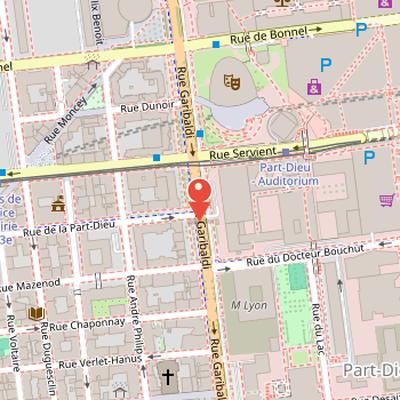
Nearby Objects
-
 Tour Part-Dieu 200 m away
 -
 Auditorium Maurice-Ravel 200 m away
 -
 Tour Silex 2 250 m away
 -
 Bourse du Travail 300 m away
 -
 Westfield La Part-Dieu 350 m away
Naming and Location
Rue Garibaldi is a wide and long street in Lyon, extending through the 3rd, 6th and 7th arrondissements. It is named after the Italian politician Giuseppe Garibaldi. The introduction also notes a former square called Place Garibaldi, which referred to Garibaldi's nephews. Those nephews died during World War I.
History and Street Naming
Rue Garibaldi was built gradually throughout the 19th century from the Cours Vitton. Its naming history changed several times: it was formerly called Rue Sainte-Elisabeth in reference to Elisabeth of France, then named Rue Garibaldi after a municipal council deliberation on 1 March 1871. It was later renamed Rue Sainte-Elisabeth after being called Rue Garibaldi, and then renamed Rue Garibaldi again on 6 July 1882. Rue Rave became part of the street in 1913. The street has also been associated with a Masonic temple built by architect Peter Martin, and with television host Simone Garnier, who lived there. A project connected with the street is reported to cost about 5 million euro.
Street Form and Urban Landscape
Rue Garibaldi begins north of the 6th arrondissement, after the Boulevard des Belges, and ends in the south at the Avenue Berthelot in the 7th arrondissement. At 3,850 meters, it is one of the longest streets in the city. Its overall appearance is often compared to a highway, and it can sometimes be composed of five lanes. In much of the 3rd arrondissement, it is almost impassable for pedestrians and requires an underpass.
The street is mostly lined with trees and with high buildings, many of them around 20 floors and built from 1950. Near Rue Duquesne, the built environment is dominated by large buildings with golden and rounded doors. Around Cours Vitton, the street becomes narrower and is bordered by five-floor older stone buildings and old houses to the west, where the city hall of the 6th arrondissement is located. East of Cours Vitton, more recent and high buildings appear. After Cours Lafayette, a twenty-floor tower with golden windows can be seen, followed by three cubic glass buildings housing tax offices, a bank, and the Grand Lyon.
The southern end of the street is marked by old workshops, new homes, and vacant lots. Rue Garibaldi also contains a pool, the Lycee Saint-Joseph, many regional and departmental managements, and various associations, as well as the Centre regional des oeuvres universitaires et scolaires. Its commercial and professional life includes many doctors' offices, restaurants, and stores selling food, clothing, and furniture.