Avenue de Saxe, also known as Avenue du Maréchal de Saxe, is a major route in Lyon’s 3rd and 6th arrondissements. Named after Maurice de Saxe, Marshal of France, it extends from the Cours Gambetta to the Cours Franklin Roosevelt. The avenue was planned by French architect Jean-Antoine Morand as a wide, tree-lined street, and its current name was given in 1825.
The avenue is mostly bordered by Haussmann-style buildings from the 19th century, with two rows of plane trees along its length. Its urban fabric includes sculptures and decorations on building doors, 1880s facades with carved heads at numbers 52 to 56, and the Art Deco Palace of the Automobile at numbers 55 to 57. Other features include a white stone castle near the Rue Servient, small older buildings among 20th-century reconstructions, and towers at the corners of the Rue Rabelais and Rue Villeroy. The avenue also contains the Théatre Tête d'Or at number 60, built in 1925, and the Consulate of Burkina Faso. The southern part presents an almost continuous frontage of shopping venues.
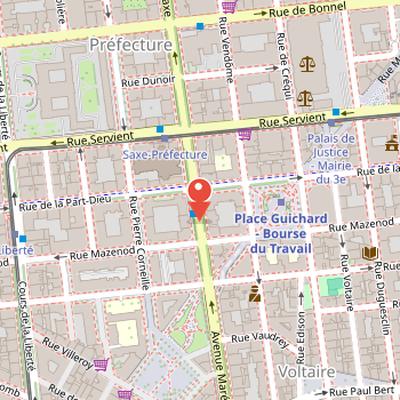
Nearby Objects
-
 Place Guichard 120 m away
 -
 Bourse du Travail 200 m away
 -
 Bahadourian 300 m away
 -
 Prefecture Hotel of Rhône 300 m away
 -
 Rue Duguesclin 450 m away
Avenue de Saxe in Lyon
Avenue du Marechal de Saxe, also known as Avenue de Saxe, is an avenue in Lyon. It is located in the 3rd and 6th arrondissements of the city. The avenue is named after Maurice de Saxe, who was a Marshal of France.
Architecture and Streetscape
Avenue de Saxe begins perpendicularly with the Cours Gambetta and ends with the Cours Franklin Roosevelt. It is a main route of the 3rd arrondissement of Lyon and is mostly surrounded by buildings dating from Haussmann's 19th century. The avenue is bordered by two rows of plane trees, and many of the buildings have sculptures and decorations on their doors.
The street also preserves a varied architectural sequence. Part of it formed the Avenue Jean-Jaures. At numbers 52 to 56, there is a group of 1880s facades with carved heads, while at numbers 55 to 57 stands the Palace of the Automobile, built in Art Deco style. After the Rue Servient, the avenue features a white stone castle surrounded by a small wooden house. Among the many 20th-century reconstructions, there are also small old buildings. The corners with the Rue Rabelais and the Rue Villeroy are marked by towers, including a six-floor tower at the latter intersection.
Buildings and Street Character
Avenue de Saxe includes several notable addresses and a distinct commercial character. The Consulate of Burkina Faso is located on the avenue, and the Theatre Tete d'Or is found at number 60. The theatre was built in 1925 and replaced La Cigale Hall on 10 September 2001. In its southern part, the avenue has an almost continuous frontage of shopping venues. The street is also described as one of the most expensive and one of the noisiest in Lyon.
History and Planning of Avenue de Saxe
Avenue de Saxe formed a major component of the street layout in the Brotteaux quarter, alongside Avenue du Marechal Foch. It was planned by French architect Jean-Antoine Morand as a wide avenue with trees, reflecting an ordered and spacious urban design. The street received its current name in 1825. Its later history includes the birth of French aerospace engineer Charles Voisin at number 139 on 12 July 1882, and the presence of the Masonic Order of Mopses in the avenue in 1902.