Palais des Congrès Acropolis was an old complex in Nice composed of two structures: a convention center and an exhibition hall. Located on Esplanade Kennedy, it was owned by the city of Nice and its management and operation were delegated to GL Events. The building was a three-level structure with a stage, backstage, and front stage, as well as a ceiling-height space of specified dimensions. On the second level, it included the Hermes conference room with 300 seats, the Rhodes multipurpose space, and a total of seventeen rooms. Several meeting rooms were renovated under architect Jean-Michel Wilmotte.
The site is connected to the historical development of the area, where the Paillon was progressively covered during the first half of the 20th century. Nearby features included the former pont Barla, the esplanade Risso, and the stade du XV Corps, later renamed stade Jean-Bouin and eventually replaced by the complexe sportif Jean-Bouin. The exhibition hall’s origins date to the 1950s, when plans were made for the palais des expositions as part of the city’s efforts to reinforce its welcoming function. Demolition of the complex later began and ended in unspecified months.
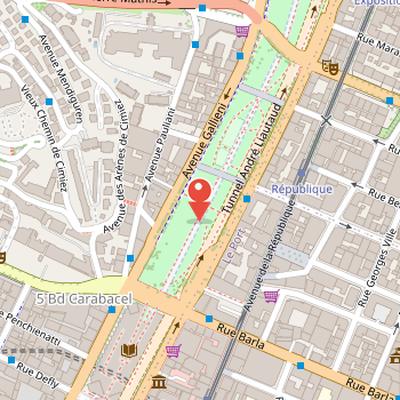
Nearby Objects
-
 Louis-Nucéra Library 200 m away
 -
 Muséum d'histoire naturelle de Nice 250 m away
 -
 Monument to Giuseppe Garibaldi 350 m away
 -
 Place Garibaldi 350 m away
Former Complex and Demolition
The Palais des Congres Acropolis was an old complex made up of two structures: a convention center and an exhibition hall. It was owned by the city of Nice, while its management and operation were delegated to the company GL Events. Demolition of the complex began in an unspecified month and ended in an unspecified month.
From Esplanade to Congress Centre
The site occupied by the Palais des Congres Acropolis was progressively covered by the Paillon during the first half of the 20th century. In the same area, the pont Barla became the traverse Barla, and the esplanade Risso, now known as the esplanade John-Fitzgerald-Kennedy, was inaugurated in 1931. West of the esplanade, the stade du XV Corps opened in 1937 and later became the stade Jean-Bouin in 1951, before being replaced by the complexe sportif Jean-Bouin in the 1980s.
In the 1950s, when Nice's economic activity was traditionally focused on tourism, mayor Jean Medecin aimed to reinforce the city's welcoming role. In this context, a plan was made in 1954 to build the palais des expositions on the north side of the esplanade. Construction began in 1956 according to plans by architects Richard and Michel Laugier. The original building consisted of a hall of unspecified size. The foundation stone and inauguration dates are not recorded in the available history.
Later, several meeting rooms of the palais des congres were renovated under architect Jean-Michel Wilmotte.
Layout and uses of Palais des Congres Acropolis
Palais des congres is located on the Esplanade Kennedy and is arranged as a three-level building. Its interior includes a stage, backstage, and front stage, together with a ceiling height and surface area defined for one of its main spaces. The second level contains several distinct areas, including the Hermes conference room with 300 seats, the Rhodes multipurpose space with a modular surface area, and a total of seventeen rooms. This level also includes various offices for organizers. On the west side of the building are six Gallieni commission rooms with seating capacities ranging from 30 to 140. At the north end, the Athena conference hall can seat 758 spectators.
The building is used for a wide range of events, including shows, conferences, concerts, exhibitions, fairs, conventions, and political meetings. It regularly hosts major medical, scientific, and technological congresses linked to the Faculty of Medicine of Nice and Sophia Antipolis technopolis. Since 2005, it has also hosted C'est pas classique every autumn, an event organized by the General Council of Alpes-Maritimes to promote classical music through free concerts. Among other notable events, the Palais des congres hosted an informal meeting of NATO Defense Ministers and the Afrique-France event.
Palais des Expositions: a large pillar-free hall
The Palais des expositions offered a total capacity of several thousand square meters on three levels, with a large ground-level hall designed without pillars. Its concrete floor and open layout allowed the installation of nearly 700 stands, making it suited to large-scale exhibitions and conventions. The roof was built with a reinforced concrete arch vault structure that let daylight pass through, and the vault structure also permitted the installation of plexiglas panels.
The venue also had a notable event history. It hosted the first Beatles concert outside Paris on July 9, 1965. Later in 1965, it held two Rotary International conventions, from October 21 to 23 and from November 11 to 13. In 1966, it hosted the 5th World Gas Conference, and on December 7 to 9, 2000, it was the site of a European Council meeting.
Management and concession of Acropolis
The management of Palais des Congres Acropolis was transferred through a municipal concession in which the city of Nice granted exploitation, management, and maintenance of the site to Nice Animation for a fourteen year period. The contract was described as a concession with the city of Nice as a member by right, although the city later ceased to be a member by right of the Nice Animation association. A new call for tenders was launched in 2004 to select the future delegate, and several candidates were involved in the process. Three offers were submitted that year by Nice Acropolis, GL Events, and the CCI de Nice-Cote d'Azur, while negotiations with the city also involved Nice Acropolis, CCI-Cari, GL Events, and Expomedia France.
The lease contract began on an unspecified date and was set to last ten years. It also included renovation funding, with 7 million euros coming from the delegate and 19.5 million euros from the city of Nice. GL Events ultimately operated Acropolis through the Societe d'exploitation de Nice Acropolis, which it owned entirely. This choice was legally challenged first by Nice Acropolis through a summary procedure that was later withdrawn, and the administrative court of Nice confirmed the legality of the direct negotiation leading to the selection of GL Events.