The Abbey of St. Victor is a French abbey founded by Saint Jean-Cassien near the tombs of the martyrs of Marseille, including Saint Victor of Marseille. It has been an important Catholic place in southern France for more than 1,700 years. The monastery was dissolved during the French Revolution, but the church is still in use.
The abbey gained considerable importance around the millennium through its influence over Provence. One of its abbots, Guillaume de Grimoard, was elected pope in 1362 as Urban V. The abbey began an irreversible decline from the 15th century.
In 1968, Gaston Defferre, mayor of Marseille, placed a collection of sarcophagi in the crypts. Dating from the 4th to the early 8th centuries, they had previously been exhibited at Borély Castle museum. The abbey became the most important museum of early Christian art in Provence after the Arles museum. Historical accounts also describe the church as built on an ancient quarry site used in the Hellenistic period, with later Christian use connected to a large necropolis and burial traditions in Marseille.
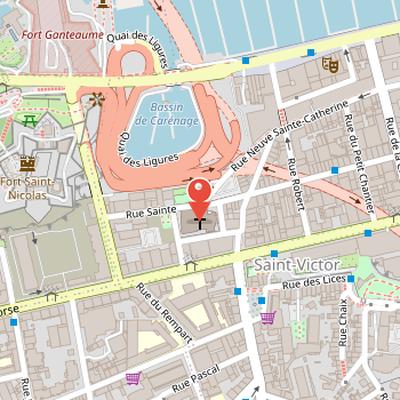
Nearby Objects
-
 Théâtre National de la Criée 300 m away
 -
 Eglise Saint-Laurent 650 m away
 -
 Palais du Pharo 750 m away
 -
 Place de Lenche 800 m away
 -
 Maison Diamantée 800 m away
History and Cultural Role
The Abbey of St. Victor was a French abbey founded by Saint Jean-Cassien near the tombs of the martyrs of Marseille, including Saint Victor of Marseille, who died in 303 or 304. For more than 1700 years, it has been an important Catholic site in southern France. The monastery gained considerable importance around the millennium, when its influence extended over all of Provence. One of its abbots, Guillaume de Grimoard, was elected pope in 1362 as Urban V. From the 15th century onward, the abbey entered an irreversible decline, and its monastery was dissolved during the French Revolution, although the church remains in use. In 1968, Gaston Defferre, mayor of Marseille, placed a rich collection of sarcophagi in the crypts. These sarcophagi, dating from the 4th to the early 8th centuries and previously exhibited at the Borily Castle museum, helped make the abbey the most important museum of early Christian art in Provence after the Arles museum.
Early History and Crypt of Saint Victor
Historia de la abadia places the abbey church on an ancient quarry site that had already been used in the Hellenistic period. The same area also served as a burial place in Greek and Roman times, becoming the third burial site in the city. The memory of this funerary use is preserved in the name of Sainte street, and further tombs were found around the abbey and near the Prado-Carenage tunnel station. The site is identified with a large necropolis, where a paleochristian foundation was established to receive martyrs bodies.
The Christian presence in Marseille is presented as later than the legends surrounding Mary Magdalene, Lazarus, or the arrival of martyrs in the first and second centuries. Historians cited in the source consider these early accounts to be legends, while recent research confirms Christians were present in Marseille from the third century. A marble slab discovered in 1839 in the former sacristy of the Saint-Victor crypt became important because of its incomplete inscription, which led to controversy over whether it proved the antiquity of the Marseille martyrology. Two hypotheses are given for the missing text: one sees it as a reference to the martyrdom of Volusian and Fortunatus by fire during the persecution of Decius in the mid-third century, supported by the anchor symbol and the language of the inscription; the other interprets it as commemorating two sailors who died in a shipwreck.
Within this context, the source suggests that Saint Victor may have been buried in the paleochristian cemetery. Saint Victor is identified as a Christian officer who died around 290 by order of Emperor Maximian, and some propose that his martyrdom took place on July 21, 303 or 304. The church was structured at the beginning of the fourth century, and the bishop of Marseille, Oresius, was present at the Council of Arles in 314. His successor, Proculus, built a building between 380 and 430 that included the current chapel of Our Lady of the Confession. This structure was transformed into a crypt in the fifth century for the construction of the abbey church.
The architectural arrangement is also described: the building axis was oriented north to south, with the upper church laid out perpendicular east to west. The chapel of Saint Andrew in the abbey crypt was founded on an open gallery and is located under the Isarn tower, where the current entrance is found. Michel Fixot proposed a restitution of the primitive Christian monument associated with the site. The history of Saint Victor is presented as shaped by religious and political rivalry between Marseille and Arles, and by the later integration of Provence into the kingdom of France in the eighth century after King Renato's death.
Origins and Monastic Significance
According to tradition, the monastery was founded by John Cassian after he had stayed with Egyptian anchorite monks. Cassian arrived in Marseille in 416, probably led by Lazarus, bishop of Aix. He remained in Marseille until his death between 433 and 435. During this period, he contributed to the monastery and produced important works that served as a guideline for monastic life.
Growth, Influence, and Decline of the Abbey
The Abbey of Saint Victor in Marseille is presented as the first abbey founded in an urban area, and it is associated with two monasteries reportedly founded in the city: Saint-Sauveur for women and Saint Victor for men. The Abbey of Saint Victor is located south of the old port, while the Abbey of Saint-Sauveur is located south of Place de Lenche, although some historians consider the exact locations of these monasteries unknown. The construction of a pilgrimage building at Saint Victor is certain, and the abbey is described as having created works in urban locations with rapid execution that contributed to Marseille's spiritual reputation.
In the historical narrative, the abbey is linked to doctrinal and theological activity. It held doctrinal positions inspired by semi-Pelagianism, forming a school of fathers of Marseille, and it generated numerous theological debates in the city influenced by Salvian's doctrines. The abbey is also described as being located in a city that was growing during the barbarian period throughout the 5th century.
The later history of Saint Victor was marked by disorder and repeated violence. During the 7th century, the Church of Marseille experienced turbulence, and there were no recorded bishops for two-thirds of the century after Bishop Pierre. This period is described as one of widespread disorder affecting the abbey. Between the 8th and mid-9th centuries, Saint Victor lost its independent existence, with the bishop of Marseille established there and the abbot no longer necessary. The abbey also lost property ownership when it was merged with Marseille's episcopal church. After Charles Martel took Marseille in 736, the city entered a period of movement, and the abbey later had better direction during the Carolingian era, although it did not become a center of humanism because of its Mediterranean location. Its cultural decline in Mediterranean regions is described as irreversible during the Carolingian period.
The abbey suffered several attacks and devastations. In 838, a Saracen fleet probably from Spain attacked, taking clergy captive and destroying the Saint Victor monastery. Greek pirates devastated the city again in 848, leaving only the fortified castle Baboni in Place de la Tourette as effective shelter. In 923, the abbey was devastated again by Saracens after they landed in Massif des Maures, and the bishop of Marseille fled to Arles. Destruction and abandonment ended when Guillermo I de Provence rejected the Saracens of La Garde-Freinet in 972, bringing peace back to Provence.
Despite these disruptions, the abbey recovered. San Victor served as the residence of the bishops of Marseille from 750 to 960. Charlemagne made a donation granting rights over salt, goods, customs, and anchorage in the port of Marseille, and Lotario I confirmed this donation. The decline of the Benedictine abbey of San Victor is linked to barbarian incursions around the end of the 9th and start of the 10th century, but in 948 Bishop Honorato II rebuilt the abbey and restored monastic life. According to Paul Amargier, Bishop Honorato introduced the Rule of Saint Benedict on October 31, 977, establishing libertas on all legal and economic levels in the abbey. In 1005, he separated episcopal incomes from abbatial incomes before resigning and passing his position to his nephew Pons I. The monks then elected Guifred as abbot, and his arrival marked the beginning of a brilliant period. Guifred had previously led the community at the abbey of Psalmodie in Gard, and he was followed by Isarn, abbot from 1020 to 1047, who is closely connected with Odilon, abbot of Cluny.
The abbey's influence extended widely through its ties with the viscounts of Marseille and the Provençal aristocracy, which promoted the growth of its temporal power and patrimonial assets. It had profound spiritual and cultural influence in Provence during a time of political and religious reorganization. Its territorial possessions grew considerably in the diocese of Marseille, with 440 churches and convents dependent on San Victor. It also held dependencies in the archdioceses of Aix-en-Provence, Frijus-Toulon, Riez, Gap, Embrun, and Vaison-la-Romaine, as well as in dioceses in Auvergne and Languedoc. Additional possessions are recorded in Sardinia and Spain. The entire southern part of the Old Port in Marseille belonged to the monks, as did the southeast zone near current Beauvau street, which contained rich saltworks. The abbey retained the saltworks until Francis I annexed them in 1518 to enlarge the galley arsenal. It also received a water privilege from Saint-Menet to the sea. With sixty priories across the viscounty, the abbey became a main agricultural planner in southern Provence, and more than sixty monks and twenty novices lived there. San Victor thus became a major spiritual and training center.
Rebuilding, Reform, and Influence
The upper church of the abbey was fully rebuilt and consecrated by Pope Benedict IX on October 15, 1040. In historical tradition, the abbey also received the title Secunda Roma through a forged but long-used document. During the second half of the 11th century, the abbey was led by a sequence of influential abbots: Pierre from 1047 to 1060, Durand from 1060 to 1065, Bernard de Millau from 1065 to 1079, and Richard Millau from 1079 to 1106. Richard Millau was designated by the pope to succeed his brother Bernard and later became cardinal and papal legate in 1079. He also served as archbishop of Narbonne while leading the community and actively participated in the Gregorian reform, aiding Popes Gregory VII and Urban II. The abbey's own history states that it had been exempted from a bishop's jurisdiction by a bull of Pope Leo IX, and that this exemption was confirmed by later popes in the context of monastic reform. It also notes that Bernard and Richard de Millau served Pope Gregory VII, which influenced the abbey's liberation. The abbots of San Victor were described as the most powerful men in the region, and the abbey's influence extended further through figures such as Raymond, a monk who became bishop of Marseille in 1073. The grand cartulary of San Victor was created between 1070 and 1080.
Abbey Rights, Property, and Decline
The history of the Abbey of St. Victor records a series of changes in authority, finances, and administration. Its cartulary commemorated the abbey's break with the bishop of Marseille, after which it became a monastic sovereignty directly subject to the pope. After the death of Pope Gregory VII, reformed monasteries regained independence. In the mid-12th century, the abbey faced growing difficulties as Provence became contested by the counts of Toulouse and the kings of Aragon. Church and convent incomes worsened, and the abbey incurred large debts. Around 1182, Pope Lucius III authorized the alienation of property, and the monastery borrowed funds from Jewish moneylenders, with reimbursement made by the bishop of Frejus.
Further problems appeared in 1188, when economic and political claims from the bourgeoisie increased. The Holy Spirit Brotherhood was formed by the bourgeoisie that year, and they gradually entered power roles previously held by abbots, bishops, and viscounts. A papal bull dated 25 June 1188 mandated improved administration, but deterioration continued, including weakened discipline and a pillaged library. Popes Celestino III and Inocencio III attempted to restore discipline, while material concerns seem to have outweighed religious zeal. Different abbots also claimed their rights and stated the need for money for the construction of abbey buildings. In territorial terms, the abbey controlled the entire southern shore of the Old Port with salt marshes and an area between Saint-Michel and Notre-Dame de la Garde, as well as part of the Huveaune valley with canals and windmills.
Abbey of St. Victor in the Marseille Succession Crisis
According to the Historia de la abadía, Geoffrey Raymond III, Viscount of Marseille, known as Barral, died in 1192 without a male heir. His daughter Barrala was married to Uc IV de Baux, who claimed the lordship of Marseille with the support of Count Alfonso II of Provence of Aragon. Barral also had two brothers, Geoffrey IV, bishop of Beziers, and Roncelin, who had been a monk and later abbot of San Victor.
The Historia de la abadía reports that in 1193 the people of Marseille attacked San Victor abbey, causing damage and removing Abbot Roncelin in order to appoint him Viscount of Marseille. Roncelin later married a woman whose name is uncertain, given as Audiarz or Alasacie, and participated in meetings as Viscount of Marseille. Pope Inocencio III excommunicated him in September 1209. He submitted in 1211, divorced his wife, and returned to the abbey on July 22, 1212. After his return, he received the entire patrimony of the abbey. Following Roncelin's death in 1215, the Historia de la abadía notes renewed conflicts and city rebellion against the count and bishop.
Municipal Power and Abbey Relations
The history of the Abbey of St. Victor was marked by conflict between the municipality, the abbot, and the bishop. In 1208, the city was united with Raymond VI of Toulouse, who was suspected in the assassination of a papal legate. This led to excommunication in 1218 and the dissolution of the Brotherhood of the Holy Spirit. The disputes then gradually eased, and in 1220 the bishop recognized the city's existence. In 1225, the city's privileges and rights were confirmed by Raymond VII of Toulouse and Raymond Berenger IV. The abbey later reached an agreement with the municipality that recognized its rights and granted an annual retroactive rent for six years. Throughout the century, conflicts continued, but seigneurial rights were gradually transferred to the municipality.
Reconstruction, Expansion, and Defensive Form
Reconstruction of the abbey's new church began in 1201 under the leadership of Hugo de Glazinis. He was buried in 1250 in the temple he had almost completely built. The altar of Notre Dame in the upper church was dedicated on May 3, 1251, and the church was completed in 1279. At that time, the medieval constructions became the current crypts, and the Isarn tower was built. The abbey also received later additions, including a chapel in the nave between the north tower and the Isarn keep tower.
The abbey's history also includes administrative and urban functions. One abbot allowed vineyard cultivation, garden planting, and the construction of a chapel that later became Notre-Dame de la Garde. Another abbot, Guillermo de Grimoard, became pope Urban V in 1362. On January 9, 1363, Urban V ordered the church to be expanded under the direction of Rastin, a master mason, with twenty-two workers.
The building also had a defensive appearance and played an important role in the fortifications of Marseille. A tower in the north transept served as a dungeon, and four buttresses around the apse functioned as towers. The upper dungeon, which had twenty-three bells, no longer exists. The choir was located in the vault with ribbed vaults of the central apse.
Urban V and the Abbey Tomb
The Abbey of St. Victor was closely linked to Pope Urban V in the later 14th century. On October 11, 1365, Urban V was received there during a visit intended to ensure the correct execution of works. During this visit, he passed through the Trinitarian convent, Lenche square, Notre-Dame-des-Accoules church, and San Victor church, and he confirmed the liberation of Episcopal jurisdiction, placing San Victor directly under papal authority.
After Urban V died in Avignon on December 19, 1370, his remains were first buried in the Cathedral of Avignon. They were later transferred to the Abbey of San Victor in Marseille on May 31, 1372, as requested. The burial ceremony took place on June 5, 1372, and was presided over by Cardinal Anglic de Grimoard. The abbey hosted many prelates and abbots on that occasion, including Etienne Aubert.
Urban V was buried in a tomb commissioned by his successor Gregory XI and crafted by the master stonemason Jean Joglari. The tomb was described as 7 meters high and 3.7 meters wide, with a carved image of Urban V. It later disappeared, leaving only the remains of columns and a broken pinnacle on the choir wall of the abbey. It is not known whether Urban V's remains were dispersed or hidden, and the sarcophagus covered with iron and velvet was not found. The enrichments connected with Urban V marked one of the last great periods of the abbey.
From Monastic Decline to Secular Chapter
The history of the Abbey of St. Victor shows a long period of decline followed by institutional change. In 1348, the abbey suffered devastation from the plague, and it experienced multiple disasters during the Hundred Years' War. Its life only began to revive gradually after 1430. At the beginning of the 15th century, it sheltered Antipope Peter de Luna Benedict XIII of Avignon, and in April 1481 Cardinal Jean de la Balue, who had been imprisoned from 1469 to around 1481, also took refuge there.
Over time, the abbey is described as having strayed from the rule of its founder, San Benito. The monks abandoned the monastery and preferred to stay in the city. They dressed richly as helpers of the Provenzal nobility and used their clothing to show their belonging to the nobility. Their conduct seriously violated the monastic rule.
The abbey's library was also notable. According to an inventory made at an unspecified date, it contained works on theology, liturgy, law, history, ancient literature, medicine, and science. During the abbacy of Jules de Medicis, who held the office from 1570 to 1588, historians suspect that he stole the abbey's library. Later, Louis Antoine de Ruffi wrote in 1696 that the manuscripts were taken to France, and J.A.B. Mortreuil argued that Julien de Medicis had offered the manuscripts to Queen Catherine de Medicis, a claim that led to controversy with Agustin Fabre.
The abbey was also affected by political conflict. During the Holy League of Paris, it was taken by the troops of the duke of Savoy under Méolhan, but it was reconquered by the people of Marseille. After the death of Charles de Casaulx, no reforms were made. On September 22, 1648, the councilors wrote to Cardinal Mazarin asking him to intervene for the secularization of the abbey, but Pope Innocent X refused to issue the bull of secularization. He entrusted the abbey's fate to the Benedictine congregations of Saint-Maur, which also handled the monasteries of Montmajour, Saint-Denis, and Saint-Germain de Pres.
A concordat between the Benedictines of Saint-Maur and the monks of St. Victor was approved by King Louis XIV on April 4, 1662, but he later promulgated a regulation revoking it. Despite the king's promises, part of the monks continued a dissolute life. In 1708, Bishop Vintimille del Luc found that the convent enclosure no longer existed and noted that the monks rented houses in the city in order to frequent it regularly. The transformation continued with the creation of a collegiate church at St. Victor on July 13, 1726, which formed a chapter made up of an abbot, a priest, a treasurer, and sixteen canons. The monks were secularized into canons, and Pope Clement XII granted a papal bull of secularization on December 17, 1739. In 1774, a royal decree established it as a noble chapter, requiring members to be Provenzals with four noble ancestors. From that date, the canons used the title canon-count of St. Victor and were authorized by a papal bull to wear a scapular as the only religious sign outside the temple. The last abbot was Prince Louis Francois Camille de Lorraine Lambesc, who died in 1787, and he was not replaced because of the outbreak of the Revolution.
The Abbey in the Revolutionary Period
On the eve of the Revolution, the abbey formed an extensive complex divided into two parts in relation to the current church. Its exterior walls were reinforced by square towers with battlements, and its various aspects are known through different plans and engravings, including sketches made by Joseph Marchand during the revolutionary period.
The abbey was declared National Property in 1791. In June 1793, eight lots were offered for sale but found no buyers, and a new auction based on eleven lots was launched in July 1793. Destruction began with the demolition of the cloister in 1793. The complex was then targeted for destruction by a decree signed by Barras, Freron, Saliceti, and Ricord on January 6, 1794.
In 1794, the abbey was stripped of treasures along with two churches. Its relics were burned, and the gold and silver disappeared. The monks withdrew, and the monastery was used from that year as a straw and hay deposit and a prison. According to Joseph Marchand, the church was preserved thanks to the protection of prisoners, while the cloister housed soldiers called Alobroges. In 1797, requests were made to use the old church for religious worship, but the army reclaimed the building the same year to store forage for horses.
The archbishop resumed possession in December 1802. A decision to restore worship at the church of San Victor was made on January 14, 1803, followed by the restoration of the upper church on May 19, 1804. The crypts were restored in 1822, while destruction of the cloister and other buildings continued until the middle of the 19th century.
Later Street Changes and Parochial House
The area around the Abbey of St. Victor underwent further urban change as Sainte street was extended and Cordeleria street became Avenue de Corcega. New streets were also created nearby, and buildings were constructed between Abadia street and Avenue de Corcega. In this setting, the parochial house was built in 1860. A well located in its cellars supplied water to the monks' lavabo, linking the building to the practical needs of the monastic community.
The Present Church Interior
The current church is made up of two main parts: the nave, and the transept and choir. Its entrance is located in the tower of Isarn, with the door opening on the east side of that tower. The porch is described as very sober. Its strongly convex vault rests on two powerful rectangular cross-ribbed arches without a keystone, and these arches in turn rest on pillars with sharp edges set into the angles.
Inside the porch is a Carrara marble sarcophagus dating from the end of the 12th century or the beginning of the 13th century. It was discovered during excavations in the basement of the porch. Its decoration is simplified in the center, where a Latin cross is placed in a rectangular compartment framed by two large panels with strigils.
The nave has four bays and two side aisles and is Gothic in style. It dates from the time of Hugues de Glavinis, who died in 1250. Although vaults with pointed barrel ribs were planned for all the ceilings, the architect chose to keep smooth vaults in the nave, leaving the columns unused. The nave also evokes the Romanesque period. In the 17th century, the nave was directly illuminated by drilling openings in the vaults to create windows.
The Organ and Rear Nave Arrangement
In the current church, the organ is placed at the back of the central nave on a gallery. The instrument was originally built in 1840 by A. Zieger. Its case was designed by D. Godel of Geneva in 1974 and built by the Foix house in Marseille that same year. The instrumental part was also made in 1974 by organ builder J. Dunand of Villeurbanne, who reused about twenty stops from the Zieger organ. Under the organ is the access to the crypt, and nearby at the back of the nave is the entrance to the Chapel of the Blessed Sacrament. This arrangement links several important elements of the church's interior around the rear of the nave.
Chapels and Liturgical Furnishings
The present church contains several devotional elements that shape the experience of its chapels and interior circulation. To the left of the entrance to the Chapel of the Blessed Sacrament stands a statue of Notre-Dame de la Sabiduría, made according to a model of classical Catalan virgins of the 14th century. In the same chapel there is a white marble altar, measuring 178 x x 112 cm and dating from the 17th century. Its frontal face shows two groups of six columns framing the emblem of Christ, while the opposite face repeats the central emblem with the symbol of the lamb. The small lateral faces are decorated with friezes of doves pecking grains of vine clusters.
The church also places a statue of Saint Victor, patron of Marseille, in the chapel between the tower of Isarn and the tomb of Urban V. This statue was carved by Richard Van Rhijn, installed on January 24, 2007, and blessed by Georges Pontier, archbishop of Marseille. Another important area is the Holy Spirit chapel, located under the organ. It includes a monolithic well from Saint-Remy de Provence used as a baptismal font, a carved bust of Christ, and a tapestry by Lorimy-Delaroziere representing the Holy Spirit. A wooden walkway gives access to a view of the southern crypt basement, including the Saint-Blaise chapel and the Atrium.
The Travertine Sarcophagus in the Entrance Porch
In the current church, a travertine marble sarcophagus is displayed under a tapestry by Lorimy-Delaroziere representing the Apocalypse, in front of the entrance porch. The sarcophagus measures 1.93 x 0.70 x 0.58 cm and has a roof-like lid. Its long side shows scenes of Abraham's sacrifice and the healing of the blind. It was exhumed in 1970 during consolidation and construction works under a nave pillar, and it subsequently underwent detailed archaeological studies.
The studies identified the buried person as a woman of about twenty years of age who measured 157 cm. She showed poliomyelitis sequelae on the right leg. She was buried wearing mainly a silk tunic decorated with woven bands and a gold thread embroidered galon. A vegetal crown on the head was interpreted as symbolizing victory and eternal life. The sarcophagus sculptures, the silk clothing, a gold cross on the forehead, and the use of incense all suggest that she likely held a high social rank.
Architectural Features of the Present Church
The eastern side of the present church, including the choir and transept, was rebuilt by Pope Urban V. The apse is five-sided and is externally supported by four large sloping buttresses. It is lit by three narrow window sections set in deep cavities. The monastery walls project outward to form a fortress, with walls up to 3.25 meters thick.
The transept includes several notable openings and devotional elements. The northern transept has an oculus perforation, while the southern transept has a semicircular arch perforation. The transept arms contain closed niches with grilles that hold a collection of reliquaries. At the south crucero is the entrance to the sacristy, and the south crucero end displays a Papety painting of Saint Joseph and the Child Jesus, while the north crucero contains a painting by the Catalan Michel Serre representing the Virgin.
The church also preserves funerary and liturgical features. On the Gospel side there is an arcosolium from the funerary monument sculpted in 1372 for Pope Urban V. The tomb long-side representations are arranged in three groups. The tabernacle and altar, dedicated in 1966 and made by Jean Bernard, are stone and bronze; the altar includes a frieze quoting Saint Paul, 'one Lord Jesus Christ,' and rests on two pedestals, each with four statues. The keystone of the vault dates from the choir period of 1360 to 1370 and depicts Saint Victor on horseback, with the horse harness and rider clothing decorations accurately representing the period. Access to the crypt is by stairs at the rear of the nave under the organ, and the entrance leads directly into the chapel of Saint Mauront, which forms the foundation of the upper western church.
Funerary Monuments and Sarcophagi
The Abbey of St. Victor preserves several funerary monuments and carved sarcophagi that illustrate different types of memorial and biblical imagery. Among the best known is a Carrara marble sarcophagus associated with Maurice of Agaunum, whose front face measures 2.22 by 0.68 by 0.57 meters. Its front is divided into seven parts decorated with shells and spiral columns with Corinthian style capitals. The center shows a beardless Christ seated on a throne, with a sheep turning its head at his feet, while twelve apostles appear in pairs on both sides. Another sarcophagus, measuring 2.10 by 0.55 cm and dated to the late period, is divided into five compartments and is known as Cristo doctor because it shows Christ teaching the apostles Peter and Paul. Its right side depicts the arrest of Christ and his appearance before Pontius Pilate washing his hands, and its left side shows Christ appearing to the apostle Paul and the stoning of Paul in Lystra. A fragment of a late century Carrara marble sarcophagus also survives, showing a procession of five apostles; the complete sarcophagus once featured Christ on a mountain giving the law to Saint Peter, surrounded by twelve apostles, in a setting marked by battlements and fortified gates. This bas-relief was probably taken from a cemetery to decorate the tomb claimed to be of the Seven Sleepers, and it was represented by Louis Antoine de Ruffi in his History of Marseille.
Other sarcophagi in the abbey present additional biblical scenes. One, measuring 2.05 x 0.62 x 0.54 cm and dated from the beginning of the century, has a center medallion with a portrait framed by two panels; its sides show Jonah with the large fish, Moses receiving the Tablets of the Law, and Moses striking a rock to produce a spring. Another sarcophagus, measuring 1.92 x 0.65 x 0.43 cm and dating from the first half of the century, has a front face divided by seven arcuations supported by columns. Its center depicts Christ crowned by the hand of God standing on a mountain with four rivers, while Saint Peter carrying a cross and Saint Paul flanked by five apostles on each side. The lid frieze adds symbolic scenes, including two deer with two trees representing paradise, two angels carrying a panel with two dolphins framing a chrismon, and the miracles of the wedding at Cana and the promised land.
The abbey also contains a funerary slab dating from the mid-century, now missing part of its lower right corner but represented intact by Louis Antoine de Ruffi. Its lower left side depicts the abbey porch with the bell tower flanked by two towers, the center bears a Maltese cross, and the right side shows a priest wearing priestly vestments. In the chapel, the tombstone of Abbot Isarn of Marseille lies under the access staircase. On the east chapel wall, the sarcophagi of Saint Eusebia and Saint Ursula are placed in individual niches, with the epitaph of Hugues de Glazinis opposite Isarn's tombstone. The abbey also preserves a plate carved in the bottom of a sarcophagus, preserved in form by Aubin Louis Millin, and a fresco fragment on a vault representing monk builders.
Abbot Isarn's memorial slab presents him lying on a long slab with two semicircles and a wider rectangular center. His body is shown only in the two semicircles, with his head and pastoral staff in one and his feet in the other, while the rectangular center contains an inscription in eight lines and the semicircles include smaller inscriptions with a T and a pastoral staff. These inscriptions date from the late 11th century, shortly after Isarn's death in 1047. The translated inscription, reproduced in Charles Seinturier's work, states that Isarn governed faithfully for 27 years, died on 24 September, the 8th of the calends of October, and left life with courage to enter the luminous kingdom.
Mural Remnants and the Chapel of Isarn
The current church preserves a mural painting fragment dated to the century, located on a double arch in the chapel of Isarn. The fresco fragment shows black circles and turquoise blue tunics in a scene of stonecutting and construction, with precise gestures of workers using masonry and stonecutting tools. The artist represented various artisans engaged in the completion of the church, making the fragment a notable record of building activity within the monument.
From the chapel of Isarn, the route continues north to the chapel of San Andres, which is included in the foundations of the tower of Isarn. This chapel once contained an X-shaped cross that had been stolen in Patras, Greece, and held the relics of Saint Andres. The cross was sent back on January 19, 1980 by a delegation from the diocese of Marseille and the parish of Saint Victor, under the mandate of Cardinal Roger Etchegaray, archbishop of Marseille. In return, the archimandrite of the Greek church gave an icon with the saint's effigy as a gift.
The chapel also has an eastern opening that reveals excavations and some existing sarcophagi. West of the chapel of San Andres is a room discovered in 1857 and known as the old sacristy. It contains epitaphs of Fortunatus and Volusianus, the sarcophagus of Christ enthroned, the sarcophagus of sheep and deer, a fragment of the Anastasis sarcophagus, a sarcophagus cover with acrostics, and an ancient pagan epitaph. The entrance to the sacristy shows the western base of the tower of Isarn on the right, built of well-carved stones from Cape Couronne, and the masonry is described as contrasting with earlier rustic constructions and indicating a technically and financially capable period near the beginning of the century.
Funerary Monuments and Devotional Objects
The Abbey of St. Victor contains a group of funerary and devotional works that reflect different periods of its history. Among the oldest is an epitaph in the current church that records the martyrdom of Fortunatus and Volusianus during the reign of Emperor Trajan Decius in the mid-third century. The same setting preserves a large Cassis stone sarcophagus, about 2 meters long, reconstructed from fragments with the help of old drawings by Louis Antoine de Ruffi and Joseph Marchand. Its imagery combines Christ seated on a medallion carried by two winged angels, Saint Paul on the left, Saint Peter on the right, the divine lamb standing on a mountain with the rivers of paradise, and scenes of the miracles of Cana and the multiplication of loaves. The lid also shows two groups of three sheep facing a chrismon with a Latinized rho and the letters Alpha and Omega.
Another sarcophagus fragment, made of Carrara marble and dated to the end of the 4th century, presents four arcades. In the central compartment a cross stands over a chrismon, while barbarian soldiers guard the tomb on either side of the cross's arms. Saint Paul appears on the right and Saint Peter on the left as apostles acclaiming the central motif, with other apostles shown in the remaining arcades. Its lid has two acroteria with a man's head with long wavy hair, and the front side bears a long inscription praising the noble lady Eugenie. A funerary stele from the second half of the 4th century was discovered in medieval masonry reuse; it contains the funerary formula DM inside a semicircle dedicated to the Roman manes gods.
The martyrium itself is built above two twin tombs dug in rock and dated to the end of the 4th century. These tombs have a north-south orientation and are closed by heavy Cassis stone slabs containing two male bodies. Since 1963, Fernand Benoit has traditionally interpreted these bodies as martyrs, which gave the martyrium its name. Over them stands a small paleochristian basilica with a narrow central nave 3.17 meters wide, arches, and stone pillar supports. The right collateral to the west underwent major medieval modifications. At the entrance of the nave stood the statue of the Black Virgin or Nuestra Senora de la Confesion, placed against the left pillar, and the sarcophagus of San Casiano was set in the center.
The Black Virgin statue is 98 centimeters tall, made of walnut wood, and dated to the late or early . It survived the Revolution, though its treasure was dispersed in 1794. Sold at auction and awarded to M. Laforet, a municipal official, it was exhibited in various churches before returning solemnly to San Victor on May 20, 1804. The statue portrays the Virgin Mary crowned and veiled, seated in majesty and holding the child Jesus on her knees with her left hand. It is especially honored on February 2, the day of Candelaria.
The abbey also preserves a child sarcophagus made of Saint-Beat stone, measuring 1.40 x 0.48 x 0.45 meters and dating from the first half of the . Its decoration is divided into five niches separated by pilasters. The left niche shows the parents presenting the dead child, the central niche shows a young person praying with raised arms, and the remaining three compartments contain images of saints. In addition, a bas-relief of Mary Magdalene shows her leaning on a rock with a skull at the foot, accompanied by five angels and a Christ on the cross; it is attributed to a student of Pierre Puget.
The Atrium Columns and Mosaic
The atrium of the current church once had nine columns taken from pagan buildings, three of them in marble and the rest in granite. Around 1803, Prefect Charles-Francois Delacroix removed the ancient pillars and replaced them with columns of an undefined style. The southern, eastern, and western faces were described as having monolithic granite columns, except for the western column, which was made of marble. Two columns of the atrium were later replaced with stone columns, and the four northern face columns were replaced by cylindrical drums that were considered too thick. Some of the original columns were reused in gardens and plazas, and one was used as the pedestal for the bust of Homer on Aubagne street. The only surviving trace of the atrium decoration is a floral mosaic, which includes chalice-shaped elements alternating with elongated almonds and volute parts.
Restoration, Commemoration, and Living Traditions
In 1965, the year Saint-Victor was declared in connection with the completion of the renovation works of the Abbey of Saint Victor. This period of commemoration marked the sixth centenary of the consecration of the new main altar by Pope Urban V on October 15, 1365. To prepare a colloquium, excavations were carried out in Marseille in 1963 under the direction of Fernand Benoit, during which the rock-cut tomb of the martyrium was uncovered. A congress was then held on January 29 and 30, 1966, and its proceedings were later published in a special study in Provence Historique. After the colloquium, the Association of Friends of Saint Victor was created, with the purpose of promoting knowledge of Saint Victor and organizing two or three annual artistic, cultural, or archaeological activities.
The abbey also remained an active place of public devotion and cultural life. It hosted the Saint-Victor music festival, which received prestigious guests such as Yehudi Menuhin and Maurice Andre, and whose fame extended beyond Marseille. The church is also associated with the Candelaria festival on February 2, when the statue of the Black Virgin is displayed in the upper part of the church and a procession is organized. This celebration gathers between 60,000 and 80,000 people. During Candelaria, boat-shaped cookies are made to represent the boat that brought the Saintes-Maries-de-la-Mer, and green wax candles are burned as offerings in the church. The use of green wax is linked both to a tradition mentioned by Francois Marchetti in 1683 and to symbolic meanings such as Mary's virginity, privileged use by the Counts of Provence, or youthful growth and hope. In 1997, the Abbey of Saint Victor was entered into the French Historical Monuments Inventory.