Lyon-Part-Dieu station, known as La gare de Lyon-Part-Dieu, is a French railway station in the La Part-Dieu district of Lyon, capital of the Auvergne-Rhône-Alpes region. Operated by the Société nationale des chemins de fer français (SNCF), it accommodates international, national, and regional traffic. It is the first European station by the number of connecting passengers and the first French station by annual passenger numbers.
The station occupies the site of a former freight station called la Part-Dieu and replaced Lyon-Brotteaux station, which had served the same lines to the north. It was designed by architects Eugène Gachon and Jean-Louis Girodet and put into service as part of an urban development project that created Lyon’s second city center and the La Part-Dieu shopping center. Facing the shopping center on boulevard Vivier-Merle, it is also associated with an important administrative center and the business district dominated by Tour Part-Dieu. In railway terms, it is considered an essential element of the Lyon railway junction and serves numerous TGV, Intercités, and TER Auvergne-Rhône-Alpes trains.
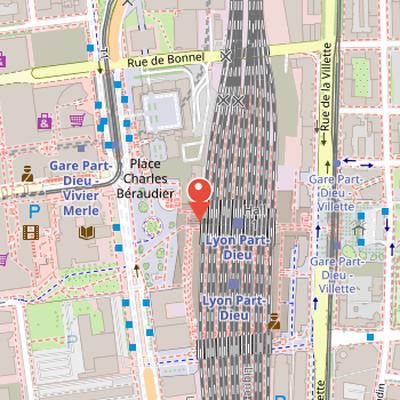
Nearby Objects
-
 Gare Part-Dieu - Vivier Merle 150 m away
 -
 Bibliothèque municipale de Lyon 200 m away
 -
 Tour Oxygène 250 m away
 -
 Tour Swiss Life 300 m away
 -
 Westfield La Part-Dieu 300 m away
Railway Station in La Part-Dieu
La gare de Lyon-Part-Dieu is a French railway station located in the La Part-Dieu district of Lyon, in the city of Lyon, capital of the Auvergne-Rhone-Alpes region. It is operated by the Societe nationale des chemins de fer francais (SNCF) and serves international, national, and regional traffic. The station is notable for its scale of use: it is the first European station by the number of connecting passengers and the first French station by annual passenger numbers.
Railway Location and Role
Gare de Lyon-Part-Dieu is identified as a station at kilometer point 5,010 on the Lyon-Perrache to Geneve line, where it lies between Lyon-Perrache and Crepieux-la-Pape stations. It is also recorded at kilometer point 507,505 on the Collonges-Fontaines to Lyon-Guillotiere line, and it is situated at a specific altitude. In railway terms, the station is considered an essential element of the Lyon railway junction. Before Lyon-Part-Dieu opened, TGV services connected Paris-Gare-de-Lyon with Lyon-Brotteaux and Lyon-Perrache stations.
Role and Setting of Gare de Lyon-Part-Dieu
Gare de Lyon-Part-Dieu occupies the site of the former freight station known as la Part-Dieu. It was designed by the architects Eugene Gachon and Jean-Louis Girodet and put into service as part of an urban development project that created Lyon's second city center and the La Part-Dieu shopping center. The station replaced Lyon-Brotteaux, which had been located to the north on the same lines, and it was intended to compensate for the limitations of Lyon-Perrache station. It accommodates TGV trains arriving from Paris.
The station faces the La Part-Dieu shopping center on boulevard Vivier-Merle and is associated with an important administrative center and the business district dominated by Tour Part-Dieu. It is also the main transit hub in Lyon for TCL, with 17 lines passing through or starting at Gare Part-Dieu - Vivier Merle or Gare Part-Dieu - Villette.
Passenger Services and Rail Connections
Lyon-Part-Dieu station is served by numerous TGV, Intercites, and TER Auvergne-Rhone-Alpes trains. It has direct TGV connections to Germany via Strasbourg since the opening of LGV Rhin-Rhone. The station also had direct AVE services to Barcelona until their suspension in 2022, and these services were relaunched by Renfe in 2023 under competition rules. Since December 2013, Lyon-Part-Dieu has maintained a daily round-trip TGV service to Milan via Turin, and since May 15, 2022, a Frecciarossa service operated by Trenitalia France has run as the sole Lyon-Part-Dieu to Milan route. The station has also been connected by low-cost Ouigo trains between Marne-la-Vallee-Chessy and Lyon-Part-Dieu since May 2014. From December 2007 to 2020, it was served by the regular Eurostar London-Lyon-Avignon-Marseille connection.
Station Design and Urban Role
Gare de Lyon-Part-Dieu has a two-level structure with an uncommon architecture for French stations. The ground floor hall serves as the passenger building and includes sales points and shops, while the platforms are located on the upper level and are reached by escalators. The station functions both as a pedestrian street between districts and as a secured transit center.
Its use grew beyond the initial travel passage and destination predictions made for the period from 1983 to 2001. By 2001, passenger traffic involved 500 trains. To respond to this growth, the station was restructured from 1995 to 2001, with the number of platforms increased and external services revised.
The surrounding area has also changed significantly. Since 1970, it has experienced constant residential and tertiary development linking Villeurbanne and Lyon economically and urbanistically. A business center has developed along the north-south axis near the former rear of the Brotteaux stations. SNCF has also provided annual attendance estimates for the period from 2015 to 2024.
Redevelopment Around Gare de Lyon-Part-Dieu
Several plans were studied to address the saturation of Gare de Lyon-Part-Dieu. Among them, three projects attracted particular attention, but the solutions were described as very costly and difficult because of the subsoil, which would require a tunnel and a deep station. Gérard Collomb opposed dedicating land along boulevard Stalingrad to enlarge La Part-Dieu, and a long-term Lyon railway node development project was later announced, with debate led by a special commission.
The mission Part-Dieu was established and selected the urban agency l'AUC, which launched the first studies for a multimodal exchange pole. The redevelopment program included projects such as tour Incity, Green Part-Dieu, Crystallin, new archives buildings, Equinox, and public space transformations. Between 2014 and 2016, building B10 was demolished between boulevard Vivier-Merle and place Charles-Beraudier to open the square.
The first urban project realizations included the offices Silex1, Silex2, Terralta, the renovation of 107 rue Servient, To Lyon, Sky 56, and housing projects Sky Avenue, Bricks, and Emergence Lafayette. The transformation and extension of the shopping center and the evolution of the multimodal exchange pole were planned until 2024, alongside developments at place de Francfort, boulevard Viver-Merle, place Charles-Beraudier, and the renewal of parc Mandela around fort Montluc. Other projects continued in the northern place Beraudier sector, around place de Milan, near place du Lac and rue Bouchut, and with the development of bois de la Part Dieu near tour BML and a future real estate island on the current France 3 Lyon headquarters.
Railway infrastructure plans also formed part of the broader project, including the addition of two new tracks between Saint-Clair and Guillotiere over about 4.5 kilometers, an extension of the Gare de Lyon-Part-Dieu, and a four-track upgrade of the Lyon to Grenoble line surface section between gare de Saint-Fons and the LGV Rhone-Alpes bifurcation in Grenay.
Hommage Plaque at Lyon-Part-Dieu
Hommage is a commemorative plaque located at the entrance of Lyon-Part-Dieu station on the Vivier-Merle side. It honors Charles Beraudier, a Lyon political figure and resistant who lived from 1920 to 1988. The plaque also states that the forecourt of Lyon-Part-Dieu station on the Vivier-Merle side is named after Charles Beraudier.