The Bibliothèque municipale de Lyon is a municipal library classified and distributed across sixteen sites in the city of Lyon. It ensures the regional legal deposit for printed materials in the Auvergne-Rhône-Alpes region and includes a major heritage collection. Its headquarters, the Bibliothèque de la Part-Dieu, is among the largest public libraries in Europe and is organized around themed rooms and a conservation storage tower known as the ‘silo’.
The institution holds manuscripts, incunabula, ancient books, artist books, prints, and photographs forming the second largest set in France, after the Bibliothèque nationale de France. Its collections are the result of a long history that begins in 1565 at the Collège de la Trinité, managed by the Jesuits. Over time, the library expanded through donations, bequests, and municipal development, including the bequest of Archbishop Camille de Neufville de Villeroy in 1693. The first public library of Lyon opened in 1731, while later reorganizations and acquisitions shaped the municipal library’s holdings in the 19th century.
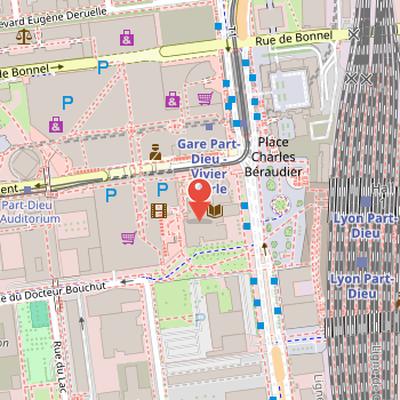
Nearby Objects
-
 Westfield La Part-Dieu 160 m away
 -
 Gare Part-Dieu - Vivier Merle 200 m away
 -
 Tour Silex 2 200 m away
 -
 Lyon-Part-Dieu station 200 m away
 -
 Tour Oxygène 200 m away
The Bibliotheque municipale de Lyon
The Bibliotheque municipale de Lyon is a municipal library spread across sixteen sites in the city of Lyon. It is responsible for the regional legal deposit of printed materials for the Auvergne-Rhone-Alpes region. Its headquarters, the Bibliotheque de la Part-Dieu, is among the largest public libraries in Europe and includes different themed rooms arranged around a storage tower known as the silo, which is used for conservation. The library's collections of manuscripts, incunabula, ancient books, artist books, prints, and photographs form the second largest set in France, after the Bibliotheque nationale de France, and include approximately documents.
From Jesuit College to Municipal Library
The collections of the Bibliotheque municipale de Lyon originate at the College de la Trinite, which was managed by Jesuits in 1565. The books were grouped in a room built in the first half of the 16th century, and the collection expanded with funding from the Consulat and donations from Jesuit fathers. In 1693, Archbishop Camille de Neufville de Villeroy bequeathed printed and manuscript works, strengthening the holdings of the library, which remained reserved for professors and was only exceptionally open to external persons.
A first public library in Lyon opened in the Saint-Jean district at hotel Flechere in 1731. It was open two days per week and mainly held legal documents. After the Jesuits were expelled in 1763, the Consulat consolidated the two collections at the College de la Trinite, bringing them together into a collection of 20,000 documents that formed the Bibliotheque de la Ville de Lyon. During the Revolution, the library closed and religious assets were confiscated into multiple depots. A significant collection from the chapter of Cathedrale Saint-Jean joined the existing funds, while other works were removed during the army occupation after the siege of Lyon and sent to Paris collections. The remaining collection was entrusted to the new Ecole centrale in 1795.
The municipality then took management of the library by law on 28 Pluviose an VIII, and Antoine-Francois Delandine served as first director from 1803 to 1820. In the 19th century, major acquisitions included the Charvin legacy in 1842, the Coste collection in 1855, and the Mestre legacy, with many literary texts, in 1882. A second municipal library was created in 1831 by Mayor Gabriel Prunelle and installed in Palais Saint-Pierre, where it was dedicated to sciences and arts. It also included collections from the Academie de Lyon and other learned societies, and was enriched by the Lambert legacy in 1850, the Bonafous legacy on sericulture in 1859, and the Des Guidi legacy in 1869. In 1911, the municipality combined the two libraries in the former archiepiscopal palace, which had been vacated following the law separating Churches and State.
Major 20th-Century Acquisitions
The Bibliotheque municipale de Lyon significantly expanded its holdings through a series of major acquisitions during the 20th century. In 1905, it received the Morins-Pons legacy of historical prints. Further important additions followed in 1921, when the library acquired the collections of the Societe de Geographie de Lyon and those of Professor Alexandre Lacassagne. In 1925, it obtained the collections of the Societe d'Agriculture, Sciences et Industries de Lyon.
Later acquisitions continued to shape the library's profile as a major repository of specialized material. In 1960, it acquired the Pierre Adamoli collection through the Academie de Lyon. This was followed by the G. Vermard fonds in 1990 and the Rude fonds on the canut revolt in 1991. The former Fondation nationale de la Photographie collections were added in 1993, then the M. Vallet fonds in 1995 and the Bibliotheque de la Chronique Sociale de France in 1996. In 1998, the library acquired the Jesuit library of Les Fontaines.
The Part-Dieu Library
The Part-Dieu library was built between 1969 and 1972 in the new Part-Dieu district, following architect Jacques Perrin-Fayolle's plans. It was designed as a large library complex made up of several five-story buildings arranged around a 17-level document storage tower. The new facility replaced the Palais Saint-Jean library, which had become inadequate in terms of user capacity and storage conditions.
From the time of its opening to the public, the library was presented as the largest reading-capacity library in France. It housed major documentary and heritage collections, as well as the regional printer legal deposit, and served as headquarters for 14 branches and 2 bookmobiles. The institution was also described as holding the second most important collections in France within an area of about an unspecified size. By 1976, the Part-Dieu library held approximately 2 million volumes.
The building offered reading capacity across multiple rooms, including the first French regional documentation room focused on the history of Grand Lyon and Rhone-Alpes. Its main hall featured a wall sculpted by Morog. In 1995, the reading and reference rooms were reorganized into thematic departments. The library also maintained the first public French institution to preserve an LGBT collection.
The Part-Dieu Silo and Library Organization
The Bibliotheque municipale de Lyon uses the Part-Dieu silo as a major architectural element in its urban setting, where it serves as a visible marker of the librarys identity. Sites actuels built the 17-level silo with a metallic frame and reinforced concrete fireproof floors, and described it as a keep of knowledge because of its height and structure. The building greatly expanded storage capacity, increasing shelving from 7,000 meters at Palais Saint-Jean to 36,000 meters in the Part-Dieu silo.
The silo was designed for conservation as well as storage. Limited light entry, together with temperature and humidity control, helps preserve the collections, while each floor is divided into three fireproof sections. The aisles and rows are arranged in a fishbone pattern, and books are organized by typology or format across different floors to optimize space. A fire safety system releases Argonite gas, composed of argon, nitrogen, and oxygen reduced from 21 percent to 12 percent. From 2017 to 2023, important work was carried out to improve conservation, lighting, and asbestos removal.
Access to the stored collections is managed through a paternoster lift that circulates in a loop between the silo floors. User requests are transported in trays and handed over by librarians. At the time of construction, ten rooms were open to the public for study and consultation. In 2021, these public rooms were managed by two different directions.
The librarys collections are organized through three services: the modern silo, old and specialized collections, and regional documentation. The institution also opened a second entrance facing the station on the east side of the building in an unspecified month, reinforcing its links with the surrounding area. In 1994, the artotheque was inaugurated to open acquisitions toward contemporary artistic creation.
The 2nd Arrondissement Library
The first 2nd arrondissement library opened at 10 rue Bourgelat, facing the Saint-Martin d'Ainay basilica. At its opening, the site had a total area of 7,000 documents, and it was later enlarged with a 50 square metre childrens room. After three years of work and a budget of 3,582,000 euros, the original site closed and reopened at 13 rue de Conde. The new library has a total area that includes 1,127 square metres of public space and 24,000 documents.
The library is housed in a building with a gymnasium designed by architect Philippe Lamy. It occupies four levels, three of which are accessible to the public. These public areas include childrens, adults, and digital sections, as well as eight public-access computers. A bibliobus also serves the 2nd arrondissement bimonthly at Place de l'Hippodrome in the Sainte-Blandine quarter. In 2022, the library had 32,000 documents, 57,000 visitors, and 140,000 loans.
Current Library Sites Across Lyon
The Bibliotheque municipale de Lyon operates a network of current sites distributed across several districts of the city, each with distinct locations, opening dates, and services. In the 3rd arrondissement, the bibliotheque du 3 has been located at 246 rue Duguesclin in Moncey-Voltaire since 1980, while the bibliotheque Marguerite Yourcenar du 3, at 86 avenue Lacassagne, opened in 2017 and offers games for all, videogames, and a Fablab. In the 4th arrondissement, the bibliotheque du 4 at 12 bis rue de Cuire in la Croix-Rousse has been open since 2006 after renovation, with a global surface area and services. In the 5th arrondissement, the bibliotheque du 5 is installed at 4 avenue Adolphe-Max in Saint-Jean and has occupied the Palais Saint-Jean, a former bishops residence, since 1909; it was the central library of Lyon until the relocation to Part Dieu in 1972.
Other sites reflect a wide variety of formats and audiences. The bibliotheque du Point du Jour, at 10-12 rue Joliot-Curie, opened in 2008 and offers a space distributed over three levels. The bibliotheque du 6 Clemenece Lortet, existing since 1963, opened a new building with access at 33 rue Bossuet and offers more than collections, including games and videogames. In the 7th arrondissement, the bibliotheque du 7 Jean Mace at 2 rue Domer opened in 2008 and is specialized for adolescents and adults, while the bibliotheque du 7 Guillotiere at 25 rue Bechevelin opened in 1984 and is specialized for the youth audience. Also in Gerland, the bibliotheque Hannah Arendt de Gerland at 34 rue Jacques-Monod offers a collection with games and videogames.
Further current sites include the mediatheque du 8 Bachut Marguerite Duras at 2 place du 11-novembre-1918, which opened in 2006 and offers the Cap'culture sante space, and the bibliotheque du 9 La Duchere Annie Schwartz at 4 place de l'Abbe-Pierre, opened in 2011 and gathering collections. The bibliotheque du 9 Saint-Rambert at 3 place Schonberg opened in 1983 and offers collections on two levels. The mediatheque de Vaise Marceline Desbordes-Valmore at place Valmy opened in 2000 and includes an Arts vivants department.
The Bibliotheque municipale de Lyon also includes an off-site Service mobile. This service has eight librarians and three bibliobuses, and it provides document loans and occasional animations to individuals and professionals.
Collections and Documentary Heritage
The collections of the Bibliotheque municipale de Lyon are organized around a public reading plan that combines heritage conservation with documents intended for information, leisure, education, and culture. They are distributed across all sites of the Lyon library network and are designed both to meet the documentation needs of the modern world and to support public borrowing through a wide range of available materials. Planning for the collections at the Part-Dieu library site began in 1966 under director Henri-Jean Martin.
The library network includes heritage collections dedicated to the study and preservation of knowledge, alongside current borrowable collections. Its holdings are extensive and varied, and the 2021 activity report recorded the total number of collections available in the network, together with visitor attendance and document loan figures.
Among the most notable holdings is one of the richest collections in Europe, including the oldest document, the Merovingian Lyon scriptorium. The collections also include volumes of old books, with major 16th-century editions by Lyon editors such as Sebastien Gryphe, Jean de Tournes, and Etienne Dolet. Manuscript holdings number 400, including 50 Merovingian and Carolingian manuscripts and 240 medieval manuscripts, of which 140 are illuminated. The library also holds 18,000 printed documents dated before 1921.
Other significant materials include musical scores, archival discs, popular song collections, and more than 15,000 ancient prints, including the Camille de Neufville de Villeroy and Adamoli collections, which were enriched with rare pieces. The collections also contain important photographic holdings by Andre Kertesz, Robert Doisneau, and William Klein, as well as about 300,000 periodicals.
Several specialised fonds broaden the scope of the library's documentary heritage. The Jesuit Fontaines Collection, gathered by the Jesuit Order from 1951 to 1998, includes 40,000 titles now conserved at the municipal library under a convention. The fonds Michel Chomarat, deposited since 1992, includes posters, games, songs, flyers, and other documents relating to LGBTQI history and culture, marginality, occultism, Nostradamus, religious popular iconography, and street literature. The collections also hold valuable Chinese works from the Republican and Maoist periods in classical and popular culture.
Historical documentary collections include the Fonds de la guerre 1914-1918, started in 1915 under Lyon mayor Edouard Herriot to collect World War I documents. By 1920 it contained 16,000 documents, including periodicals and soldier testimonies, and it was rediscovered and used for World War I centenary celebrations in the early 2000s. The Fonds Coste, created in the 1850s from the collection of Lyon bibliophile Jean-Antoine-Louis Coste, brings together varied documents, including printed works by Lyon authors and publishers of the 15th and 16th centuries, and many monographs and iconographic documents about Lyon. The Fonds Memoires des musiques lyonnaises, created in 2009 with 7,500 documents, is the most important music collection in the municipal library; it originated from donations by Nacre and the association Dandelyon and was later developed through acquisitions linked to metropolitan artists or labels.
Digital Heritage Collections and Numelyo
The Bibliotheque municipale de Lyon maintains digital collections under the Direction du Patrimoine. These collections include both native digital holdings and digitized materials. Digitized collections result from projects supported by historical partners such as the Ministere de la Culture and the Bibliotheque nationale de France.
A major access point for these resources is Numelyo, the city of Lyon's patrimonial digital library. Numelyo hosts digitized collections dating from 1993, including enluminures and books digitized by Google after 2008. After winning a 2008 Ville de Lyon tender for public domain ancient printed books, Google digitized books from the Bibliotheque municipale de Lyon starting at the end of 2009, and these files progressively feed into Numelyo.
The collections also include several named fonds. The fonds Jules Sylvestre was involved in a 2024-2025 pedagogical project between the Bibliotheque municipale de Lyon and the Ecole du Louvre. The fonds Georges Vermard contains works from 1960 to 1970 relating to many regional events. The fonds of the photographer Marcelle Vallet covers the period from 1950 to 1970 and consists mainly of portraits of personalities and anonymous individuals.
Another group, Photographes en Rhone-Alpes, gathers local and regional fonds with contributions from amateurs and confirmed photographers. These collections are intended for public consultation, reinforcing the library's role as a public resource for regional photographic and documentary heritage.
Autres services
Autres services is the virtual reference service of the Bibliotheque municipale de Lyon. It functions as an online question and answer service that allows anyone to ask a question and receive a reply from a librarian. The service also includes the webzine L'Influx, which features content written by librarians. Through L'Influx, Autres services presents current affairs topics in the form of collections, extending the library's public-facing role beyond its physical spaces.