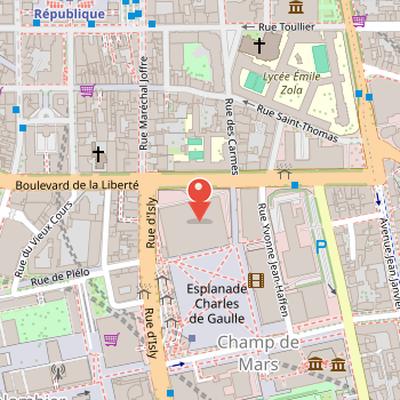
Le Liberté is a concert hall and former sports hall in downtown Rennes, situated between Esplanade Charles-de-Gaulle and Boulevard de la Liberté. It is adjacent to Les Champs Libres and the multiplex cinema, and lies near the Théâtre national de Bretagne and the Gare SNCF. The site is served by the metro, including Charles de Gaulle station on line A, and by an underground car park with 200 spaces.
The building’s history began after Henri Fréville was elected mayor of Rennes in 1953. In 1956, the municipal council approved the construction of a multi-sport hall intended for sports, concerts, and congresses. Architect Louis Arretche was assigned to the design, and the work was carried out by the entrepreneurs Brochard and Gaudichet. After three years of construction, the hall was inaugurated by Maurice Herzog and Henri Fréville.
Originally used for major sporting events, the venue also hosted an increasing number of concerts in the 1980s. It was renamed Le Liberté in 1996, when it was renovated for concert hosting. The building was closed again in 2006 for renovations and later reopened with Laurent Voulzy’s inaugural concert and the inauguration of the L’Étage hall at level 1. Its roof, resembling two crossing sails, is reflected in the building’s initial logo.
Nearby Objects
-
 Esplanade Charles-de-Gaulle 100 m away
 -
 Museum of Brittany 250 m away
 -
 Musée des Beaux-Arts de Rennes 300 m away
 -
 Théâtre National de Bretagne 350 m away
 -
 Place de la République 350 m away
Location and Access
Le LibertE is located in downtown Rennes between the esplanade Charles-de-Gaulle and boulevard de la LibertE. It stands adjacent to the cultural facilities Les Champs Libres and the multiplex cinema, and it is also near the TheEtre national de Bretagne and the Gare SNCF. The site is served by the metro, including Charles de Gaulle station on metro line A, and by an underground parking lot with 200 spaces.
Planning and Construction
According to Histoire, the project that led to Le Liberthe was linked to municipal planning in Rennes after Henri Freville was elected mayor in 1953. Freville considered transforming the south center of the city, then occupied by the Champ de Mars. In 1956, the municipal council approved the construction of a multi-sport hall intended for sports, concerts, and congresses. Architect Louis Arretche was assigned to design the building, and entrepreneurs Brochard and Gaudichet were responsible for its construction. After three years of work, the hall was inaugurated by Maurice Herzog and Henri Freville. Its main function was to host major sporting events.
Renovation and Changing Uses
According to Histoire, Le Liberte began to host an increasing number of concerts in the 1980s, as national and international artists performed there more often. In 1996, the sports hall was renamed Le Liberte and renovated to support concert hosting. The venue then closed in 2006 for further renovations. After reopening, Laurent Voulzy gave the inaugural concert, and the L'Etage hall at level 1 was also inaugurated. Histoire notes that Les Transmusicales returned to Le Liberte for their anniversary in November, alongside other venues, although the site was considered too small for large festival attendance. In parallel with its concert role, Le Liberte remained an important sports venue. The first sporting event after reopening was a match between Cesson Rennes Metropole Handball and Montpellier Agglomeration Handball, and the first match post-reopening in 2012 was involved in a fixed betting scandal. From 2012 to 2019, Le Liberte regularly hosted major Cesson Rennes Metropole Handball matches, while other matches were played at Palais des Sports de Cesson-Sevigne. In 2019, the club moved to Glaz Arena, built in Cesson-Sevigne.
Roof Form and Architectural Identity
Le Libertes architecture is marked by a roof resembling two crossing sails, a form that was also reflected in the buildings initial logo. This roof shape became widely recognized enough to inspire the nickname les fesses a Arretche among the local population. The design is not only visually distinctive but also technically significant, since the roof is formed by a double concrete vault with a span, described as both a technical and architectural feat.
Spaces and Uses
Le Libert e is organized on two floors. Its main room has a modular surface area and is designed to accommodate a specific number of seats. The venue also includes a room called Le Libert e - L Etage, which likewise has a modular surface and can hold up to 900 standing people. This upper room is mainly dedicated to current music, chanson, and world music, and it is identified as a place for expressing the musical dynamics of Rennes. The main access to the room is located on the esplanade Charles de Gaulle.
The site also serves as a major setting for the Festival Stunfest, which focuses on video game culture. For this event, almost the entire venue is used, with activities taking place in the corridors, Le Libert e, Le Libert e - L Etage, and on the esplanade Charles de Gaulle. The festival is held annually in mid-May over three days and attracts nearly a certain number of attendees.