The Musée des Beaux-Arts de Rennes is an art and archaeology museum located in Rennes, Ille-et-Vilaine, in Brittany. It is housed in the old university palace on quai Émile-Zola and is served by Rennes metro lines A and B at République and Saint-Germain stations. The museum was constituted with initial funds from artworks seized during revolutionary confiscations in 1794 in Rennes. A significant part of its collection also comes from the cabinet of curiosities of the marquis de Robien, president of the Parliament of Brittany, who gathered artworks and objects from many periods.
The collections include European paintings and sculptures from the 16th to the 19th centuries, as well as art objects from Europe, Africa, and America. They also contain regional, Roman, Etruscan, Greek, and Egyptian antiquities. Among the notable works are a cartonnage fragment named Djed-Amon, ancient Greek and Etruscan ceramics, and a marble statue of Diana the Huntress. The museum also preserves 1,107 drawing sheets from the Robien collection, representing artists such as Filippo Lippi, Leonardo da Vinci, Botticelli, Donatello, Michelangelo, and Albrecht Dürer. The museum has an annex, the musée Maurepas, in the Maurepas district, where two exhibitions per year are offered with free access.
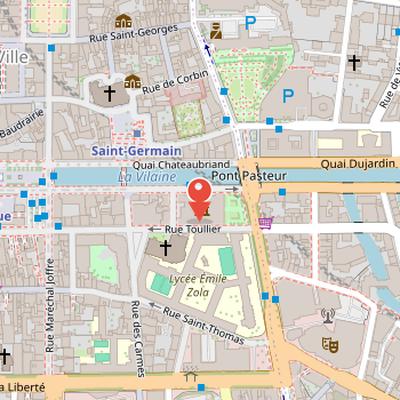
Nearby Objects
-
 Place Saint-Germain 150 m away
 -
 Église Saint-Germain de Rennes 200 m away
 -
 Théâtre National de Bretagne 250 m away
 -
 Saint George Palace 250 m away
 -
 Place de la République 300 m away
Collection Origins and Metro Access
The Musee des Beaux-Arts de Rennes is a French art and archaeology museum in Rennes, Ille-et-Vilaine, Bretagne. Its collection was first constituted with funds from artworks seized during revolutionary confiscations in Rennes in 1794. A significant part of the holdings comes from the cabinet of curiosities of the marquis de Robien, president of the Parliament of Brittany, who assembled an important collection of artworks and objects from all eras. The museum is also linked to the broader history of provincial art collections, alongside the collection of the marquis de Livois in Angers, which was one of the great provincial collections of ancient painting. Today, the museum is served by line A of the Rennes metro at Republique station and by line B at Saint-Germain station.
Location and Annex
The Musee des Beaux-Arts de Rennes is located in the old university palace of Rennes, on quai Emile-Zola. It also has an annex called the Musee Maurepas, established at an unspecified date. This annex is situated at the foot of a residential building known as La Banane in the Maurepas district. The Musee Maurepas presents two exhibitions per year, and access is free.
Collections of the Musee des Beaux-Arts de Rennes
The collections of the Musee des Beaux-Arts de Rennes cover a wide chronological and geographic range. They include European paintings and sculptures from the 16th to the 19th centuries, as well as art objects from Europe, Africa, and America. The museum also holds regional, Roman, Etruscan, Greek, and Egyptian antiquities, showing a broad interest in both classical and non-European heritage.
Among the antiquities are a cartonnage fragment named Djed-Amon from Egypt, a Corinthian skyphos dating to around 600-570 BC, two Attic pelikes from Rhodes, an Etruscan plate with a woman's head in medallion form from the 4th century BC, and a marble statue of Diana the Huntress from Rome. These objects highlight the depth of the museum's ancient holdings.
A major part of the collections is the Robien drawing collection, which contains 1107 drawing sheets. It is divided equally between Italian, French, and Northern schools. The drawings represent many artists, including Filippo Lippi, Leonardo da Vinci, Botticelli, Donatello, Domenico Ghirlandaio, Giovanni Bellini, Michelangelo, Albrecht Durer, Bernard van Orley, Lorenzo di Credi, Francesco di Stefano Pesellino, Le Sodoma, Le Corrège, Pontormo, Giulio Romano, Paris Bordone, Baccio Bandinelli, Parmigianino, Nicolo dell'Abbate, Alessandro Allori, Federico Barocci, Rubens, Pierre de Cortone, Andrea Sacchi, Simon Vouet, Pierre Puget, Rembrandt, Salvator Rosa, Antoine Watteau, Sebastiano Ricci, Pierre Bonnard, Maurice Denis, Edouard Vuillard, and Pablo Picasso.
Specific drawings include Domenico Ghirlandaio's Femme vue de dos, draperie, circa 1480; Albrecht Durer's La Messe des anges, circa 1500; Parmigianino's Jeune garcon vue de dos, tete de profil from the 1520s; Bernardino Campi's L'Immaculee Conception from the 1560s; Carlo Urbino's L'Adoration de bergers, dated 1540; and Antoine Sallaert's Alexandre et Diogene, dated 1612. Additional drawing holdings represent artists such as Lucas de Leyde, Domenico Beccafumi, Hendrick Goltzius, Agostino Carracci, Jacques Callot, Le Lorrain, Charles Le Brun, Jacob van Ruisdael, Adriaen van Ostade, Jean-Antoine Watteau, and Francois Boucher.
Collections and Artistic Scope
The collections of the Musee des Beaux-Arts de Rennes cover a wide geographical and chronological range. They include works from Francophone Africa, Asia Minor and the Far East, the Americas from the polar circle to the southern tropic, and Oceania, as well as a non-European fund that includes Japanese prints. European art is also strongly represented, although some periods remain nearly absent, including the medieval fund despite a significant deposit from the Musee de Cluny. The medieval section is represented by a painting by Mariotto di Nardo and two panels by the Italian primitive Lippo di Benivieni from the same polyptych.
Among the European schools, the museum holds major Venetian works by Paris Bordone, Paul Veronese, and Leandro Bassano, along with notable paintings such as Woman Between Two Ages from the School of Fontainebleau and Saint Luke Painting the Virgin by Maarten van Heemskerck. French seventeenth-century painting forms the core of the museum, with important works by Lubin Baugin, including Still Life with Apricots Cup, one of his four known still lifes, as well as paintings by Claude Vignon, Francois Perrier, Philippe de Champaigne, Mathieu Le Nain, Jacques Stella, Eustache Le Sueur, Laurent de La Hyre, Charles Le Brun, Noel Coypel, Charles de La Fosse, Jean Jouvenet, and Georges de La Tour. The collections also include Charles Le Brun's Descente de Croix, Philippe de Champaigne's Madeleine Penitente and Le Christ au jardin des oliviers, and seventeenth-century sculpture represented mainly by large bas-reliefs by Antoine Coysevox from the pedestal of the Monument to Louis XIV in Rennes.
Other strengths include works by northern European artists such as Rubens, major Italian masters such as Ludovico Carracci, Le Guerchin, Pierre de Cortone, Guido Reni, and Luca Giordano, and important additions from Jose de Ribera, including Saint Jude Thaddee purchased in Rennes in January 2014 and Saint Matthieu received as a donation in 2015. The museum also displays paintings by Francois Desportes, Jean Restout, and Francesco Casanova, small-format works by Chardin, Francesco Guardi, Greuze, Carle Van Loo, and Francois Boucher, and sketches by Francesco Solimena, Giacomo del Po, Corrado Giaquinto, Gabriel-Francois Doyen, and Francois-Andre Vincent.
Highlights of the Collections
The collections at the Musee des Beaux-Arts de Rennes include a range of paintings, sculpture, and a sketch that illustrate the breadth of its holdings. In sculpture, the collections showcase the maquette of the statue of Louis XV by Jean-Baptiste Lemoyne and the Mirabeau by Deseine. Among the paintings on display are Paul Veronese's Persée délivrant Andromède, oil on canvas, 1576-1578, Gerrit van Honthorst's Le Reniement de saint Pierre, oil on canvas, between 1612 and 1621, and Jacob Jordaens's Connais-toi toi-même. The museum also displays works such as Lubin Baugin's Nature morte a la coupe d'abricots, Peter Lely's Louise de La Valliere et ses enfants, Claude Vignon's Cleopatre se donnant la mort, and Georges de La Tour's Le Nouveau-ne, oil on canvas, 1645-1648. Other highlighted works include Le Guerchin's Pieta, Franciscus Gysbrechts's Vanite, Alexandre-Francois Desportes's La Chasse au loup, Gabriel-Francois Doyen's La Mort de Virginie, Jean Simeon Chardin's Le Panier de prunes, and Pierre-Paul Rubens's La Chasse au tigre. The collections also acquired the sketch La Mort de Virginie by Gabriel-Francois Doyen in 2011.
Paintings and Sculpture in the Collections
The museum's collections bring together a wide range of paintings and sculptures from the 19th and 20th centuries. In painting, the holdings include works by Charles Meynier, Amaury-Duval, and Leon Cogniet from the first half of the 19th century, followed by artists such as Camille Corot, Eugene Boudin, Johan Barthold Jongkind, Gustave Caillebotte, and Auguste Michel Nobillet from the second half of the century. The collection also includes Alfred Sisley, Odilon Redon, Emile Bernard, and members of the Nabis group, including Paul Serusier, Georges Lacombe, Paul-Elie Ranson, and Maurice Denis. Breton artists Jean-Julien Lemordant and Andre Meriel-Bussy are represented, along with several works by Picasso. Contemporary painting is present through works by Sam Francis, Jean Couy, Pierre Soulages, Aurelie Nemours, and Genevieve Asse.
Several individual paintings are identified in the collection, including Leon Cogniet's Scene du Massacre des Innocents from 1824, Jean-Achille Benouville's Paysage d'Italie, Gustave Caillebotte's Le Pont de l'Europe, Paul Gauguin's Vase de fleurs a la fenetre from 1881, Eugene Boudin's Trouville, les jetees, mer haute from 1885, Emile Bernard's L'Arbre jaune from 1888, Paul Serusier's Solitude from 1890 to 1892, Georges Lacombe's Marine bleue, Effet de vague from around 1893, and Serusier's Cylindre d'or from around 1910. The collections also contain Gilles Aillaud's La Fosse from 1967.
The sculpture collection includes works by Lorenzo Bartolini, such as Napoleone-Elisa Baciocchi et son chien from 1812, as well as sculptures by James Pradier, Pierre Gourdel, Charles Joseph Lenoir, Louis-Ernest Barrias, Alfred Boucher, Auguste Rodin, Germaine Richier, Julien-Charles Dubois, Pierre Travaux, Aime Millet, Emmanuel Dolivet, and Jean Boucher. Individual works mentioned include the bust of Paul Devolant by Pierre Gourdel, Alfred Boucher's Le Terrassier, Rodin's Buste de jeune femme in marble, Richier's Pomone from 1945 in bronze, Dubois's Joueur d'onchets from 1842, Travaux's La Reverie from 1855, Millet's Chateaubriand from 1875, Dolivet's Madeleine from 1886, Rodin's Buste de jeune femme acquired in 1887, and Jean Boucher's Buste d'Anne de Bretagne from 1915.
Acquisition of a Bronze Model
The Acquisitions reports describe a bronze model of the Monument a Louis XIV by Antoine Coysevox, dating from the 1690s. The work had been owned by a British aristocrat and was previously known only through engravings and drawings by Jean-Francois Huguet. The French Ministry of Culture launched a corporate sponsorship appeal to help finance its purchase, and the statue was acquired by the city of Rennes with sponsorship from the agro-food group Norac. It then joined the collections of the Rennes Museum of Fine Arts.