Museum of Brittany is a regional museum of society and history located at Champs Libres in Rennes, where it has been based since 2006. It previously shared space with the Musée des Beaux-Arts de Rennes in the palais universitaire on the quai de la Vilaine. The museum’s collections focus on the history of Brittany, including archaeology and ethnography, and document Breton heritage from early human traces to the present. Its role includes the enrichment and conservation of heritage connected with Brittany’s history and society. The institution evolved from an earlier focus on archaeology and ethnology toward a museum of society. Its history is linked to museum collections formed from revolutionary confiscations in 1794 and to Christophe-Paul de Robien’s cabinet of curiosities. Over time, its collections developed through key stages, including a Breton object collection begun in 1909 and later shared regional collections. The museum has been labeled Tourisme et Handicap since 2007 and offers guided tours, including LSF and tactile visits, as well as audioguides.
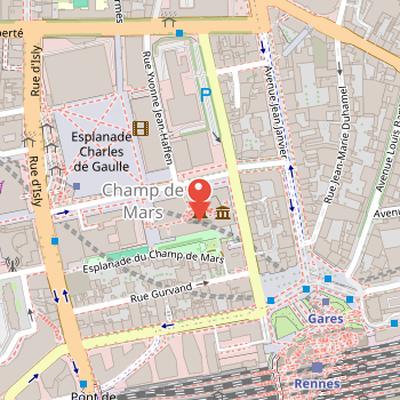
Nearby Objects
-
 Esplanade Charles-de-Gaulle 200 m away
 -
 Le Liberté 250 m away
 -
 Cinéma Arvor 300 m away
 -
 Théâtre National de Bretagne 350 m away
 -
 Musée des Beaux-Arts de Rennes 500 m away
Museum at Champs Libres
The Museum of Brittany is a museum of society and history located at Champs libres in Rennes, where it has been based since 2006. Before that, it was located in the palais universitaire on quai de la Vilaine together with the Musee des Beaux-Arts de Rennes. It celebrated its anniversaries at Champs libres in 2016.
The museum is a regional institution that evolved from archaeology and ethnology toward a museum of society. Its missions include the enrichment and conservation of heritage connected with Brittany's history and society. Its collections include more than a certain number of objects representative of Breton heritage, covering the period from the earliest human traces to the present.
The museum has held the label Tourisme et Handicap since 2007. It offers several forms of guided visits, including LSF and tactile tours, and it also provides audioguides for visitors.
Museum Development and Collection History
The Museum of Brittany's collections originated from two main sources: the revolutionary confiscations of 1794 and Christophe-Paul de Robien's cabinet of curiosities. A first inventory register listing objects from the Rennes museum was opened in 1845. In 1909, the museum began building a Breton object collection, which led to the opening in 1913 of a Breton Museum with two rooms devoted to ethnography. After World War II, regional ethnography museums received new momentum through the French Museums Directorate and Georges Henri Riviere, and the museum's collections became shared with the Museum of Brittany, with an emphasis on the region's rural and agricultural past.
The museum's public and institutional development continued in later decades. The association of museum friends, ADAMB, was created in 1981 to support museum activities, and it became AMEBB in 1987, the same year the museum decided to move from the Vilaine quays to a new building. Management transferred from the municipality to Rennes Metropole in 2000. The museum was directed by Francois Hubert from 1983 to 2005, Jean-Paul Le Maguet from 2005 to 2009, Pascal Aumasson from 2009 to 2012, and Celine Chanas from 2012 onward. Between 2015 and 2021, the museum carried out a new scientific and cultural project involving inventory work, digitization, an online collection portal, and exhibition renewal. The project was renewed in 2022 as part of the Champs Libres new establishment plan.
Recognition and Awards
The Museum of Brittany at Les Champs Libres has received several awards for its public and digital cultural role. In 2018, it was awarded the Patrimoine pour tous prize. In the same year, Rennes Metropole received the Prix Territoriaux La Gazette-GMF for its online collection portal. In 2023, Les Champs Libres, including the Museum of Brittany, was awarded the Label Culture Libre at Gold level. These distinctions highlight the institution's visibility and its contribution to access to cultural heritage.
Collections and Photography
The collections of the Museum of Brittany center on the history of the Brittany region, with particular emphasis on archaeology and ethnography. They are shared with the Ecomusee du Pays de Rennes, while the Museum of Brittany manages their scientific, documentary, and administrative aspects. The museum also makes more than objects and documents accessible under public domain or Creative Commons licenses, and in 2024 its online portal provided access to more than objects and documents. In addition, the museum operates a blog called Musee devoile, which presents new acquisitions and different professions.
The archaeology collections originated in the holdings of Christophe-Paul de Robien and developed further from the marquis de Robien's collection starting in the 1880s. Photography has become another important area of acquisition. Among the oldest photographs in Brittany are images taken between 1852 and 1853 by Louis-Remy Robert, who also produced a series of calotypes used as the basis for lithographs by Emile van Marcke in an atlas published in 1855. The museum initiated a new photography acquisition policy for contemporary Breton photographers for 2015-2021, with purchases made through series acquisitions, temporary exhibitions, books, and creative residencies. Photographs by Charles Freger joined the public collections in 2015, followed by works by Dominique Delpoux and Guy Le Querrec in 2018, Mark Neville, Delphine Dauphy, and Mark Loyon in 2019, Stephane Lavoue in 2020, Laurent Bellec in 2021, Alain Amet, Aglae Bory, Jerome Blin, Nolwen Brod, and Richard Dumas in 2022, and Mathieu Pernot in 2023.
The museum has also highlighted photography through online publication. A page titled La face cachee de l'image was created on the KuB blog by Les Champs Libres and the Museum of Brittany, featuring twelve photographs and videos from the museum's photographic collection. Individual works and related articles further connect the collection to Breton culture, including Paul Gruyer's photograph A l'abri de la tempete, Douarnenez, which shows two fishermen sharing a drink outside a Douarnenez bistro. An article by Sophie Chmura presents Gruyer as an artist and author, discusses his travels, his collaboration with Gustave Geffroy to celebrate Brittany, his publications with Hachette, and his work on Breton architectural heritage. His works are described as a scholarly reference source.
Exhibition Program and Regional Partnerships
The exhibition program of the Museum of Brittany is organized by the Musee de Bretagne and is presented in trilingual form in French, English, and Breton. Since the 1980s, it has developed temporary exhibitions in collaboration with other Breton cultural institutions or museums. These exhibitions take place in two temporary exhibition rooms within the Champs Libres, measuring 200 and respectively, and they allow connected exhibitions between the two spaces.
The program covers a wide range of subjects through a multidisciplinary approach. It often links historical perspectives with current societal issues, and most exhibitions are accompanied by publications ranging from catalogs to exhibition journals. A reference exhibition in the program presents the history and culture of Brittany over more than . Its parcours aims to show the uniqueness of Brittany in its universal dimensions, while also illustrating the alternation between periods of isolation and openness to the world and the consequences of these periods on Brittany's development. Since 2022, the program has also engaged in a project for the evolution of the parcours.
Several exhibitions in the program are built around significant historical and cultural material. One reference exhibition displays objects such as the Statue de barde from the Paule fortress, the Brigitte du Ménez Hom, a stela mentioning Titus Flavius Postuminus dated 135, a page from the Cartulaire de Redon, an ancient capital from the Saint-Sauveur Basilica in Rennes, the Odorico Isidore altar step mosaic from late century in Rennes, and an octroi boundary post from early century in Rennes. Another exhibition devoted to the Dreyfus Affair uses scenography to highlight a carceral atmosphere, presents important moments and actors, projects a documentary, and shows numerous objects recounting the case while emphasizing the scale of the investigation and its influence on Human Rights.
The program also includes photographic and thematic exhibitions. One catalog addresses landscape, daily life, and historical photographs, including works by Paul Gruyer, Constant Puyo, Robert Demachy, Emile Mage, and Paul Geniaux from the museum collections. These photographs show Breton people in colorful costumes considered exotic, as well as a mode of life described as archaic and captured with varying naturalness. A chapter titled Quand l habit fait le moine, tenues de travail en photographie focuses on clothing as a marker of social status and community belonging, offering a perspective on Breton traditions and working conditions between the 19th and 20th centuries.
The exhibition Terre-Neuve/ Terre-Neuvas was co-produced with museums in Saint-Brieuc, Saint-Malo, and Granville and presented in four cities. Divided into two parts, it focused on groups who go to sea and those who stay on land. The first part, L aventure de la peche morutiere, presented in Rennes and Saint-Malo, addressed the history, working conditions, and characteristics of the Grande Peche, along with its importance for the territories where it was practiced. The second part, Le temps de l absence, presented in Saint-Brieuc and Granville, examined life on land during fishing campaigns, the role of fishing in the economy and in popular events such as Pardon des Islandais, and literary, pictorial, and cinematic representations related to cod fishing.
In early 2014, the exhibition program received the label exposition d interet national, created by the French Ministry of Culture in 1999 to support remarkable museum exhibitions. According to the criteria cited for the label, the program was recognized for innovative museal discourse, an unprecedented thematic approach, scenography, and mediation to diverse audiences. In 2016, the director of the Musee de Bretagne described it as a notable label for a museum of history and society. As a museum of society, it aligns with ICOM missions by representing societies from diverse viewpoints while addressing social and civic roles and centering collections and reflection around humans.
Cod Fishing and Collective Memory
The geographical distribution of the expositions corresponds to the territory shaped by five centuries of cod fishing development. The ports of Saint-Brieuc, Saint-Malo, and Granville formed the largest cod fishing armament basin in France. Cod fishing was an important part of the history of Brittany and Normandy, and it ended in 1992. The Terre-Neuve and Terre-Neuvas expositions had a strong impact on collective memory, in part because many participants are still alive. Their legacy also remains present in the genealogies of many families in Brittany and Normandy, where one or more Terre-neuvas are often included.
Expositions and the Four Partner Museums
Expositions positioned itself at the boundary between history and memory. Before the exhibition opened, important collection work was carried out, and the objects gathered for this process were presented within the exhibition parcours. In this way, Expositions aligned with the missions of a history and society museum. The project also involved four partner institutions, which included museums of society, art, and history. Their collaboration reflected a multidisciplinary approach and addressed diverse types of public. By associating four museums, the exhibition increased the visibility of significant cultural institutions. It also contributed to weaving a living collective memory that was still under construction. One of the stated objectives of Expositions was to give greater visibility to the four museums by encouraging visitors to attend multiple exhibitions.
Exhibitions on the Grande Peche
The Museum of Brittany was involved in exhibition work connected to the history of the Grande Peche and the people who took part in it. It collaborated with the association Memoire et Patrimoine des Terre-Neuvas on exhibitions, and this association supported the projects by lending objects to partner museums through its founder, Lionel Martin. The exhibitions were part of broader public and scholarly efforts to continue research on the subject, alongside conferences and guided visits organized in connection with fishing heritage. In 2013, a conference titled Terre-Neuve, le pain etait la-bas was held at the Champs Libres de Rennes, where historian Raymonde Litalien and archaeologist Peter Pope shared their knowledge with the public. Other local initiatives also contributed to this heritage work, including a guided walk of the city docks in Binic and a conference that invited former Terre-Neuvas to testify. The exhibition Terre-Neuve/ Terre-Neuvas was later adapted at the Musee national de la Marine in Paris under the title Dans les mailles du filet. Presented from March 27 to September 7, 2014, it retraced the history of the Grande Peche, its actors, and environmental issues. The facts also note the role of associations devoted to preserving cod fishing heritage, including Fecamp Terre-Neuve, created in 2003 and active in maritime history research, and Memoire et Patrimoine des Terre-Neuvas, established in 2003 and dedicated to preserving and promoting heritage related to the Grande Peche.
The 2022 Celtique? Exhibition and Its Debate
In 2022, the Museum of Brittany held the temporary exhibition Celtique? , which questioned contemporary Brittany's Celtic identity. The exhibition linked Brittany to a Celtic universe through cultural and popular references, and it sought to understand why Brittany has crystallized Celtic heritage more strongly than any other region in France. A publication accompanied the exhibition under the title Celtique? La Bretagne et son heritage celtique , presenting material ranging from archaeology to contemporary culture, with a preamble by Gauthier Aubert of University Rennes 2.
The exhibition soon became the subject of controversy. A few months after opening, it was criticized for partiality by Alan Stivell, which led to the withdrawal of sponsorship. Ronan Le Coadic and Herv e Le Bihan, both from University Rennes-II, accused it of ideological manipulation and made further critiques. Other university professors argued that the exhibition did not take into account linguistic and ritual Celtic filiations in Brittany. In response, the director announced that the exhibition had been revised and completed during the summer of 2022.
The exhibition also prompted reactions within the academic community. About thirty historians from Rennes 2 published a tribute stating that history is not fixed knowledge, and CELTIC-BLM of University Rennes 2 issued a communiqué of solidarity supporting the scientific criticisms. The exhibition and its publication were later reviewed in Annales de Bretagne et des Pays de l'Ouest by Eva Guillorelet and Marcel Calvez. Debate continued after the museum presentation, including a roundtable at the Festival Interceltique de Lorient on 19 August 2023 and further discussion at the CRBC seminar La Bretagne et le grand public, r ecepteurs, passeurs, vulgarisateurs .