Philharmonie de Paris is a French cultural center in the southeast part of Parc de la Villette in Paris. It includes a concert hall named Pierre Boulez, as well as exhibition spaces, educational workshops, and rehearsal rooms. The building faces the Grande halle de la Villette and is located next to Cité de la musique, on the site of the former Paris-Bestiaux train station, which closed in 1977.
The establishment belongs to the public industrial and commercial entity Cité de la musique - Philharmonie de Paris, under the supervision of the minister responsible for Culture. Olivier Mantei directs the establishment, and Patricia Barbizet presides over it. Its main focus is symphonic music with high-quality acoustic equipment, and it also presents chamber music, jazz, and world music. Resident ensembles include the Orchestre de Paris, Ensemble intercontemporain, Les Arts Florissants, Orchestre national d’Île-de-France, and Orchestre de chambre de Paris. The site also includes an underground parking lot, and it is accessible to people with reduced mobility and disabled persons.
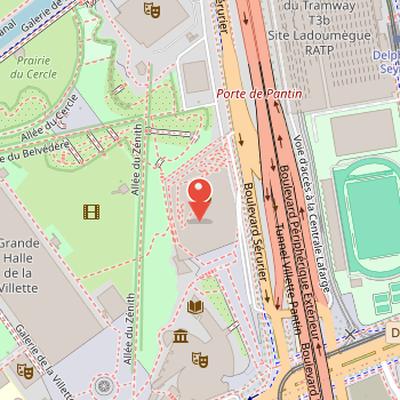
Nearby Objects
-
 Cité de la musique 200 m away
 -
 Zénith Paris 300 m away
 -
 Parc de la Villette 300 m away
 -
 Cité des Sciences et de l'Industrie 650 m away
 -
 Parc des Buttes-Chaumont 1500 m away
Music, Spaces, and Programming
The Philharmonie de Paris is a French cultural center that includes a concert hall named Pierre Boulez, along with exhibition spaces, educational workshops, and rehearsal rooms. It belongs to the public industrial and commercial establishment Cite de la musique - Philharmonie de Paris, which is supervised by the minister responsible for Culture. The establishment is directed by Olivier Mantei and chaired by Patricia Barbizet.
Its main focus is symphonic music, supported by high-quality acoustic equipment. The institution also presents chamber music, jazz, and world music. Among its resident ensembles are the Orchestre de Paris, Ensemble intercontemporain, Les Arts Florissants, Orchestre national d'Ile-de-France, and Orchestre de chambre de Paris.
Site and Urban Setting
The Philharmonie de Paris is located in the southeast part of Parc de la Villette in Paris. Its site faces the Grande halle de la Villette and is next to the Cite de la musique. The building extends over the former site of the Paris-Bestiaux train station, which was closed in 1977. After the station closed, SNCF transferred the land to the Ville de Paris. The site is bordered to the east by boulevard Serurier and to the south by avenue Jean Jaures.
Construction, accessibility, and environmental design
The construction project for the Philharmonie de Paris included an underground parking lot with 564 public parking spaces managed by Q-Park, as well as 15 parking spaces managed by the Philharmonie for people with reduced mobility. The site was made accessible to people with reduced mobility and disabled persons, in compliance with the Ville de Paris master plan for public buildings, which relates to the law on equality of rights and opportunities for disabled persons.
The project followed the policies of the Ministry of Culture and Communication and the Ville de Paris on environmental quality in the building sector. It used an HQE approach to guide the site from design to daily use, with the aim of obtaining environmental certification. The stated objectives included energy and acoustic management, as well as interior and exterior acoustics, water management, maintenance, and upkeep.
Funding for the project was divided between public partners, with 45 percent covered by the State through the Ministry of Culture and Communication, 45 percent by the Ville de Paris, and 10 percent by the Region Ile-de-France. The project also allowed for possible private financial participation.
Design, Cost, and Site
The Philharmonie de Paris was developed as a complex architectural and urban project in Parc de la Villette, beside the Cite de la musique by Christian de Portzamparc and near the Grande Halle de la Villette, the Cite des sciences et de l'industrie, and the Geode. Its form was conceived as an aluminum hill with horizontally stacked tiles and a vertical fin, and it stands as a mound that offers a panorama over Paris beyond the peripherique. The project was marked by a difficult design and construction process, shaped by financing issues, tensions between architects and between architects and contractors, and a realization that deviated from the architect's original vision.
Cost estimates became a major part of the building's history. In 2002, Laurent Bayle estimated the work cost at 110 million euros and the total project cost at 172 million euros, figures that Jean Nouvel accepted during the architecture competition. Later evaluations by Bouygues Construction and Vinci placed the work price between 306 and 360 million euros, while Zaha Hadid's proposal was estimated at 300 million euros. A legal procedure is ongoing between the Philharmonie de Paris and Jean Nouvel over the project cost, and the Ministry of Culture covered the last financial overrun. Senator Yann Gaillard also estimated the total all-cost at a specific figure in an unspecified year. For comparison, the Philharmonie of the Elbe in Hamburg is mentioned as another costly concert hall project.
The building also includes several functional spaces. Its site contains a concert hall with 2,400 seats, an exhibition space of approximately 3,300 square meters, an educational center of 2,900 square meters, as well as orchestra residences, rehearsal rooms, studios, and a restaurant. The concert hall involved Brigitte Metra as associate architect, with acoustic design by Marshall Day Acoustics, executive advice from Yasuhisa Toyota of Nagata Acoustics, building acoustic design by Studio DAP, and scenography by Jacques Le Marquet and ducks sceno. The venue's high visibility also allows simplified rental and a single pricing rate, although prices vary according to the show offered and many reduced-price tickets are available.
The Musical Facilities
The musical facilities of the Philharmonie de Paris include an auditorium mainly dedicated to symphonic music. Its wrap-around structure is designed so that the distance between the conductor and the farthest listener stays within a maximum limit, while the total room volume does not exceed a specific limit in order to ensure good acoustic performance. This design allows the development of a late sound field and suitable reverberation for symphonic concerts. The auditorium is also planned to support acoustic and technical scenography modularity.
The facilities include the grand symphonic organ of the Philharmonie de Paris, built by Rieger Orgelbau. The organ was inaugurated on a specific date and contains a specific number of stops, with parts made of wood and metal. The musical complex is complemented by two large rehearsal rooms and six rehearsal or formation rooms, as well as small studios dedicated to soloist and chamber musician rehearsals and to hosting resident performers or composers. These spaces are also used for the educational project of the Philharmonie de Paris.
Philharmonie des enfants
Philharmonie des enfants is a playful and educational space for children aged 4 to 10. It is divided into five thematic universes: Forret des sons, Machines sonores, En scene, Des voix par milliers, and Par ici la musique. The space is designed to be explored autonomously, without adult mediation, allowing children to move through the experience at their own pace.
Its content is centered on discovery and learning through sound. Children can explore sounds and sound phenomena, learn how musical instruments work, and experience the world of musicians. The space also presents the body as an instrument and shows music as both a language and a means of expression.
Sound Identity for the Philharmonie de Paris
In 2015, the agency Sixieme Son created Identite sonore for the Philharmonie de Paris. The sound identity was implemented to support the institution's communication and speeches. This made it part of the Philharmonie de Paris's public presence, serving a specific role in how the organization presented itself.
The New Philharmonie Project
The Philharmonie de Paris project, referred to as Philharmonie 1, was intended to complement the Cite de la musique, designed by Christian de Portzamparc and inaugurated in 1995. The new project had already been included in the programs of Jacques Chirac and Lionel Jospin for the 2002 presidential election. It was officially announced on March 7, 2006, by Culture Minister Renaud Donnedieu de Vabres and others, following an international design competition launched on March 3, 2006. From 98 submissions, six architectural teams were selected, and Ateliers Jean Nouvel was chosen for project realization on March 8, 2007.
Construction began in stages. Execution studies and excavation started in 2008, followed by building-related work in 2009. The project then stopped in 2011 because of financing disputes over 75 million euros from the State, before construction resumed in 2013. In 2014, Culture Minister Aurelie Filippetti considered the possibility of cancellation, but the work continued. The building began construction on the parc de la Villette in Paris in 2015, and the first public concert took place that year, performed by the Orchestre de Paris and its choir. The first concert program consisted exclusively of French music, and President Francois Hollande attended the event with many political and artistic figures. Jean Nouvel boycotted the inaugural concert event.
Education and Social Outreach
The Philharmonie de Paris combines concert activity with education and social outreach. Public reports state that attendance at Philharmonie I and II reaches 92 percent in East Paris, while the institution's own resources increased from 40 percent before 2020 to 49 percent in 2024. This growth is attributed to a 17 percent increase in ticket sales and donations.
Since 2010, the Philharmonie has led the Demos project, described as a music education and orchestral social program. Patronized by Lilian Thuram, Demos targets children aged 7 to 12 who have never learned music. Participants gather in symphony orchestras for three years, with musicians and animators supervising them in their neighborhoods. Each child receives an instrument.
The Philharmonie also initiated Exister avec la Voix Ensemble, or EVE, in 2019 for three years. This experimental choral singing project targets primary school children in reinforced priority education networks.