Cité des Sciences et de l'Industrie is a French establishment specialized in the diffusion of scientific and technical culture. Created at the initiative of President Valéry Giscard d'Estaing, it was designed to spread scientific and technical knowledge to a wide public, including children and adolescents, and to encourage citizens’ interest in issues connected with science, research, and industry. The institution is located at Porte de la Villette, near the périphérique in Paris, on a site formerly occupied by the abattoirs de la Villette. It forms part of the Parc de la Villette, alongside the Philharmonie de Paris and the Conservatoire national supérieur de musique et de danse de Paris.
The building occupies part of the former slaughterhouse complex, with the rehabilitation project assigned to architect Adrien Fainsilber. The reinforced concrete structure of the unfinished main auction hall was partially preserved, and the museum was installed in three of the four bays of the unfinished building. The institution opened to the public and was inaugurated with François Mitterrand present. In 2009, it merged with the Palais de la découverte into the public establishment Universcience.
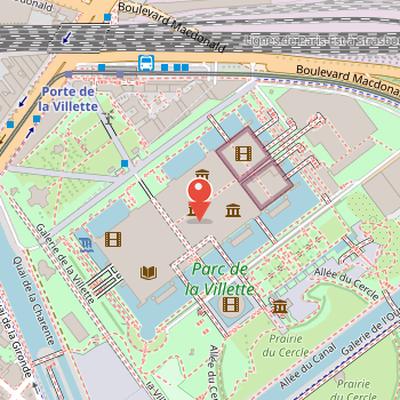
Nearby Objects
-
 Parc de la Villette 350 m away
 -
 Zénith Paris 400 m away
 -
 Philharmonie de Paris 650 m away
 -
 Cité de la musique 800 m away
 -
 Cours Florent 1700 m away
Scientific Culture at La Villette
The Cité des Sciences et de l'Industrie is a French establishment dedicated to the diffusion of scientific and technical culture. Created at the initiative of President Valery Giscard d'Estaing, it is intended to make scientific and technical knowledge accessible to a wide public, including children and adolescents. Its mission also includes encouraging citizens to take an interest in social issues linked to science, research, and industry. The institution is located at Porte de la Villette, near the peripherique in Paris, on a site formerly occupied by the abattoirs de la Villette. It forms part of the Parc de la Villette, alongside the Philharmonie de Paris and the Conservatoire national superieur de musique et de danse de Paris. It is also part of the network of Centres de culture scientifique, technique et industrielle, which promote scientific and technical culture.
From Slaughterhouses to a Science Institution
The Cité des sciences et de l'industrie was created through the rehabilitation of the former slaughterhouses, a project assigned to architect Adrien Fainsilber. The design partly preserved the reinforced concrete structure of the unfinished main auction hall and inserted the new institution into three of the four bays of the building. The fourth bay remained unused until it was later occupied by the Vill'Up shopping center. For the roof lattice, the metal superstructure was built by Baudin-Chateuneuf, while Viry constructed the metal superstructure for the entrance hall glass roof.
The institution was established by decree as a public industrial and commercial establishment and placed under the supervision of the minister responsible for research. It opened to the public on the day Giotto spacecraft met Halley's comet and was inaugurated in the presence of Francois Mitterrand. The inauguration was marked by a 3.90 F postage stamp signed by Jacques Gauthier and by a commemorative postmark dated to the same occasion.
In 2009, the Cite des sciences et de l'industrie was merged with the Palais de la decouverte into a common establishment named Universcience, with EPIC status.
Exhibition Spaces and Visitor Areas
The Espaces of the Cite des Sciences et de l'Industrie are organized around several permanent and visitor-focused areas. Thematic permanent exhibitions are grouped on levels 1 and 2, and the exhibition ticket also includes access to temporary exhibitions covering varied subjects. On level 2, Espaces includes a planetarium with regular sessions, as well as a science news space.
The library, called bibliotheque des sciences et de l'industrie, is arranged on levels 0 and -1 and divided into three sectors: grand public, youth, and history of science. The youth library is located on level 0. Also on level -1 is a digital public space dedicated to discovering and experimenting with digital practices. Opened in 2001, it later added a Fab lab and a Living Lab. Under the name Carrefour numerique2, it hosts events with partners including open source and free culture associations.
For younger visitors, a children's area was created in 1992 on level 0 and renovated in 2008-2009. It is divided into three parts, including the cite des bebes for children under two years. This space is designed for children from 0 to 23 months, and up to 36 months for children with disabilities, with playful and evolving structures meant to stimulate curiosity and imagination. The children's zone offers a five-step discovery and learning path, and its sessions last 1h30 and present five interactive science-themed universes.
Espaces also exhibits the Argonaute, a former French Navy submarine that has been open to visitors since 1991.
Commercial and Leisure Reuse of the Fourth Nave
In January 2006, Espaces selected the Apsys project to occupy the fourth nave area, which had been unused since 1986. The project combined a shopping center with cultural and leisure spaces and was designed by Michel Macary for Espaces. A shopping center called Vill'Up opened at the site on December 21, 2010. In 2023, it was renovated to focus more strongly on leisure and dining, and reopened on April 13, 2023 as Boom Boom Villette. The new complex includes a Pathé cinema, a food court, games areas, trampolines, arcades, an escape game, and a free fall simulator.
Funding and Revenue Sources
In 2008, the Cité des Sciences et de l'Industrie received state subsidies, although the amount was not specified. Its budget also included own resources for operations and investment, both given as unspecified sums of euros. These own resources came from ticket sales, services provided by the Centre des congres de la Villette, and the sale of books, studies, exhibition products, partnerships, and concessions.
Visual Identity Changes
The Cite des Sciences et de l'Industrie used the common visual identity created by Pierre Bernard of the Grapus group in 1986. It later adopted a new logotype featuring a slightly left-inclined red square with white text inside. This visual identity was changed again with a new logotype designed by Michael Levin of Atelier Doc Levin. Levin's design was intended to reflect a contemporary identity similar to that of other cultural institutions. He also created the new logotype adopted by the Musee d'art et d'histoire du judaisme in 2016.