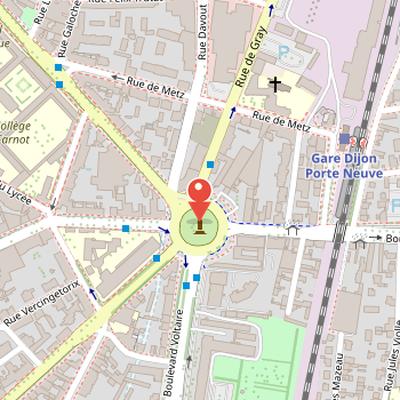
Place du Trente-Octobre is a circular square in Dijon where several major roads converge, including boulevard Thiers, rue Paul-Cabet, boulevard Carnot, boulevard Voltaire, boulevard de Strasbourg, and rue de Gray. The square is bordered by heterogeneous architecture, ranging from Haussmannian buildings near boulevard Carnot to more contemporary styles. Its name recalls events connected both to the battle between French and German forces arriving at Dijon on June 19, 1940, and to the authorization given in 1941 to display the Legion of Honour in the city’s coat of arms.
Historically, the site lay outside the city walls and was one of the city’s market and fair places. Originally named Place au Foin, it was also the site of the first battle of Dijon during the war of 1870. After the battle, the municipal council decided in November 1870 to erect a Resistance monument on the square. The monument, designed by architect Félix Vionnois, included a broad circular base and a crenellated tower, with sculpture by Mathurin Moreau and a statue by Paul Cabet. A replica statue was later inaugurated on October 30, 1878, shortly after the square was renamed Place du 30 Octobre.
Nearby Objects
-
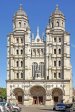 Saint-Michel Church 550 m away
 -
 Musée Rude 600 m away
 -
 Église Saint-Étienne 600 m away
 -
 Opéra de Dijon 700 m away
 -
 Conservatoire Jean-Philippe Rameau 700 m away
Situation and Urban Setting
Place du Trente-Octobre is arranged as a circular square at the meeting point of several major roads, including boulevard Thiers, rue Paul-Cabet, boulevard Carnot, boulevard Voltaire, boulevard de Strasbourg, and rue de Gray. Its setting is marked by varied architecture, with Haussmannian buildings near boulevard Carnot and more contemporary styles elsewhere. This mixture gives the square a heterogeneous urban character shaped by its converging streets and surrounding built environment.
Origin of the Name
The name of place du Trente-Octobre recalls the battle between French and German forces that reached Dijon on June 19, 1940, near the square. It also refers to the authorization granted by the President of the Republic in 1941 to display the Legion of Honour in the city's coat of arms. These two references give the square's name a historical significance tied to wartime events and civic symbolism.
History of Place du Trente-Octobre
Place du Trente-Octobre, originally called Place au Foin, was located outside the city walls and was one of several market and fair places in the city. It became the site of the first battle of Dijon during the 1870 war, when von Beyer's Badois attempted to capture the city. The area was defended by Dijon national guards, a battalion from Basses-Pyrenees, and various mobilized troops. During the fighting, a famous barricade was erected on Jeannin street. The battle ended with 160 French deaths, 341 wounded, and 101 prisoners, and the place was occupied after Dijon surrendered.
The Resistance Monument on Place du Trente-Octobre
In November 1870, the municipal council decided to erect a Resistance monument on the square, and the foundation stone was laid on December 29, 1870. The monument was designed by architect Felix Vionnois with a broad circular base and a crenellated tower. Its tower carried a high-relief sculpture by Mathurin Moreau showing a soldier protecting a wounded hunter, a woman, and a child. The monument also included a statue named La Resistance, sculpted by Paul Cabet, a pupil of Rude. This figure was shown with a crenellated crown and a Phrygian cap.
The statue was removed by military engineers on October 25, 1871, by order of the Cote-d'Or prefect, and it was damaged during removal. After Paul Cabet's death in 1876, the municipality ordered a replica by the sculptor Greber. The replica statue was inaugurated on October 30, 1878, only weeks after the square was renamed Place du 30 Octobre.