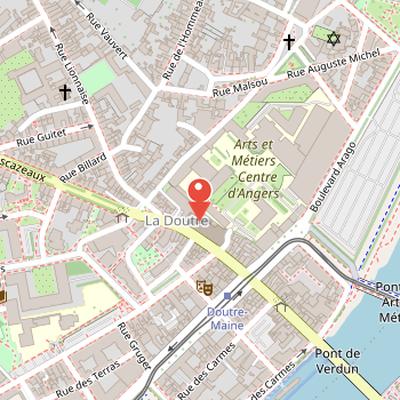
Église de la Trinité d'Angers is a church in Angers, in Maine-et-Loire, located in the Doutre district on the right bank of the Maine. Oriented to the southeast, it stands between boulevard Descazeaux to the south and the École nationale des Arts et Métiers to the north. Classified as a historic monument in 1840, it is associated with the former abbey of Notre-Dame-de-la-Charité, later known as the abbey of Ronceray.
The history of the site begins in 1028, when Foulque Nerra and Hildegarde decided to found the abbey. In the second half of the 12th century, parishioners frequented the abbey chapel, and the abbesses decided to build the Church of the Trinity beside it. The building was rebuilt at the end of the 15th century. Its bell tower dates from the 16th century, and a lantern was built at the crossing in 1540 by the Renaissance Angevin architect Jean de l'Espine. The church survived the Revolution without damage and underwent many transformations in the 19th century, including a neo-Romanesque revision by Charles Joly-Leterme between 1864 and 1880. Most of its stained-glass windows date from the 1860s and were made by the workshop of master glazier Thierry fils.
Nearby Objects
-
 Abbaye du Ronceray 60 m away
 -
 Église Saint-Laurent 350 m away
 -
 Le Quai 400 m away
 -
 Musée Jean Lurçat 400 m away
 -
 Château d'Angers 550 m away
Historical Status
The Church of the Trinity in Angers, located in Maine-et-Loire, is classified as a historical monument. This official recognition dates from 1840, placing the building among the protected heritage sites of the area. The classification indicates its importance within the local historic environment and its status as a preserved religious structure in Angers.
Location and Orientation
The Church of the Trinity in Angers is located in the Quartier de la Doutre on the right bank of the Maine. It is oriented toward the southeast. To the south, it is adjacent to Boulevard Descauzeaux, while to the north it is next to the Ecole nationale des Arts et Metiers de la ville.
History and Architectural Development
The history of the Church of the Trinity in Angers begins in 1028, when Foulque Nerra and Hildegarde decided to found the abbey of Notre-Dame-de-la-Charite, later known as the abbey of Ronceray. In the second half of the 12th century, parishioners frequented the abbey chapel, and the abbesses decided to build the Church of the Trinity beside it. The building was rebuilt at the end of the 15th century, and its bell tower dates from the 16th century. It survived the Revolution without damage.
The church was classified as a historic monument on the 1840 list, and it then underwent many transformations during the 19th century. Between 1864 and 1880, the architect Charles Joly-Leterme revisited the building in a neo-Roman style. Most of the stained glass windows also date from the 1860s and were made by the workshop of the master glazier Thierry fils.
Architecture and Interior Features
The church belongs to the first Angevin Gothic style, while several later elements show successive additions and restorations. A lantern was built at the crossing in 1540 by the Renaissance Angevin architect Jean de l'Espine. The south facade, beside boulevard Descazeaux, includes an entrance with a neo-Romanesque porch and friezes decorated with small demonic human and animal faces, as well as a human head decoration. It also preserves a restored Romanesque portal.
Inside, the building has a single nave with shallow side chapels. The nave is separated from the choir by a triumphal arch with lateral Berry passages. It is covered by a vault of three and a half bays, strengthened by irregular ribs and marked by different keystones, including a middle one described as a suspended vault keystone.
The church also contains notable furnishings and sculpture. The main altar, made of polychrome sculpted stone in 1873, was produced at the Saint-Joseph workshop in Doutre. It presents a rare trinitarian motif inspired by Italian art, with apostles surrounding Jesus and Judas replaced by Paul. The altar tabernacle door shows Christ teaching on an enameled background. Other interior features include a pulpit in a chapel with numerous sculptures, such as Saint George slaying the demon on the abat-son, the Annunciation, two evangelists on the basin, and Saint Mark at the foot, as well as an 18th-century confessional in a side chapel and a medieval Pieta whose polychromy was erased by floods in the 19th century.
Stained Glass and Postwar Restorations
Most of the stained glass windows in the nave of the Trinite were destroyed during World War II. They were replaced with white glass on the second level and with modern stained glass windows on the first level. In the choir, most of the stained glass windows were made by the Angevin workshop Thierry fils around 1865 to 1867. The choir also includes two stained glass windows depicting scenes from the life of the Virgin, inspired by other stained glass windows.
The Organ and Historic Building
The current building of the Eglise de la Trinite d'Angers was constructed at the end of the 19th century and is classified as a historical monument. The parish was founded by the nuns of the Abbey of Ronceray, and important restorations took place at the end of the 20th century. Ownership of the Trinite belongs to the city of Angers.
The church also houses a historic organ built by Maison Daublaine and Callinet in 1840. The organ is placed in the gallery and has a case divided into three flat faces, with an oak front and a Récit enclosed in an expression box at the top part of the case. All of the pipes produce sound. The instrument has two keyboards and a pedalboard with 24 stops, and its instrumental part was classified as a historical monument in 1997.
Its history includes work by Cavaillie-Coll, who dismantled the organ in 1868 to restore the gallery. The organ was later expanded by canon Jeanneteau, organist at the Trinite from 1941 to 1960, with Seve re installing the Plein Jeu and the separate pedalboard. Jean Dumez is identified as the organ holder of the organ at the Trinite. Notable elements in the design include the trompette, cornet, and grand organ fonds, with detailed stops listed for the grand organ, Récit, and pedalboard sections.