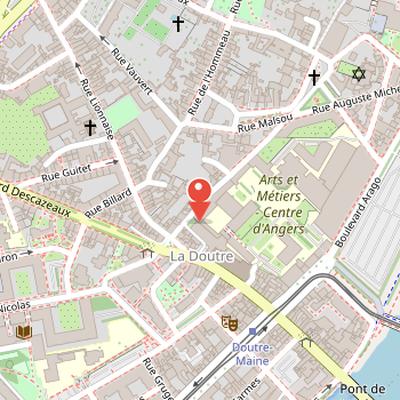
Abbaye du Ronceray d'Angers is an abbey in Angers, France, in the department of Maine-et-Loire and the region of Pays de la Loire. Its foundation charter, named abbatia Beata Maria Caritatis, dates from 1028, and the abbey is attributed to Hildegarde, second wife of Foulques III, count of Anjou. The abbey was rebuilt from 1060/1070 to 1119. It is the only female monastic establishment in Angers and is considered one of the most important in the diocese of Angers, alongside Fontevraud Abbey. The abbey belongs to the Order of Fontevraud. Its church has been classified as a historical monument since 1840, and other parts of the complex, including the monumental gate on rue de la Censerie, the facades and roofs of 17th-century buildings, cloister galleries, the grand staircase, and Anne de Belzunce's painted wooden partition cabinet with wooden baluster stairway, have also been classified or registered as historical monuments. The abbey also includes seven priories associated with the nuns of Ronceray Abbey.
Nearby Objects
-
 Église de la Trinité d'Angers 60 m away
 -
 Église Saint-Laurent 300 m away
 -
 Musée Jean Lurçat 400 m away
 -
 Le Quai 400 m away
 -
 Château d'Angers 650 m away
Location of the Abbaye du Ronceray d'Angers
The Abbaye du Ronceray d'Angers is an abbey located in Angers, France. It is situated in the department of Maine-et-Loire, within the region of Pays de la Loire. These details place the abbey in the administrative and geographical context of western France.
History and Heritage of the Ronceray Abbey
The foundation charter of the Abbaye du Ronceray d'Angers, named abbatia Beata Maria Caritatis, dates from 1028. Its foundation is attributed to Hildegarde, the second wife of Foulques III, count of Anjou. The abbey was rebuilt between 1060/1070 and 1119. Ronceray is the only female monastic establishment in Angers, and it is considered one of the most important in the diocese of Angers, alongside Fontevraud Abbey. It belongs to the Order of Fontevraud.
The abbey's history is also reflected in its name and vocable. The vocable Charity comes from the legend of the eulogy of Melaine de Rennes, while the name Ronceray comes from the brambles that surrounded the foot of a Virgin statue found in the crypt in 1527. The abbey counts seven priories: Courthamon, Seiches, Mareil, le Bourg-des-Moustiers, le Plessis-aux-Nonnains, Saint-Lambert-du-Lattay, and Avenires, all belonging to the nuns of Ronceray Abbey.
Several parts of the site have been protected as historical monuments. The church has been classified since 1840. The monumental gate on rue de la Censerie is registered, and the facades and roofs of the 17th century buildings, the cloister galleries, the grand staircase, and Anne de Belzunce's painted wooden partition cabinet with its wooden baluster stairway have been classified. The remaining interior spaces of the 17th century conventual buildings are registered as historical monuments. Since 1815, the cloister has been occupied by Gadzarts Angevin.
Early Abbesses of Le Ronceray
The recorded leadership of Abbaye du Ronceray d'Angers begins with Léoburgis, also named Lietburgis or Letburgis, who is listed as the first abbess around 1028, although the end date of her office is not known. The 11th century succession includes Bertrade, Beliarde de La Jaille-Yvon, Ascelina Brunon, Hiltrudis, and Richilde. Beliarde de La Jaille-Yvon held office from 1062 to 1073 and is recorded as the daughter of Yvon de La Jaille, seigneur de La Jaille-Yvon. Ascelina Brunon served in the 11th century and is identified as the sister of Bishop Eusèbe Brunon of Angers. Hiltrudis is noted as having been prioress of Avenieres before becoming abbess of Le Ronceray. Richilde held the office from 1073 to 1103.
The succession continued with Tetburgis from 1104 to 1120, Mabilia from 1120 to 1123, and Audeburgis or Hildeburgis from 1125 to 1133. Later abbesses included Theophanie I from 1137 to 1142, Emma I de Cholet from 1142 to 1145, Petronille from 1145 to 1152, Hersendis or Hersende I from 1152 to 1154, and Theophanie II from 1154 to 1163. Emma II, also called Jeanne de Laval, held office from 1163 to 1190 and is recorded as the daughter of Guy II, seigneur de Laval, and Emma de Normandie. Hersendis or Hersende II de Sable served from 1196 to 1220 and is recorded as having been prioress of Avesnieres before 1190, and as the daughter of Robert, seigneur de Sable, and Hersende. The list then continues with Theophanie III, who held the office from 1225 to 1230.
Abbesses and Prioresses
The recorded leadership of the Abbaye du Ronceray d'Angers is shown through a succession of abbesses and prioresses spanning from the early 13th century to the mid 16th century. Louise de Brienne-Beaumont held the office from 1230 to 1232; she is identified as the daughter of Louis de Brienne, vicomte de Beaumont, and Marie de Craon. She was followed by Agnes I de Roorta, who served from 1239 to 1243, and Alice de La Roche, who held the office from 1244 to 1258. Later officeholders included Alienor I Honnome from 1267 to 1284, Alienor II de la Roche-Sibilen from 1303 to 1324, and Alienor III Riboul from 1324 to 1337. Around 1363 to 1380, the office was held by Theophanie IV de la Suarde, followed by Isabelle I de Ventadour from 1380 to 1418. In the 15th century, Agnes II de la Bodiere served from 1419 to 1421, then Marguerite de Couesmes from 1421 to 1450; she is recorded as the daughter of Jean de Couesmes, seigneur de Luce, and Jeanne de Rieux. Philippe du Bellay held the office from 1450 to 1455 and is recorded as the daughter of Hugues, seigneur de Langey, and Isabeau de Montigny, dame de La Jousseliniere. She was followed by Alienor IV de Champagne from 1455 to 1476, Catherine de La Tremoille from 1486 to 1493, Renee Sarazin from 1493 to 1499, Catherine II de Tonnerre from 1499 to 1504, Isabelle or Isabeau de La Jaille from 1505 to 1518, Francoise I de la Chapelle-Rainsouin from 1519 to 1529, and Francoise II Auve from 1529 to 1549. This list reflects the continuity of the abbey's internal leadership across several centuries.
Anne I de Montmorency
The list of abbesses and prieors records Anne I de Montmorency as holding office from 1553 to 1555. She was appointed by King Henri II and transferred in 1555 as abbess of La Trinite de Caen. The same record identifies her as the daughter of Anne, 1st duke of Montmorency, and Madeleine de Savoie-Tende.
Abbesses and Prioresses in the Sixteenth and Seventeenth Centuries
The recorded list of abbesses and prioresses shows a succession of office holders across the later sixteenth and early seventeenth centuries. Jeanne de Maill e-Breze held the office from 1555 to 1573, followed by Yvonne I de Maill e from 1573 to 1586. Simone de Maill e then served from 1587 to 1646; she is recorded as the daughter of Claude de Maill e, seigneur de Breze, and Robinette Hamon, dame de Bouvet. After her, Yvonne II de Maill e held the office from 1646 to 1650. She was previously prioress of Avenieres and is recorded as the sister of the preceding abbess Simone de Maill e.
Abbesses and Prioresses of the Abbey
The recorded list of abbesses and prioresses for the Abbaye du Ronceray d'Angers shows a succession of officeholders across the 17th and 18th centuries. Antoinette du Puy held the office from 1651 to 1666. Charlotte I Catherine de Gramont served from 1682 to 1701 and is recorded as the first abbess of Saint-Ausone d'Angoulême. She was the daughter of Antoine, 1st duke of Gramont, and Claude de Montmorency-Bouteville.
She was followed by Angélique de Quatrebarbes de La Rongere, who held the office from 1701 to 1705 and was the daughter of Rene V de Quatrebarbes, seigneur de La Rongere, and Jacqueline de Preaulx, dame de Beauvais. Françoise III Nompar de Caumont de Lauzun served from 1706 to 1709 and is recorded as the daughter of Gabriel Nompar de Caumont, comte de Lauzun, and Charlotte de Caumont-La Force, as well as the aunt of Anne II Marie-Louise de Belsunce de Castelmoron.
Anne II Marie-Louise de Belsunce de Castelmoron then held the office from 1709 to 1742. She was the daughter of Armand, marquis de Belzunce, and Anne de Caumont de Lauzun, and the niece of the preceding abbess Françoise III Nompar de Caumont de Lauzun. Charlotte II Antoinette de Canouville de Raffetot is also listed as having held the office from 1742 to 1762. The list emphasizes the continuity of leadership at the abbey and records the family connections of several of its abbesses and prioresses.
Abbesses and Prioresses
The Liste des abbesses et prieures records Leonine d'Esparbes de Lussan Bouchard d'Aubeterre as holding office from 1762 to 1790. It also notes that she had previously been a nun of Sainte-Croix de Poitiers and abbess of Saint-Jeanne de Bonneval at Thouars. The same source identifies her as the daughter of Charles-Louis-Henri Bouchard d'Esparbes de Lussan, marquis d'Aubeterre, and Marie-Anne Jay.