Église Sainte-Thérèse de Rennes is a church building constructed between 1934 and 1936 in concrete, wood, sandstone, and schist from Pont-Réan. Its architecture adopts a plan close to the Greek cross, measuring 28 metres wide and 38 metres long, with a dome rising to 33 metres and seating for one thousand people. The stained glass windows were made by the workshop of Paul and André Rault, located at place Hoche in Rennes, while the wall paintings were produced by Louis Garin and the bronzes by Émile Evellin following Perrin’s plans. The church was consecrated on an unspecified date. It later suffered a fire during the night of June 22 to June 23, destroying the nave, choir, and roof, and its bell tower was also destroyed by fire during the night of an unspecified date. The building was completely restored and reopened. It is inventoried, holds the Label Patrimoine du 20ème siècle, and is listed as a historic monument by order of an unspecified date.
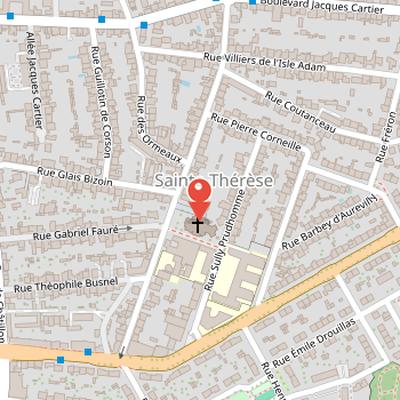
Nearby Objects
-
 Cinéma Arvor 950 m away
 -
 Museum of Brittany 1200 m away
 -
 Esplanade Charles-de-Gaulle 1400 m away
 -
 Le Liberté 1500 m away
 -
 Théâtre National de Bretagne 1500 m away
Construction, fire, and restoration
Eglise Sainte-Therese de Rennes was constructed between 1934 and 1936 using concrete, wood, sandstone, and schist from Pont-Rean. The first stone was laid on an unspecified date, and the church was later consecrated on an unspecified date. Its history includes a major fire during the night of June 22 to June 23, which destroyed the nave, choir, and roof. The bell tower was also destroyed by fire during the night of an unspecified date. The building was completely restored and later reopened on an unspecified date. It is inventoried, carries the Label Patrimoine du 20eme siecle, and is listed as a historic monument by order of an unspecified date.
Architecture and Interior Decoration
The Eglise Sainte-Therese de Rennes was designed with a plan close to the Greek cross, measuring 28 meters wide and 38 meters long. Its dome rises to 33 meters, and the building can accommodate 1,000 people inside. The interior decoration includes stained glass windows made by the workshop of Paul and Andre Rault in Rennes, wall paintings by Louis Garin, and bronzes made by Emile Evellin following Perrin's plans.