Les casernes de la Part-Dieu are military establishments in Lyon’s 3rd arrondissement, France. They were built on the site of the former Part-Dieu redoubt, which the State purchased in 1844 from the civil hospices of Lyon. Intended to house cavalry and artillery regiments, the complex was arranged symmetrically around a parade ground to keep occupants separated. Circulars from 1842 and 1843 specified the dimensions of the central courtyard and the aligned position of the riding hall. The barracks included six identical buildings with stables on the ground floor, as well as smaller buildings for administration, workshops, vehicle parks, forage stores, a horse infirmary, and veterinary rooms. Over time, the site was reorganized as cavalry units became concentrated there. From 1861 to 1914, it housed a succession of regiments including chasseurs à cheval, lancers, dragoons, hussars, and cuirassiers. The army remained in occupation until 1962, when the land was ceded to the city of Lyon.
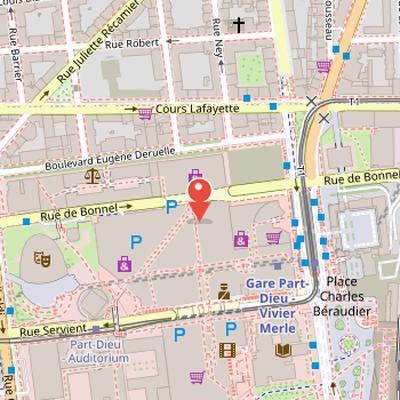
Nearby Objects
-
 Westfield La Part-Dieu 80 m away
 -
 Tour Oxygène 80 m away
 -
 Gare Part-Dieu - Vivier Merle 200 m away
 -
 Tour Part-Dieu 200 m away
 -
 Bibliothèque municipale de Lyon 250 m away
Military Function of Les casernes de la Part-Dieu
Les casernes de la Part-Dieu were military establishments located in the 3rd arrondissement of Lyon, France. They were intended to house cavalry and artillery regiments. This function identifies the site as part of Lyon's military infrastructure and places it within the urban fabric of the city.
Construction and Military Organization of the Barracks
The Barracks of La Part-Dieu were built on the site of the former Part-Dieu redoubt, which the State purchased in 1844 from the civil hospices of Lyon. The terrain was planned to accommodate 1,200 men and 24 officers, a capacity equivalent to two artillery regiments. The complex was organized around a parade ground, with two barracks placed symmetrically on either side to keep the occupants separated. Circulars from 1842 and 1843 defined the dimensions of the central courtyard and the central alignment of the riding hall.
The barracks included six identical buildings, each with stables on the ground floor, as well as smaller service buildings for administration, workshops, vehicle parks, forage stores, a horse infirmary, and veterinary rooms. In 1855, Marshal Castellane transferred artillery to La Doua and Fort de la Vitriolerie, and infantry to Fort Lamothe. Cavalry units were then concentrated at the Part-Dieu barracks, with 16 squadrons in two regiments totaling 1,120 men. After a later restructuring that moved the stables into annexes, the barracks capacity increased to 1,400 men and 40 officers.
Military Occupation of the Barracks
From 1861 to 1870, the barracks housed successive regiments of chasseurs a cheval, lancers, dragoons, and hussars, each for one to two years. From 1874 onward, two cuirassier regiments and eight other cavalry regiments successively occupied the site. In 1875, the 11th squadron of the train corps was created for regional troop logistics. The 2nd and 5th hussars replaced earlier units in 1877 and remained until 1892, while the 3rd and 7th cuirassiers arrived in 1880 and were themselves replaced by the 1st and 9th cuirassiers in 1889. The 5th regiment of chasseurs a cheval arrived in 1892, followed in 1893 by the 6th and 19th cuirassiers. The chasseurs a cheval left in 1895, and in 1896 the 13th dragoon regiment settled at the barracks, where it stayed until 1914 alongside the 2nd and 8th regiments. In 1907, the 6th cuirassier regiment was called to maintain order during the Languedoc winegrowers revolt. The three cavalry regiments left for war in 1914, and after 1918 the 6th cuirassier regiment was again garrisoned at the barracks. The army remained there until 1962, when the land was ceded to the city of Lyon.