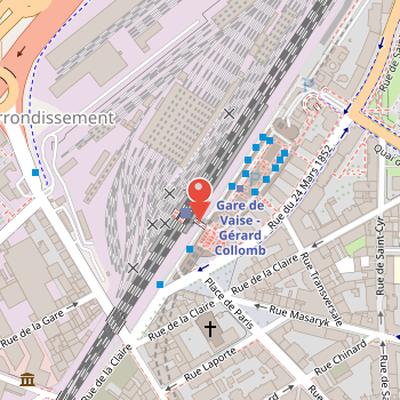
Gare de Lyon-Vaise is a French railway station on the Paris-Lyon to Marseille-Saint-Charles line, located in the Vaise district of Lyon, Auvergne-Rhône-Alpes. It is situated at kilometer point 506.389 and is positioned between Collonges - Fontaines and Lyon-Perrache. The station is served by regional passenger trains and freight trains, and it provides connections with Lyon metro line D and the TCL bus network.
The station was put into service in 1854 by the Compagnie du chemin de fer de Paris à Lyon, following a government decision in 1846 to establish stations at Vaise, Perrache, and La Guillotière for Lyon railway service. Construction began in 1852 on an elevation created using materials dredged from the Saône. The passenger building, designed by François-Alexis Cendrier, was completed in 1857, the same year the company became the Compagnie des chemins de fer de Paris à Lyon et à la Méditerranée (PLM). Gare de Lyon-Vaise also formed part of the early tram network in the 1880s, with lines from Terreaux and Perrache serving the station.
Nearby Objects
-
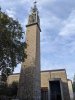 Église Notre-Dame de l'Annonciation 150 m away
 -
 Parc de la Cerisaie 950 m away
 -
 Stadium of La Duchère 1000 m away
 -
 Halle d'athlétisme Stéphane-Diagana 1000 m away
 -
 Lycée Jean Perrin 1000 m away
Railway Station in Vaise
Gare de Lyon-Vaise is a French railway station on the Paris-Lyon to Marseille-Saint-Charles line, located in the Vaise district of Lyon in Auvergne-Rhone-Alpes. It was put into service in 1854 by the Compagnie du chemin de fer de Paris a Lyon (PL), later became a station of the Compagnie des chemins de fer de Paris a Lyon et a la Mediterranee (PLM), and is now operated by SNCF. The station is served by regional passenger trains and freight trains. It also provides connections with Lyon metro line D and the TCL bus network.
Railway Setting and Connections
Gare de Lyon-Vaise is established at altitude on the Paris-Lyon to Marseille-Saint-Charles line, at kilometer point 506.389. It is situated between the open stations of Collonges - Fontaines and Lyon-Perrache. Between Lyon and Collonges, it is also located in relation to the closed stations of Saint-Rambert, Ile-Barbe, and Les Grands-Violets. The station is connected by a junction at Lyon-Gorge-de-Loup, which allows train movements between the Lyon-Saint-Paul to Montbrison line and Lyon-Vaise station.
Early Development and Access
In 1846, the government decided to install three stations for railway service in Lyon at Vaise, Perrache, and la Guillotiere. Construction for the Vaise station began in 1852, and its facilities were installed on an elevation created by 1200 cubic meters of material dredged from the Saone. Gare de Lyon-Vaise opened on September 10, 1854, operated by the Compagnie du chemin de fer de Paris a Lyon. At that time, the passenger section opened from Chalon-sur-Saone even though the station was still incomplete, and Gare de Lyon-Vaise was the penultimate station on the Paris to Lyon line. Freight service on the line began on January 1, 1855.
The track from Lyon-Vaise to Lyon-Guillotiere via Lyon-Perrache was completed in 1856, which finished the Paris to Marseille rail link. The passenger building, designed by Francois-Alexis Cendrier, was completed in 1857, the same year the company was renamed Compagnie des chemins de fer de Paris a Lyon et a la Mediterranee, or PLM. In the early 1880s, the station was also served by two tram lines of the Compagnie des Omnibus et tramways de Lyon. Tram line 6 from Terreaux opened on March 30, 1882, and tram line 7 from Perrache opened on April 5, 1882. The station's proximity to the water station on the Saone dates back to 1828.
Industrial Growth Around the Station
Histoire reports that the station's proximity allowed significant growth in goods traffic during the Second Empire. Many companies then installed workshops and warehouses in the district between the railway tracks and the river, and the area came to be known as the quartier de l'industrie because of its range of activities. The surrounding streets also saw the construction of collective buildings, while schools were installed in the district. A church was consecrated near the railway station on an unspecified date, and shopkeepers opened their boutiques in the new working-class district.
Lyon-Vaise Station in Railway and Wartime Use
Lyon-Vaise station was listed in the 1911 nomenclature of the Paris to Lyon and Mediterranean Railway Company. It opened for full high-speed passenger service and low-speed goods service, and it could receive or send private dispatches. The station was located on the Paris to Marseille and Ventimiglia line, after Saint-Rambert light train stop, and also on the Saint-Germain-des-Fosses to Lyon via Tarare line, between Saint-Rambert and Lyon-Perrache.
At the beginning of the First World War, sanitary trains were sent to the Lyon region. This was possible because the region was distant from conflict zones and had suitable infrastructure. The first sanitary train arrived in a station converted into an infirmary on an unspecified date, and sanitary trains continued until an unspecified month and year. In Vaise, the station was referred to as Infirmerie de gare 23 Lyon-Vaise.
From Freight Station to Multimodal Hub
In 1938, the goods station included covered areas for parcel service, handling daily shipments, arrivals, and transshipments. The large hall covering the tracks and platforms was dismantled in 1939 because of its poor condition. The station was then heavily damaged during the Allied bombings of May 26, 1944, and the surrounding neighborhood also suffered major destruction, with approximately 300 deaths and 400 injuries. The passenger building was destroyed and replaced by a temporary wooden structure. This destruction led to the modernization of the passenger station and a change in the function of the old steam depot, which became a maintenance and fueling center for autorails transferred from the Perrache depot. The freight station, already one of the busiest in traffic, was also modified.
The railway site was further adapted through electrification of the Lyon-Saint-Paul to Lyon-Gorge-de-Loup section to connect trains to Gare de Vaise via the Gorge-de-Loup junction. This electrified section was de-energized in 1984 because thermal autorails were in use. A new passenger building was inaugurated in 1956, but it was later demolished to make way for the new multimodal hub building. The urban land use plan of Greater Lyon was revised in 1995 to allow construction for housing, activities, services, and equipment, and to enable ownership of individual land and building units under different statutes. The project involved different owners, including SNCF and SYTRAL. The multimodal hub was eventually put into service, and its first phase brought together an SNCF station, the metro station Gare de Vaise, a bus station, parking, a taxi stand, and a student residence, although the residence was not yet completed at the time of opening.
Passenger Services and Connections
The passenger service area at Gare de Lyon-Vaise includes a passenger building with a ticket office open from Monday to Saturday, closed on Sundays and holidays. It also has machines for buying TER transport tickets, together with a post office, a tobacco shop, a sandwich shop, and two automatic bank counters. For passengers with reduced mobility, an elevator connects the railway station, bus station, and metro station.
The station is served by TER Auvergne-Rhone-Alpes regional trains linking Paray-le-Monial or Lozanne to Lyon-Perrache, Roanne to Lyon-Perrache, and Macon-Ville to Lyon-Perrache or Vienne. Lyon-Perrache can be reached in six minutes by TER, providing access to the southern peninsula. The station is also a stop for Intercites night trains for crew changes, but it is not a commercial stop.
Gare de Lyon-Vaise is linked to several forms of onward transport. It has bicycle parking and multiple parking areas, including a TCL relay parking accessible with a transport ticket and a paid parking lot. The Gare de Vaise - Gerard Collomb metro station on Lyon metro line D is accessible by pedestrian paths from Place de Paris and by underground passageways. The bus station is served by TCL bus lines C6, C6E, C14, 2, 10, 10E, 20, 21, 22, 23, 31, 43, 71, 84, 89, and S11, connecting the station with the Lyon city center, the La Duchere district, and the northern Lyon metropolitan area.
Freight Operations in 2011
In 2011, Service des marchandises limited freight activity at Lyon-Vaise station to train transport. The freight operations were managed under the Vennissieux platform and the Lyon-Chassieu customs center. During the same year, isolated wagon traffic was also allowed at the station under a commercial agreement. These arrangements show that the station continued to serve freight functions, while its activity was organized through specific operational and commercial conditions.
Maintenance Functions at Vaise
Technicentre de Lyon - UP de Vaise was created in 1854 as an old depot and later became a production unit of the Technicentre de Lyon. From 1950, it specialized in thermal engines and now focuses on the maintenance of thermal engine rolling stock in the Lyon region. Its work covers locomotives, autorails including self-propelled trains, and shunters.
The site also includes facilities for refueling and cleaning trains. Its depot grounds near the station contain the maintenance complex, whose covered area extends across the site. In 2005, SNCF invested in the facility for a new AGC maintenance workshop, showing continued development of the depot's technical role.
By 2014, the maintenance operation handled an average fleet on site. About one quarter of the fleet underwent heavy overhauls, while the remaining three quarters received routine maintenance. Around trains are refueled annually at the site, underlining its role as both a maintenance and servicing center for rail traffic in the area.