Église Notre-Dame de l'Annonciation de Lyon is a Catholic church located at Place de Paris in Lyon, facing Gare de Vaise. Described as a true visual signal in the city, it was built between 1953 and 1957 by architect Paul Erasme Koch. The building replaced a neo-Gothic church destroyed during the bombing of Vaise station in World War II; the first church on the site had been constructed by M. Bourbon and inaugurated in 1896.
The present building has a crypt serving as a basement level and follows a basilical plan without a transept. Its nave is flanked by two side aisles and covered by a lowered vault, while the chevet is flat. The main entrance is off-centre on the north side. Lighting comes from vertical bay windows in the side aisles, and the central nave is blind except for an oculus in the west gable wall. The church is dominated by a slender concrete campanile, 62 metres high, clad in golden stone from the Lyon region and topped by a light blue wrought iron structure flanked by 18 golden angels and an 11-metre cross.
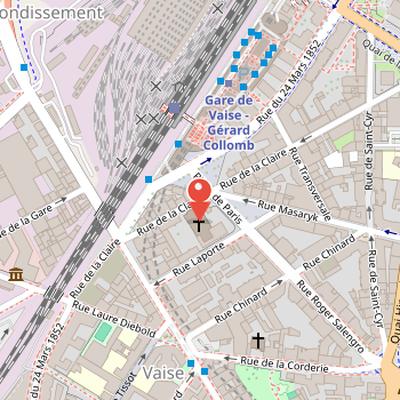
Nearby Objects
-
 Gare de Lyon-Vaise 150 m away
 -
 Parc de la Cerisaie 900 m away
 -
 Villa Gillet 1100 m away
 -
 Stadium of La Duchère 1100 m away
 -
 Halle d'athlétisme Stéphane-Diagana 1100 m away
Location and Urban Presence
The church is dedicated to Catholic worship and is located at place de Paris in Lyon. It faces the gare de Vaise, giving it a prominent position in the area. It is described as a true visual signal in Lyon, indicating a notable presence in the local urban landscape.
Construction and wartime rebuilding
The present church was built between 1953 and 1957 by the architect Paul Erasme Koch. It replaced an earlier neo-Gothic building that had been destroyed during the bombing of Vaise station in World War II. The site had an even earlier church history: the first church was constructed by M. Bourbon and inaugurated in 1896.
Architectural Form and Exterior Features
The Church of Notre-Dame de l'Annonciation in Lyon is arranged on a basilical plan without a transept. Its nave is flanked by two side aisles and covered by a lowered vault, while the building ends in a flat chevet. A crypt serves as a basement level. The interior lighting comes from vertical bay windows in the side aisles, whereas the central nave is blind except for an oculus in the west gable wall.
The exterior is marked by a slender concrete campanile rising 62 meters. It is covered with golden stone cladding from the Lyon region and topped by a light blue wrought iron structure flanked with 18 golden angels. These angels were made by Jacques Bouget according to plans by Etienne Martin and Francois Stahly. An 11 meter high cross crowns the structure. The main entrance is off-center on the north side of the building.
Related Heritage References
The available references linked to Notre-Dame de l'Annonciation in Lyon point to several related topics. These include the Annonciation, Notre-Dame-de-l'Annonciation in Lyon, the heritage label Patrimoine du XXe siecle for buildings in Lyon, and 20th-century religious buildings in Auvergne-Rhone-Alpes. Together, these associations place the church within broader discussions of religious architecture and heritage recognition in the region.